Content Marketing for Link Building: What Actually Earns Links
Which content earns backlinks, the free tools you can build (and the 40+ we built at Serpbays), and how to promote them so writers actually cite you.
· · 9 min read
Backlinko and BuzzSumo once looked at 912 million blog posts and found that 94% of them had zero links from other websites. That was 2019. Plenty has changed since then, but one thing hasn't: publishing a good article is not the same as earning links.
Content marketing for link building works when you build something other writers need to cite, and then put it in front of those writers. Skip either step and you have a blog post, not a link.
This guide covers the formats that earn links, the free tools you can build (including the 40+ we built at Serpbays, and exactly how), and how to promote all of it.
Short answer: Content marketing for link building means creating assets people reference (original data, free tools, clear explainers) and promoting them to journalists, bloggers and site owners who write about your topic. It earns the strongest links you can get, but it's slow, so most teams pair it with a few placed links while the content gains traction.
What makes content worth linking to?
A writer links to you when it saves them work or backs up their point. That's the whole test.
So before you write anything, ask one question: what would someone quote from this page? If the answer is "nothing, it's a nice overview", it won't earn links. Ten tips that already exist on twenty other sites give nobody a reason to point at yours.
Pages that pass the test usually have something you can't get elsewhere: a number, a template, a tool, or a clear take from someone who has done the work.
Which content formats earn the most links?
In my experience, these five do most of the heavy lifting:
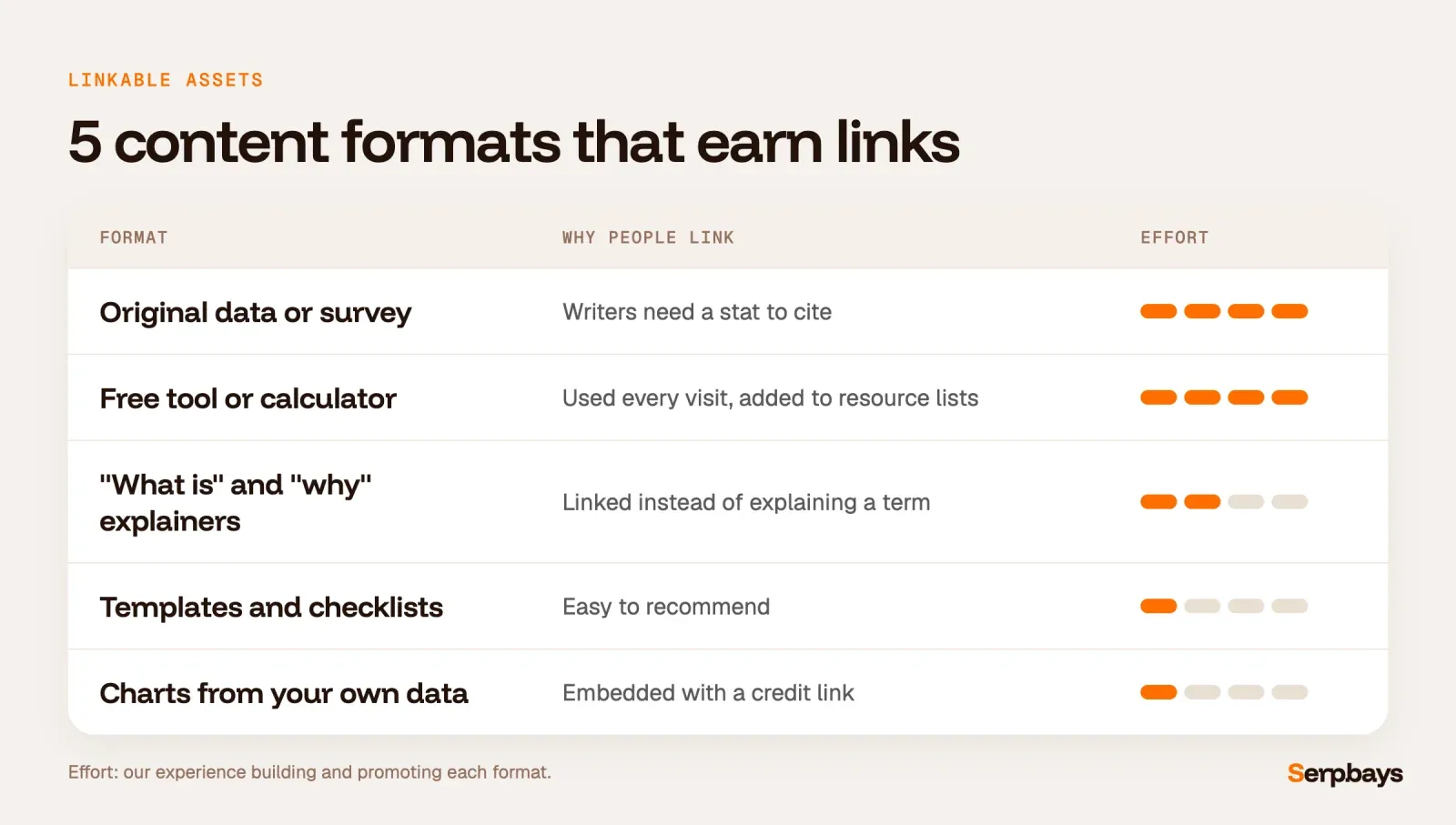
The Backlinko study points the same way: "why" posts, "what" posts and infographics earned more links than other formats, while list posts came last. Long pages also did better, with posts over 3,000 words getting 77.2% more referring domains than posts under 1,000.
Don't read that as "write longer". Read it as "be the reference". A 1,200-word page with one original number beats a 4,000-word rewrite of what's already ranking.
Why free tools are the most underrated linkable asset
An article gets read once. A tool gets used every week.
That changes how people link to it. Bloggers writing "how to check X" link to a checker instead of explaining the steps. Teachers and agencies add it to resource pages. People share it in Slack when a colleague asks a question. None of them need a pitch, because the tool does a job they already have.
Tools also age well. A statistic goes stale in a year or two. A word counter or a DNS lookup works the same in 2030.
The catch is effort. A tool needs a developer, hosting and a bit of maintenance. That's exactly why most competitors don't build them, and why the ones that do keep collecting links.
What kinds of free tools can you build?
Almost every business has a tool hiding in it. Look for a question your customers ask before they buy, then answer it with an input box instead of a blog post.
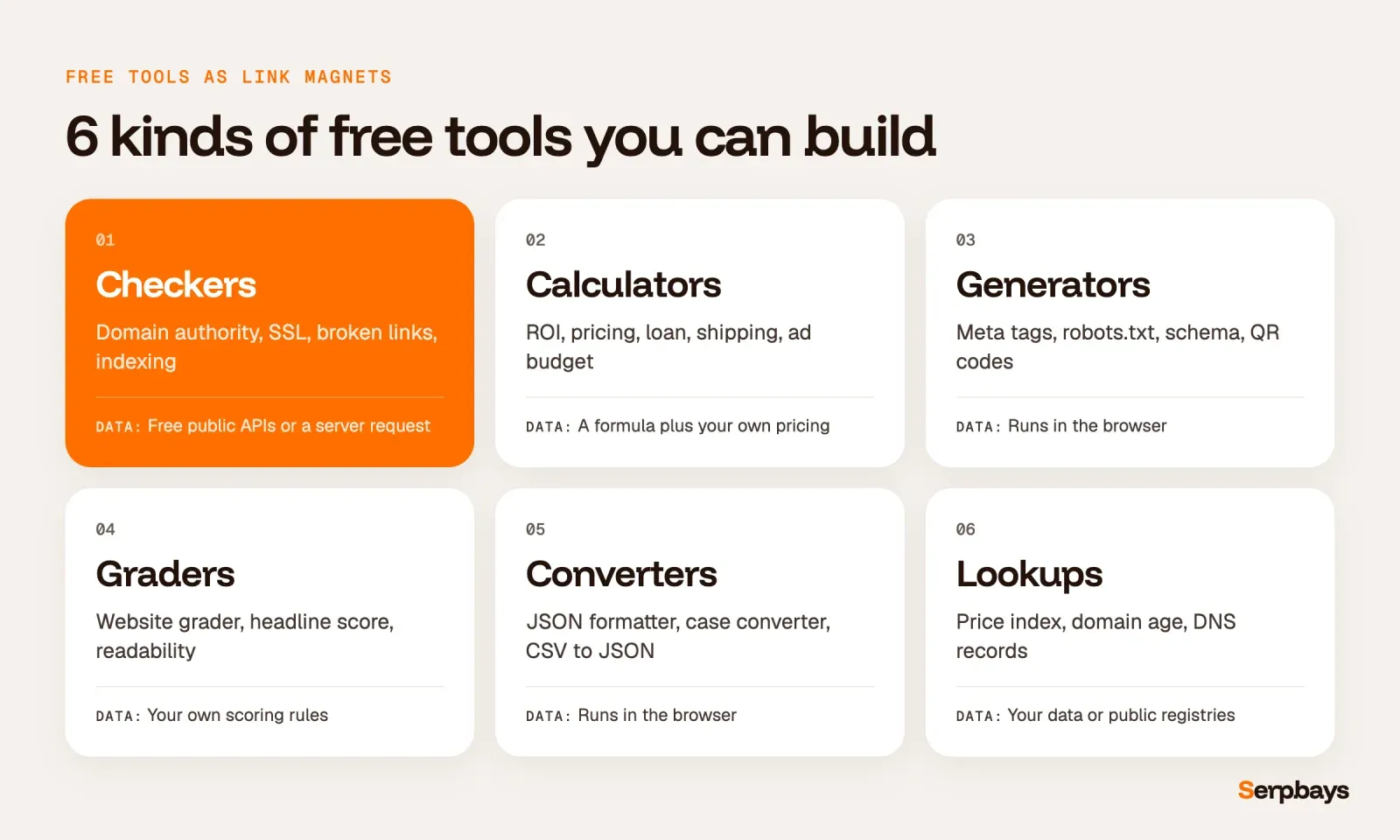
A few examples by industry: a SaaS company can build a pricing or ROI calculator, an ecommerce store a size or shipping calculator, a law firm a deadline calculator, a marketing agency an audit tool. The best ones solve one annoying problem in under a minute.
My one rule: don't build a tool nobody searches for. Check that people already type the problem into Google before you spend a week on it.
What we built at Serpbays, and exactly how
We now have more than 40 free tool pages on serpbays.com/tools. A handful went up earlier in the year; most of them went live in one week, 15 to 18 October 2026. Here's what we actually did.
- Picked tools by search demand. Every tool in the October batch started from a keyword people already search, such as "domain authority checker", "word counter" or "utm builder". If there was no demand, we didn't build it.
- Built two kinds of tools. Most run entirely in your browser: the word counter, JSON formatter, case converter, meta tag and robots.txt generators, the QR code generator and similar. The rest need a server: the free DR checker and bulk DR checker, the domain authority checker, DNS lookup, SSL checker, domain age checker, redirect checker and bulk noindex checker.
- Used free data sources, so each check costs us nothing. Domain Rating comes from Ahrefs' free DR endpoint, the DA score from OpenPageRank's free API, DNS records from Google's public DNS-over-HTTPS service and domain age from the public RDAP registries. That matters: a tool that costs money per use ends up behind a login, and gated tools don't earn links.
- Labelled the data honestly. Our DA checker says clearly that its score is based on OpenPageRank, not Moz. If someone links to a tool and later finds the numbers are dressed up, that link is gone, and so is their trust.
- No signup. You paste a domain and get the answer. Every extra step loses people who would have shared it.
- Wrote a real page around each tool. Each one explains what the metric means and how to read the result, and has an FAQ. That gives Google something to rank and gives writers a reason to link the tool page rather than the homepage.
- Linked them everywhere. The tools are linked from the homepage, the footer of every page and the bottom of every blog post, so they get crawled quickly and pick up internal authority.
Why we expect it to work, and what we've seen so far
Three reasons. People search for these problems every day, the tools answer them faster than an article can, and every "best free SEO tools" list or "how to check your DA" post is a natural place for a link.
The early data is encouraging but early. In Google Search Console, our tool pages went from about 10 impressions a day before the launch to more than 500 a day within three days of it (17 to 20 October 2026). The domain authority checker alone showed up 773 times in that window.
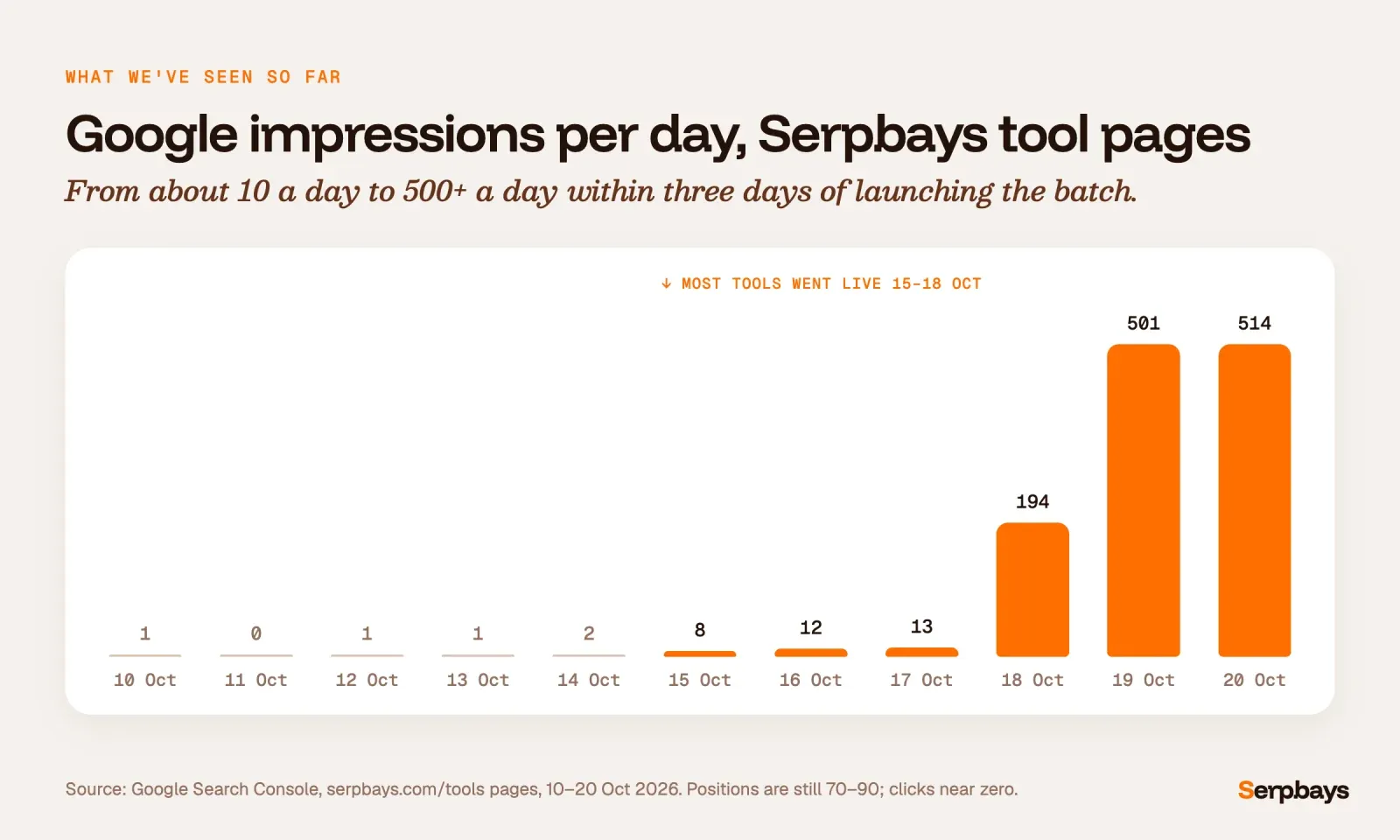
Here's the honest part: those impressions are mostly at positions 70 to 90, so clicks are still close to zero, and it's too soon to count earned links. Rankings and links follow usage, and usage takes months. Our next step is the promotion work below, starting with resource pages that already list free SEO tools.
How do you promote content so it actually gets links?
This is where most content marketing for link building fails. Teams spend three weeks on the asset and one afternoon on promotion.
Flip that ratio. Four channels work:
- Digital PR. Pitch the headline finding to journalists who cover your topic. Lead with the number, not your brand. A 2026 Editorial.Link survey of 518 SEOs found 48.6% rate digital PR as the most effective link building tactic, well ahead of guest posting at 16%. If you've given up on HARO, our list of HARO alternatives shows where reporters look for sources now.
- Resource pages and roundups. Search for "free [topic] tools" and "[topic] resources". Every page that lists tools like yours is a fair ask, as long as yours is genuinely useful.
- Upgrade outreach. Find pages that cite an outdated stat or link to a dead tool, and offer yours as the replacement. You're fixing their page, so reply rates are far better than a cold pitch.
- Communities. Share the finding or the tool (not a sales pitch) in the newsletters, subreddits and Slack groups your readers use. Writers lurk there.
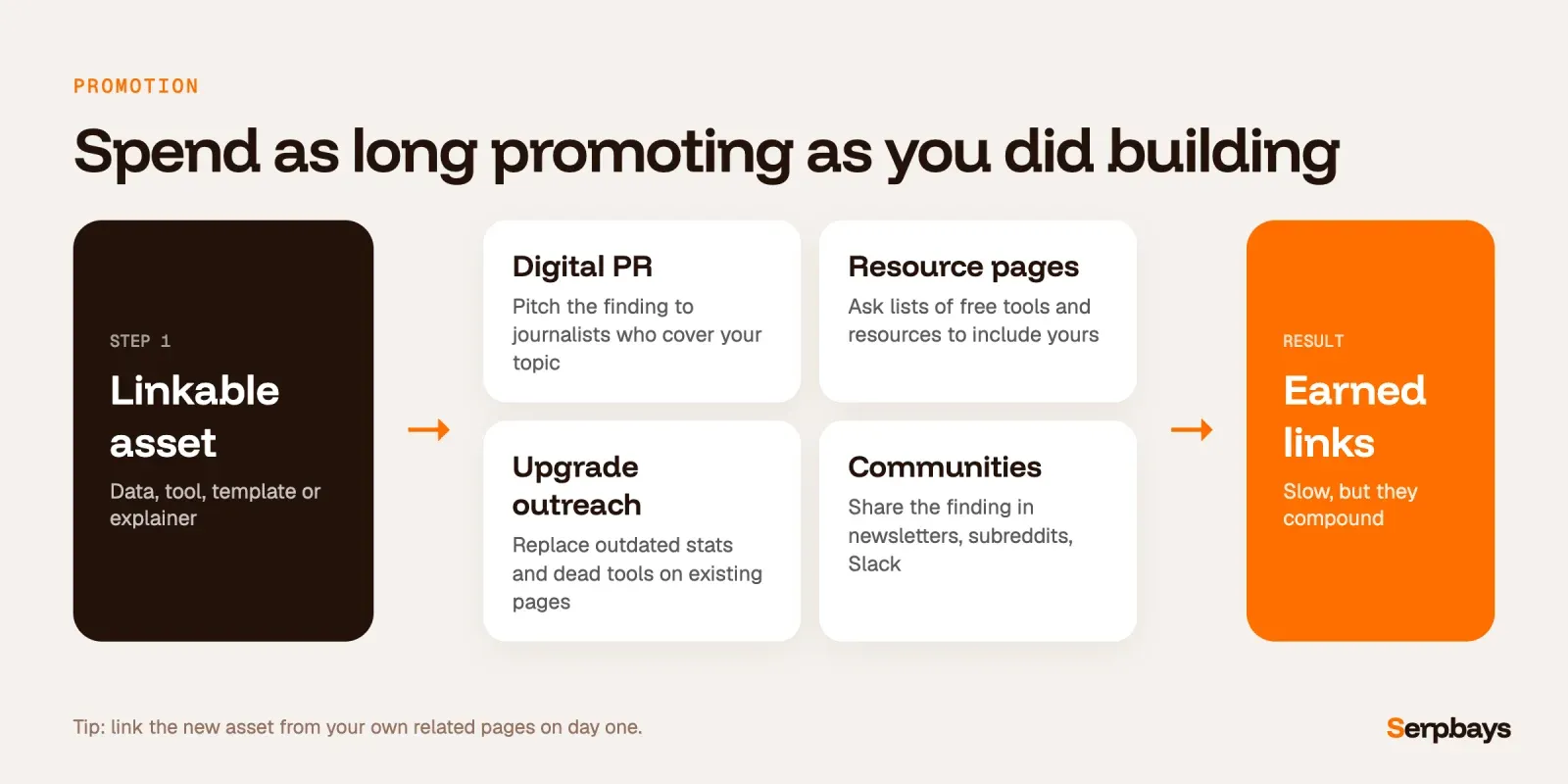
Then link to the new asset from your own related pages. It sounds obvious, yet a lot of linkable assets launch with zero internal links pointing at them.
Is content-led link building enough on its own?
Honestly, rarely. Earned links come in slowly and you can't predict when. A good data study might pick up five links in month one and fifty over the next two years. That's great for year two. It doesn't help a launch that needs to rank this quarter.
That's why most teams run both: content that earns links over time, plus a handful of placed links on relevant sites to get key pages moving. If you buy placements, label them properly. Google's spam policy treats buying links for ranking purposes as link spam unless they're marked rel="sponsored" or rel="nofollow", so the safest route is relevant sites with real traffic, disclosed as sponsored. Our guide to the best places to buy backlinks covers how to vet them.
The two also help each other. A placed link to your tool or data study gets it in front of more writers, and some of them will cite it on their own.
FAQ
How long does content marketing take to earn links?
Expect a few links in the first month if you promote actively, then a slow build over six to eighteen months. Data studies and tools keep earning the longest.
What is a linkable asset?
A page built to be cited: original research, a free tool, a template, or a clear explainer. Its job is to give other writers a reason to link, not to rank on its own.
Do I need a developer to build a free tool?
For a simple calculator or generator, often not, since no-code form and calculator builders can handle it. Anything that checks another website, like a DR or SSL checker, needs a small server and someone who can secure it properly.
Is link bait the same thing?
Mostly, yes. "Link bait" is the older, blunter name. Today it usually means the same kind of asset, built with a specific audience of linkers in mind.
Where to start this week
Write down the three questions customers ask you most before they buy. If one of them can be answered with a number or an input box, that's your first tool or data page. Build the simplest version, then pitch it to ten writers who covered the topic in the last six months. If you'd rather have the asset written for you, our content writing service can build it with you.
Vinayak Gupta is the founder of Serpbays and Wordscloud, with hands-on experience in SEO, content marketing, publisher outreach, and link building. He has worked with SEO agencies, SaaS companies, and digital brands to plan content strategies, evaluate backlink opportunities, and build authority through high-quality placements. At Serpbays, he focuses on making link building more transparent, reliable, and easier for agencies and businesses.
View profile →