Crypto Backlinks in 2026: What Google Allows, What Works and How to Vet
What Google's spam policies say about paid crypto links, why Web3 link building is harder, which tactics still work and a seven-point checklist to vet any crypto publisher.
· · 11 min read
A crypto exchange can't just buy its way onto page one. Google's ads policy bans ads for initial coin offerings and DeFi trading protocols "regardless of your location", and exchanges that can advertise need a local licence plus Google certification. So most Web3 projects end up fighting for organic rankings, and organic rankings in crypto still run on links.
That makes crypto backlinks one of the most expensive, most scammed corners of link building. I read the top-ranking pages for this term before writing this. None of the ones I could open quotes Google's link policy or tells you how a paid crypto link should be labelled. This guide does both, and gives you a vetting process you can run in an afternoon.
Short answer: Crypto backlinks are links from other websites to a crypto, blockchain or Web3 site. They matter more than usual because paid search is restricted and Google holds financial topics to a higher trust standard. The links that work are editorial links from real crypto and finance publications, earned with data or news, plus a small number of carefully vetted paid placements; PBNs, press release blasts and bulk "crypto backlinks list" packages mostly waste money.
Why is crypto link building harder than other niches?
The mechanics are the same as anywhere else. A link is a vote, and Google reads it when it decides who ranks. Three things make the crypto version, and Web3 link building in general, harder.
Paid search is gated. Google's Cryptocurrencies and related products policy lists ICO pre-sales, crypto loans, initial DEX offerings, token liquidity pools and unregulated dApps as products that can't be advertised anywhere. Exchanges and software wallets are allowed only in listed countries, and the page repeats one line country after country: "Advertisers must also be certified with Google." Plenty of Web3 projects have no ads channel at all, so SEO carries more of the load.
Crypto is YMYL. Google's guide to creating helpful content says its systems "give even more weight" to content with strong E-E-A-T on topics that could affect people's "financial stability", and it calls these "Your Money or Your Life" topics. It also says that of the E-E-A-T aspects, "trust is most important." Crypto investing content sits squarely in that group, in my reading. Who links to you is one of the clearest trust signals you have.
Good publishers are picky. In my experience, many mainstream finance and tech sites refuse token promotions outright, and the crypto-native sites that do accept sponsored posts know exactly what they're worth. The sites that say yes to anything are usually the ones you shouldn't want.
What does Google say about buying crypto backlinks?
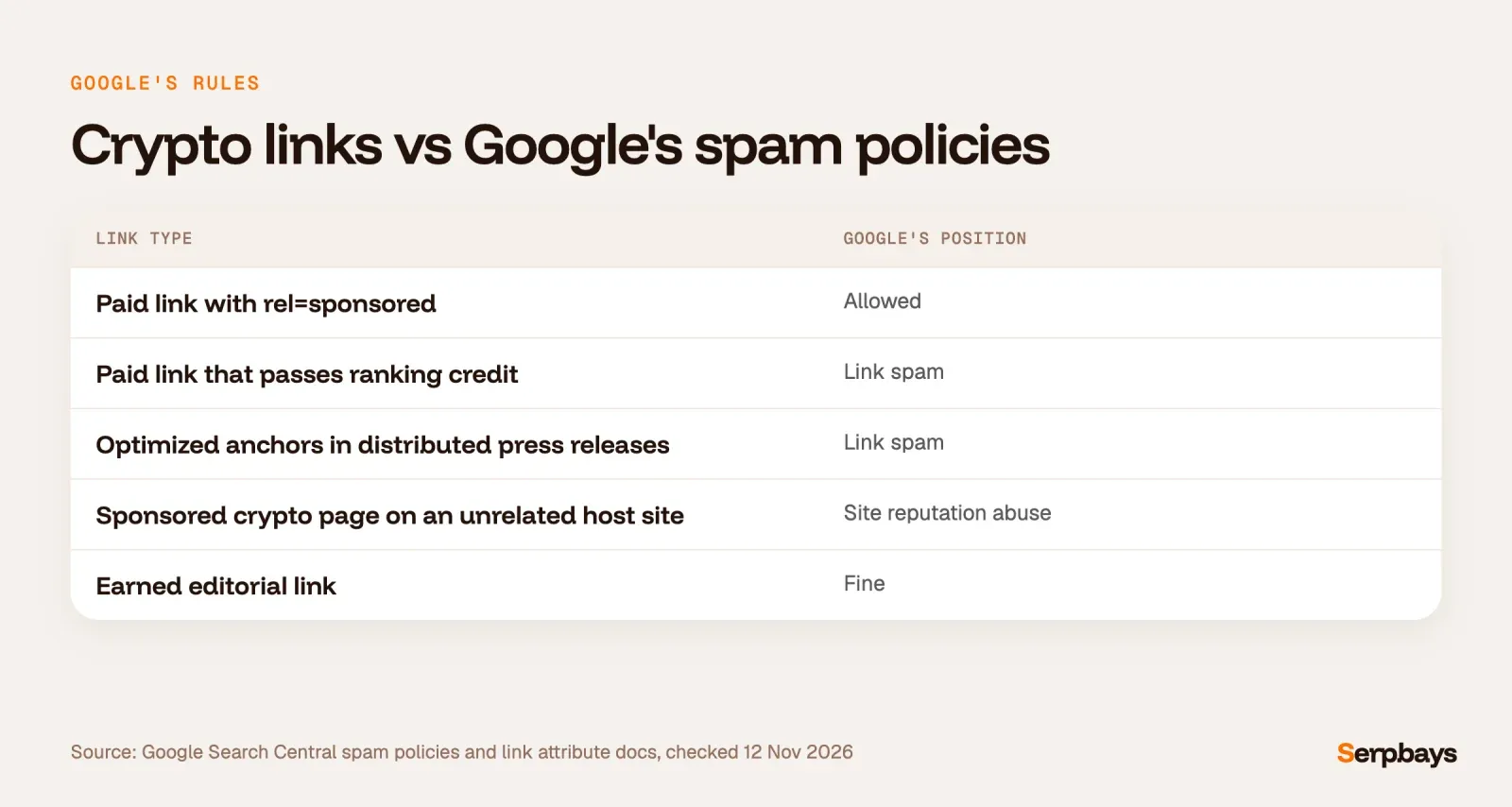
Google's spam policies for Google Search are short and specific. Under link spam, the first example is "Buying or selling links for ranking purposes", which includes "Exchanging money for links, or posts that contain links."
The same list names "Advertorials or native advertising where payment is received for articles that include links that pass ranking credit", and "links with optimized anchor text in articles, guest posts, or press releases distributed on other sites." That last phrase describes most crypto press release packages word for word.
Google also says buying and selling links is "a normal part of the economy of the web for advertising and sponsorship purposes." The line it draws is the label. A paid link is fine "as long as" it carries rel="nofollow" or rel="sponsored".
Google's page on qualifying outbound links spells out the sponsored value: "Mark links that are advertisements or paid placements (commonly called paid links) with the sponsored value."
Here's the honest part. In my experience, most paid links on the market are sold as followed. On the Serpbays marketplace, 23,699 of 24,356 live listings (97%) are listed as do-follow (Serpbays data, 12 Nov 2026). So every followed crypto placement you buy is a risk decision, not a safe purchase, and you should make it knowingly.
In my experience, the common outcome isn't a penalty, it's wasted money. When Google announced its December 2022 link spam update, it said SpamBrain "can now detect both sites buying links, and sites used for the purpose of passing outgoing links", and that "any credit passed by these unnatural links are lost." A link Google ignores costs the same as one it counts.
Site reputation abuse and sponsored crypto pages
The spam policies also cover site reputation abuse: third-party content published on a host site "mainly because of that host's already-established ranking signals." Google's own example is financial: "An educational site hosting a page about sponsored reviews of payday loans written by a third-party that distributes the same page to other sites across the web". Swap payday loans for a token presale and you have a common crypto tactic.
In an August 2026 update, Google said that from August 30, site reputation manual actions directly affect results for users outside the European Economic Area. Inside the EEA, the affected section "may be separated in our systems so that, over time, it ranks independently from the rest of the site." Either way, a "best crypto exchanges" page bolted onto an unrelated authority site is the pattern to avoid.
Which crypto backlinks actually work in 2026?
Here's what I'd put money and time into, roughly in order of safety. These are the best crypto backlinks you can get, and none of them come from a list.
- Original data and research. On-chain analysis, fee comparisons, security incident write-ups, survey results. Journalists and analysts cite numbers they can't get elsewhere. This is the slowest route and the only one fully inside the rules.
- Digital PR around real news. A product launch, a security audit result or a regulatory milestone, pitched to reporters who cover the beat. Our explainer on what digital PR is covers how the pitching works.
- A crypto guest post on a real publication. A useful article written for that site's readers, on a site that already covers crypto or finance and has organic traffic. Expect the publisher to label it, and judge the price with that in mind.
- Link insertions in relevant articles. A link insertion in an existing, ranking article about wallets or blockchain security can work well if the page genuinely fits. Our guest post vs niche edit comparison explains when to pick which.
- Ecosystem and developer mentions. Partner pages, integration docs and community resources link to projects they actually work with. These are earned by building integrations, not by asking.
Most good crypto link building, in my experience, mixes the first two with a handful of paid placements. Projects that try to buy their whole profile end up with a profile that looks bought.
What should you avoid in crypto SEO link building?
This is where most crypto SEO budgets leak. My position on each is blunt.
- PBN backlinks. Private blog networks exist to pass outgoing links, which is exactly what the 2022 SpamBrain announcement says Google can now detect. In my experience, crypto PBNs are often built on expired domains of dead projects. Skip them.
- Crypto press release blasts. Google's spam policy says wire and press release service sites are not themselves site reputation abuse, but it lists optimized anchors in "press releases distributed on other sites" as link spam. Syndicate a release to 300 sites and you get 300 copies of the same page, and very little else. Use releases for news, not links.
- Bulk "crypto backlinks list" packages. Hundreds of links for a flat fee means automated or recycled supply. Google's list of link spam includes "Using automated programs or services to create links to your site."
- Sponsored pages on unrelated authority sites. That's the site reputation abuse pattern above.
- Exact-match anchors on every link. Keep most anchors branded or naked URLs. Our anchor text distribution guide has a separate table for YMYL niches.
If you've already bought some of these, don't panic and don't disavow everything. Read our take on toxic backlinks first.
How do you vet a crypto publisher before you pay?
In my experience, crypto has more fake "news" sites than almost any other niche, so I run every placement through the same checks. It takes about ten minutes per site.
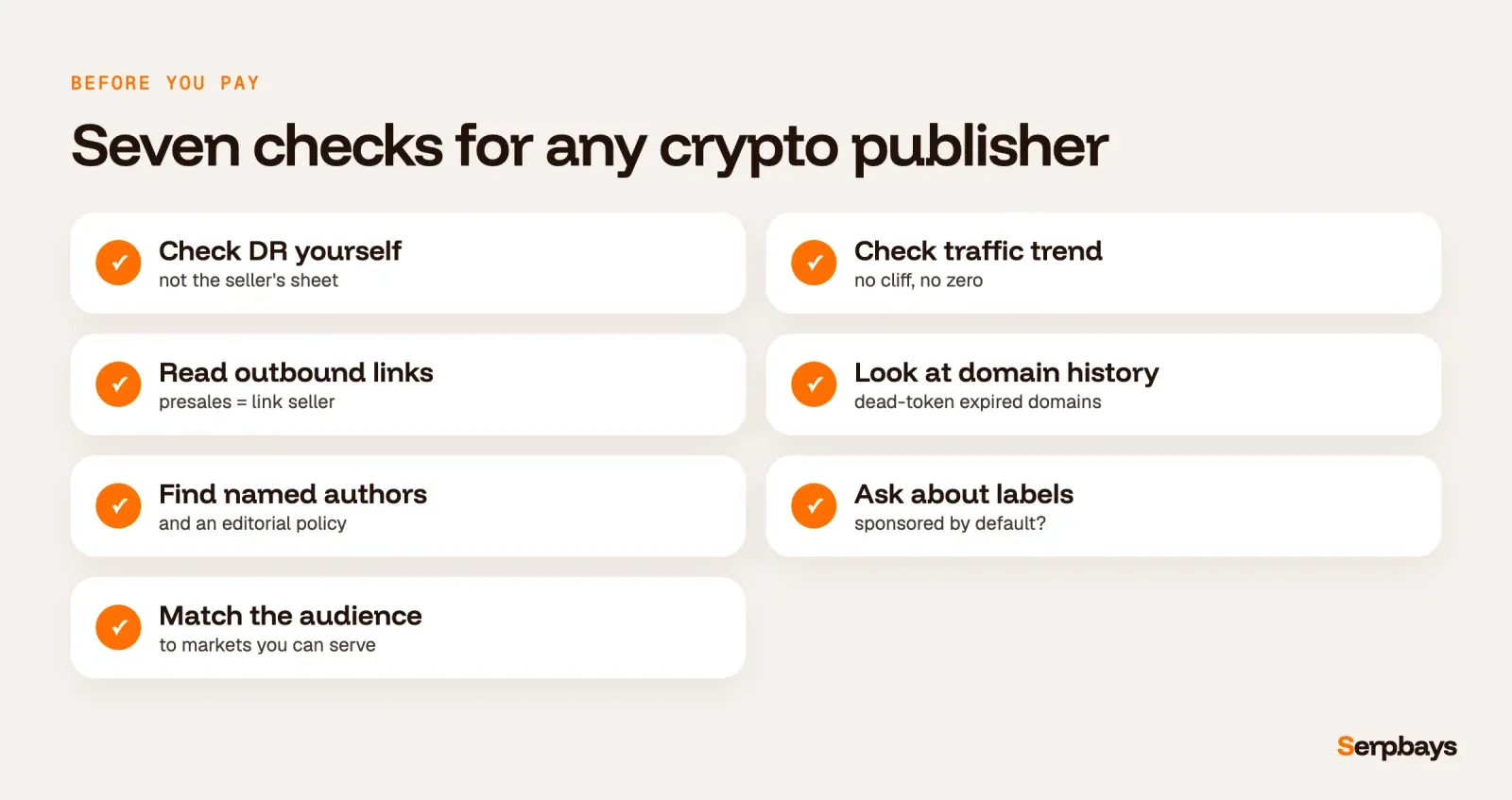
- Check the authority yourself. Don't trust a seller's spreadsheet. Paste your shortlist into the free bulk DR checker and compare.
- Check organic traffic and its trend. A high DR with almost no search traffic usually means a site that sells links and nothing else. A cliff after a Google update is another warning.
- Read the outbound links on recent posts. Open the last ten articles. If they link to token presales and "guaranteed yield" platforms with exact-match anchors, the site is a link seller with a news theme. Being in that neighbourhood is the risk.
- Look at the domain's history. The domain age checker and a look in the Wayback Machine show whether the site was a different project, or in a different language, a year ago. Expired domains of dead tokens are common.
- Find named authors and an editorial policy. Real crypto publications name their writers and say how they handle sponsored content. Anonymous sites with no policy are a YMYL trust problem for them and for you.
- Ask how paid posts are labelled. Some publishers add rel="sponsored" and a "sponsored" tag by default. Know before you pay so you can price it properly.
- Match the audience to your markets. If you can't legally serve a country, a site whose readers live there sends the wrong visitors.
A site that fails two or more of these isn't worth any price.
What do crypto backlinks cost?
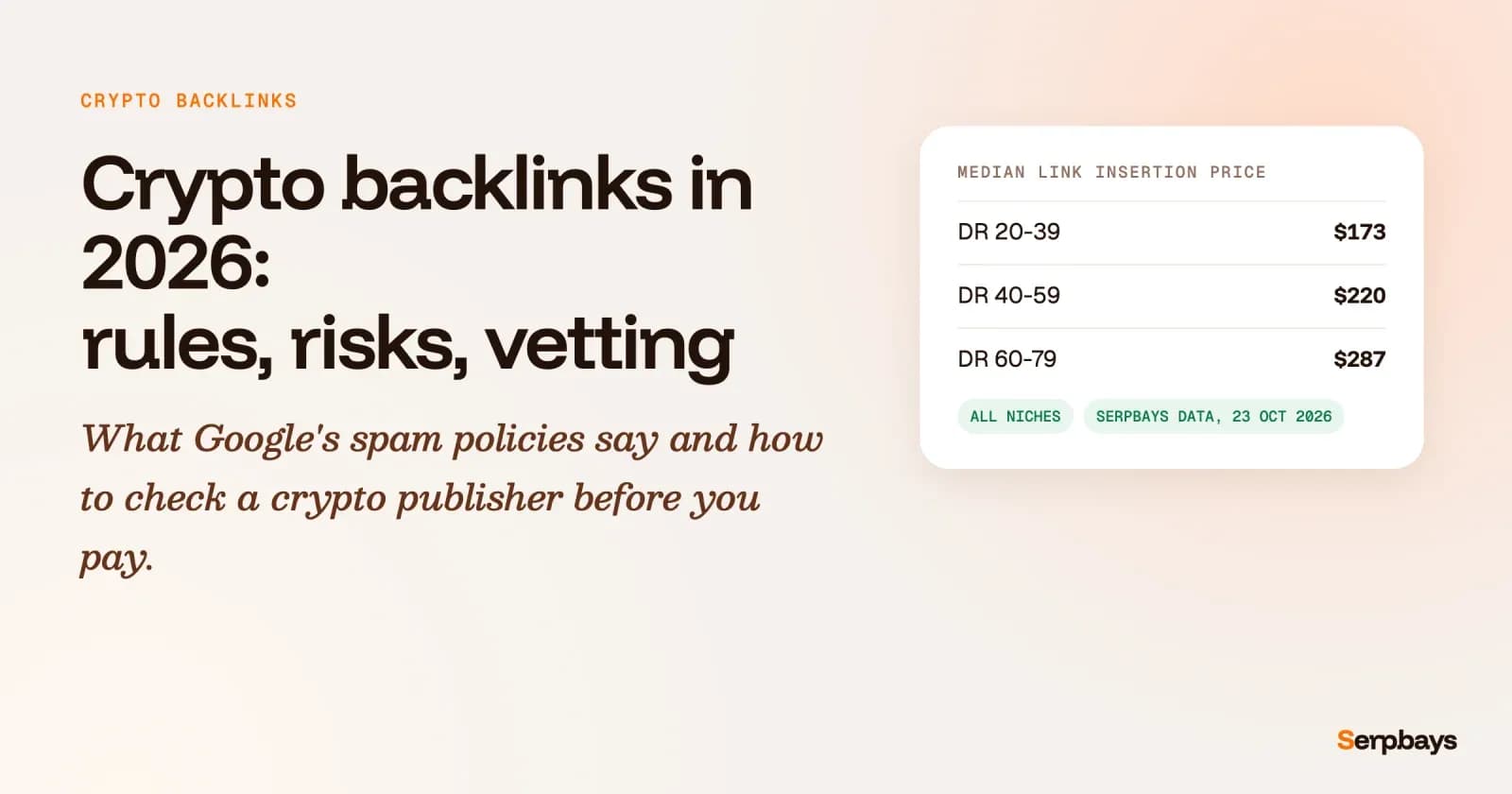
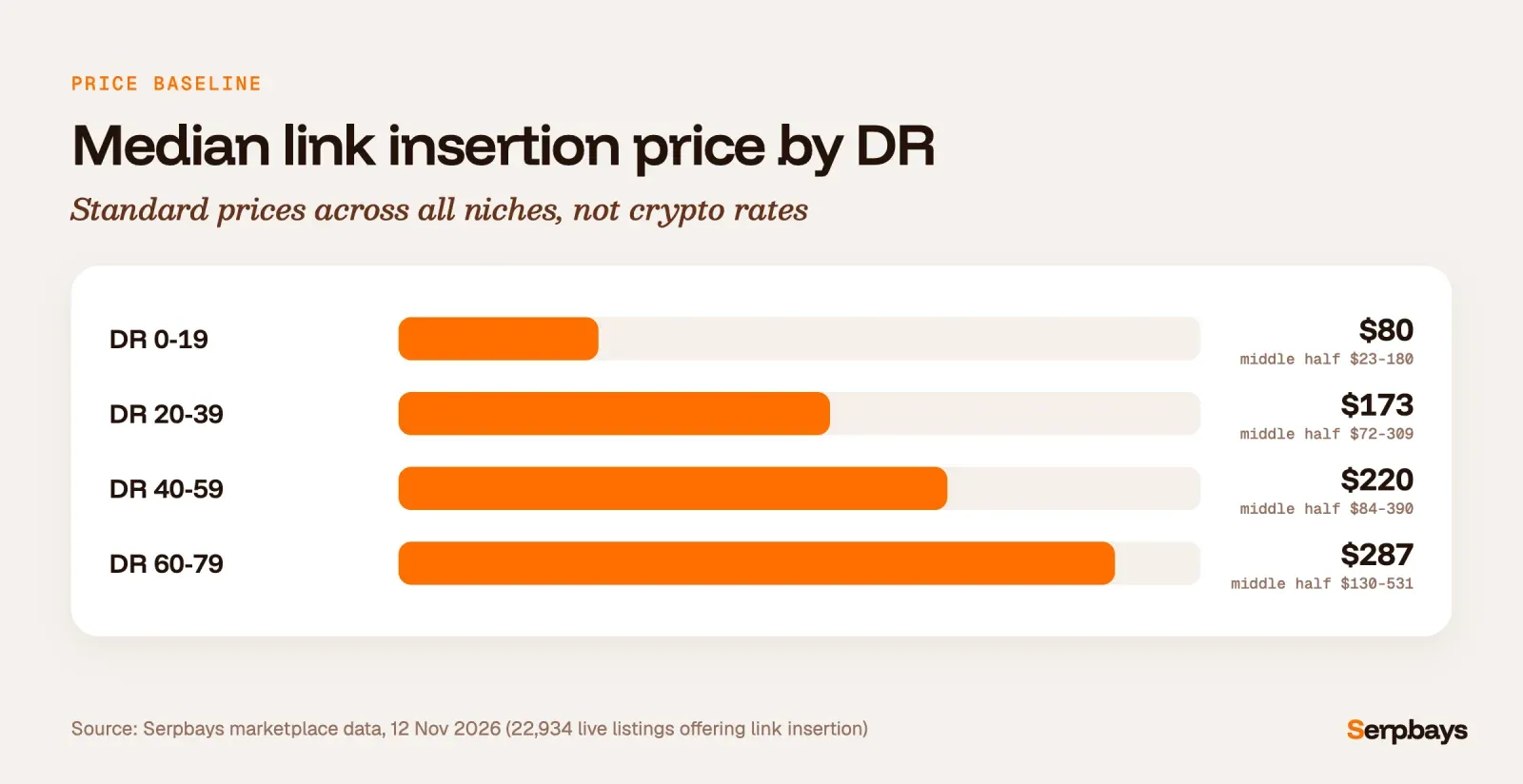
I won't give you a crypto rate card. Crypto pricing varies a lot by publisher, and many sites quote it only on request. What I can give you is the baseline: standard buyer prices across all niches on the Serpbays marketplace, from live listings.
| Ahrefs DR band | Median link insertion price | Middle half of listings |
|---|---|---|
| DR 0-19 | $80 | $23-180 |
| DR 20-39 | $173 | $72-309 |
| DR 40-59 | $220 | $84-390 |
| DR 60-79 | $287 | $130-531 |
Source: Serpbays data, 12 Nov 2026, 22,934 live listings that offer link insertion. These are general prices, not crypto rates. DR 80+ is left out because one Polish regional news portal's subdomains skew that band.
Traffic moves price more than you'd think. The median price is $96 for sites under 1,000 monthly organic visits and $441 for sites over 100,000 (same data). When a crypto publisher quotes you a rate, compare it against that baseline and ask for the rate and the link attribute in writing before you order.
If you're still comparing sources, our list of the best places to buy backlinks covers marketplaces and agencies side by side.
FAQ
Are crypto backlinks safe to buy?
No paid link is fully safe. Google's spam policies list buying links for ranking purposes as link spam, unless the link carries rel="sponsored" or rel="nofollow". Relevant, vetted placements on real publications are a calculated risk. Bulk packages and PBNs are the links most likely to be ignored or flagged.
Should a crypto guest post link be dofollow or sponsored?
Google asks for paid placements to be marked rel="sponsored". Some publishers add it by default, and a sponsored link on a respected crypto site still brings readers and brand visibility. Ask before you pay, and price the placement on what you actually get.
Do crypto press releases help SEO?
Rarely as links. Google lists optimized anchors in press releases distributed on other sites as link spam, and syndicated copies add little. A release about real news can still get picked up by journalists, and those editorial stories are the links worth having.
Your next step
Take the crypto backlinks you bought in the last six months, or the five you're about to buy, and run each through the seven checks above. Drop anything that fails two. Then compare replacements on the Serpbays crypto and blockchain backlinks page, which lists curated crypto and blockchain publishers with DR, DA and traffic shown, shows pricing once you sign in, and lets you order a guest post or link insertion.
Vinayak Gupta is the founder of Serpbays and Wordscloud, with hands-on experience in SEO, content marketing, publisher outreach, and link building. He has worked with SEO agencies, SaaS companies, and digital brands to plan content strategies, evaluate backlink opportunities, and build authority through high-quality placements. At Serpbays, he focuses on making link building more transparent, reliable, and easier for agencies and businesses.
View profile →