What Is Digital PR? How Campaigns Work, Real Examples and Metrics
What digital PR is, how a digital PR campaign runs step by step, two real examples, how it differs from link building, and the metrics worth tracking.
· · 11 min read
In 2022, the language platform Preply asked 1,265 Americans how often they watch TV with subtitles on. FOX 5 New York ran the result as a news story and linked straight back to Preply's blog. Nothing on the page marks it as sponsored. A survey earned it.
That is digital PR in one paragraph. This guide covers what it is, how a campaign actually runs, two real examples, how it differs from link building, and how to measure it without fooling yourself.
Short answer: Digital PR is public relations aimed at online publications: you create a story journalists want (usually original data, expert commentary or a timely reaction to news), pitch it, and earn coverage that mentions and often links to your site. It builds brand awareness and backlinks at the same time, but results depend on editors, so you can plan the effort, not guarantee the outcome.
What is digital PR, exactly?
Digital PR is the practice of earning coverage for a brand on news sites, magazines, trade blogs and podcasts. The coverage is editorial: a journalist chose to write about you because the story was useful to their readers.
Traditional PR chased print, TV and radio, and success meant clippings. The digital version chases online outlets, and success usually means coverage plus a link you can count, check and track. Same craft, different scoreboard.
That link is why SEO teams adopted it, and why digital PR in SEO is now treated as a link building channel of its own. A link from a national news site is hard to get any other way.
In my experience it also matters for AI search, because tools like ChatGPT cite web pages, and news coverage is among the pages they can find and trust. If you care about that side, our guide on how to get cited by ChatGPT covers it in detail.
What it is not: buying a sponsored article, mass-sending a press release to a wire service, or paying an outlet to run your copy. Those can be useful, but they're advertising or placement work. I'll come back to that difference below, because mixing them up is how budgets get wasted.
How does a digital PR campaign work?
All the digital PR campaigns I've seen work follow roughly the same path. The tools change, the order doesn't.
- Pick the audience and the outlets first. Decide which publications your buyers read, then work backwards. A B2B software brand needs trade press and business desks, not celebrity gossip sites.
- Find an angle a journalist would run without you. Ask: would this headline still be a story if our brand name were removed? If not, it's an ad.
- Build the asset. Usually a survey, an analysis of public data, a ranking, or an index. Keep the method simple enough to explain in two sentences.
- Write the pitch. Lead with the single most surprising number. Put the method and a link to the full data underneath.
- Send it to named journalists who cover the beat. Personal emails, not a blast. Journalist request platforms help for expert commentary; our list of HARO alternatives covers the ones still working.
- Follow up once, then track coverage. Log every article, whether it links, whether the link is followed, and the outlet's authority.
- Reclaim and reuse. Ask outlets that mentioned you without a link to add one, then refresh the data next year so the same journalists have a reason to come back.
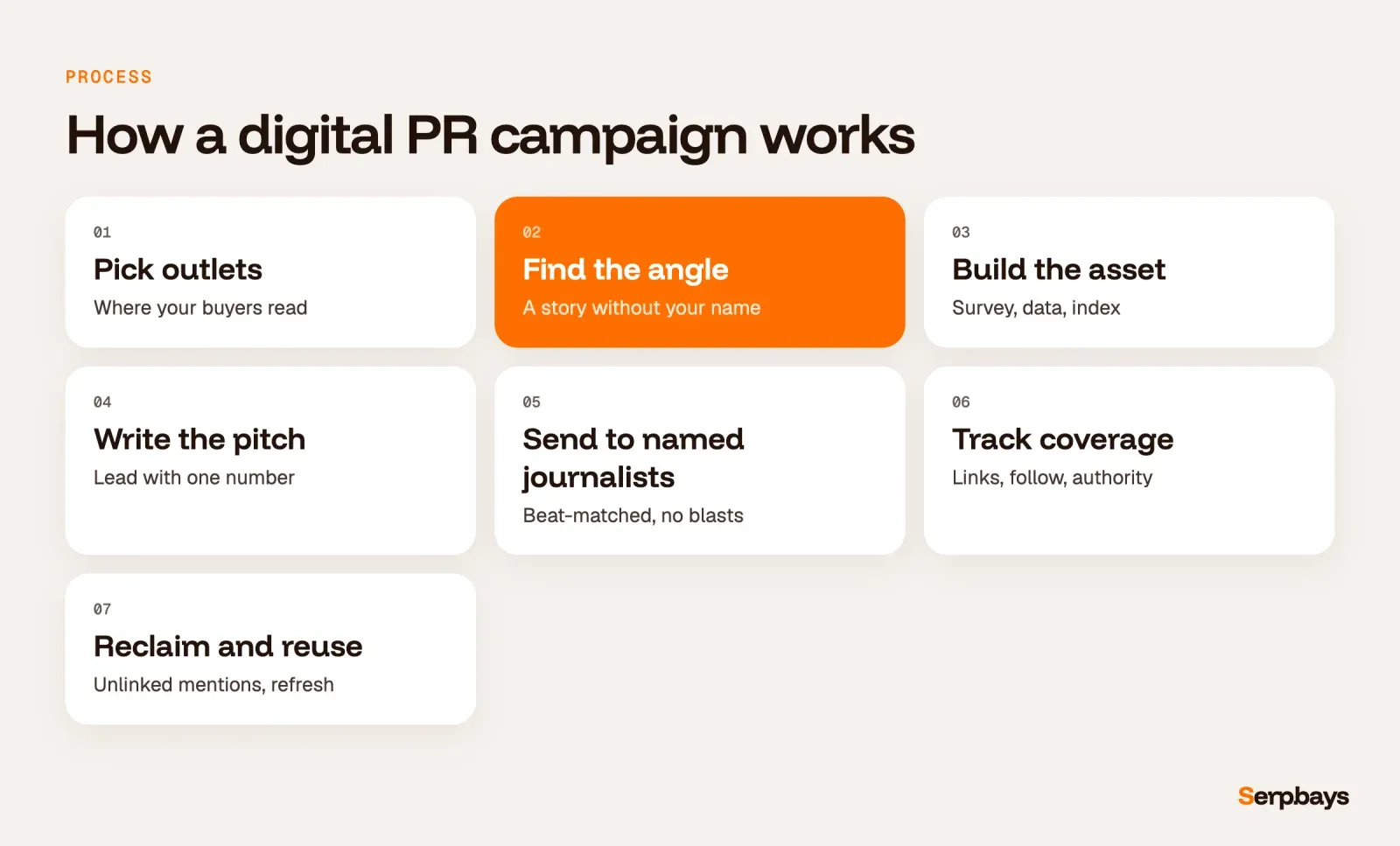
Step 2 is where most campaigns die. In my experience, teams spend weeks on design and a day on the angle. Flip that. A plain spreadsheet with a sharp finding beats a beautiful microsite with a boring one.
What do real digital PR examples look like?
Two campaigns, both verified on the coverage pages themselves.
Preply, subtitles survey (2022). Preply surveyed 1,265 Americans in May 2022 about subtitle use. FOX 5 New York published the story on 20 September 2022 under the headline "Young people watch TV with subtitles more than older viewers, survey says", credited "the language learning platform Preply", and linked to the survey page. The FOX 5 article leads with the finding that half of Americans watch with subtitles most of the time, and 70% of Gen Z are frequent users.
Why it worked: everyone has an opinion on subtitles, the finding splits by age, and a language-learning brand has an obvious reason to ask. The topic sits next to the product without being about the product.
Signs.com, "Branded in Memory" (2017). Signs.com asked 156 Americans to draw 10 famous logos (Apple, IKEA, Starbucks and others) from memory. The study page reports over 1,500 drawings, with IKEA drawn most accurately and Starbucks least. My Modern Met covered it on 4 October 2017, named Signs.com and linked to the study.
Why it worked: it's visual, it's funny, and the reader instantly tests themselves. A signage company talking about logo recall is a credible fit. Notice that neither campaign is about the brand's product. That's the pattern.
Digital PR vs link building: what's the difference?
It's one way to do link building. It isn't the only way, and it behaves very differently from the others.
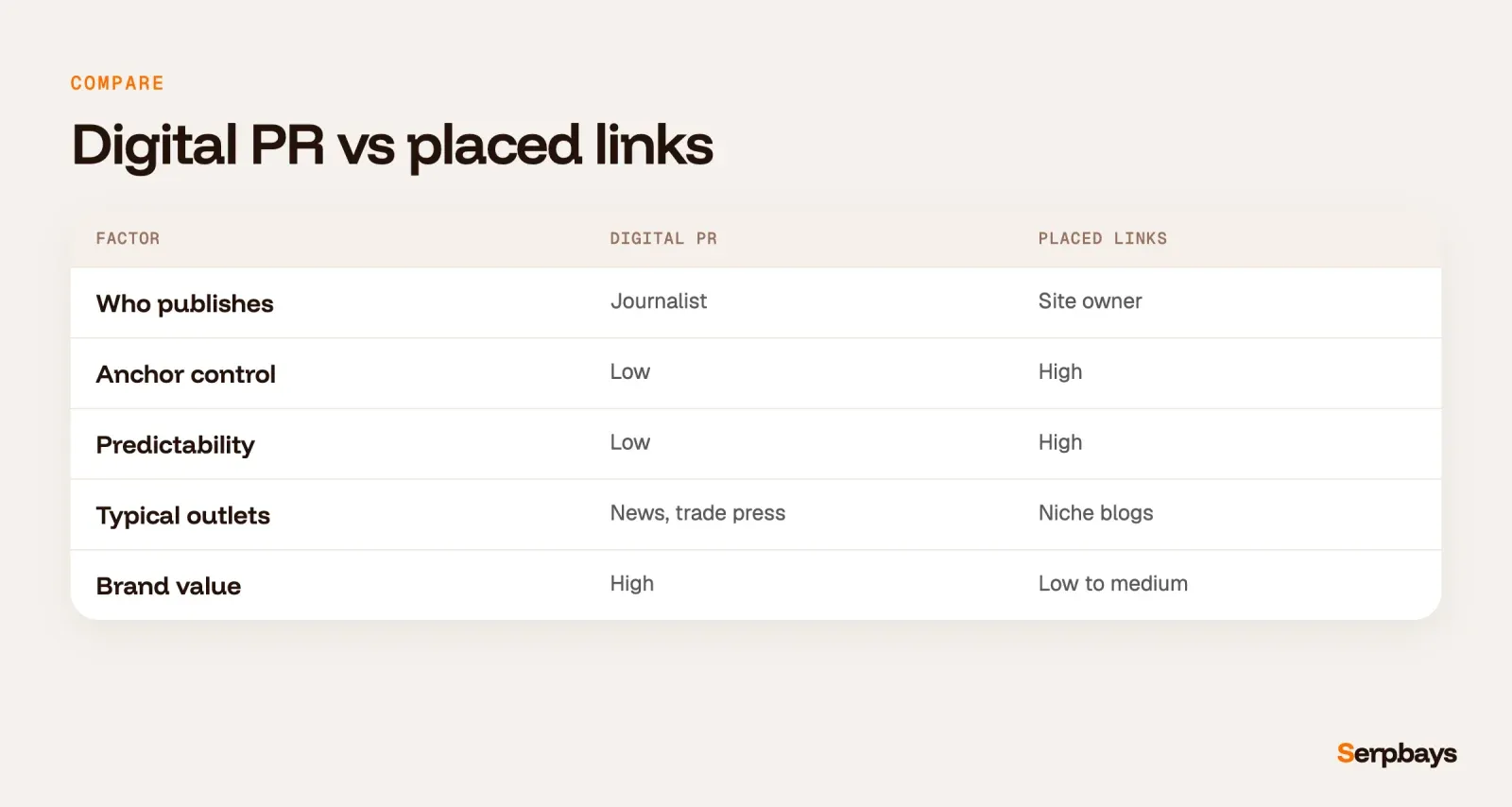
| Factor | Digital PR | Placed links (guest posts, link insertions) |
|---|---|---|
| Who decides to publish | A journalist or editor | The site owner, as part of a deal |
| Control over anchor and target page | Low | High |
| Predictability | Low: one campaign can land 0 or 40 links | High: you know the site before you pay |
| Typical outlets | News sites, national and trade press | Niche blogs and publications that accept contributions |
| Brand awareness value | High | Low to medium |
| Google's view if money changes hands for the link | Not applicable to earned coverage | Paid links should be marked rel="sponsored" or rel="nofollow" |
That last row comes from Google's spam policies, which list "buying or selling links for ranking purposes" as link spam unless the link is qualified with nofollow or sponsored. The same page names "links with optimized anchor text in articles, guest posts, or press releases distributed on other sites". So keyword-stuffed press release wires are not a shortcut.
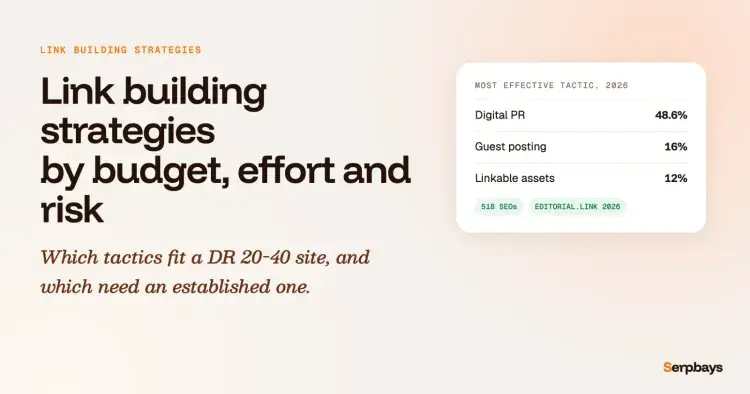
Practitioners rate digital PR highly. A 2026 Editorial.Link survey of 518 SEO professionals found 48.6% picked digital PR as the most effective link building tactic, against 16% for guest posting.
Here's my position: most brands should run both. Placed links fill the gaps you can predict, such as a product page that needs relevant links next month. Earned coverage builds the authority you can't buy on demand. If you're weighing the placed side, our guest post vs niche edit comparison breaks down those two formats.
For scale on the placement side: Serpbays has 10,058 live listings tagged News and Media with a guest post price, and 2,928 of them show 10,000+ monthly organic visits in Ahrefs. The median listed price at DR 60-79 is $360 across 978 sites (Serpbays data, 10 November 2026; DR 80+ is excluded because a block of regional news subdomains skews it).
You can browse them on the news and media backlinks page. That's placement, not digital PR, and it's worth being honest with yourself about which one you're buying.
Which digital PR strategies work in 2026?
BuzzStream's State of Digital PR 2025 report surveyed over 150 digital PR professionals in November and December 2024. The tactics they use most:
- Data-led content (94.8%). Surveys, public data analysis, indexes and rankings. Preply is the template.
- Expert commentary (92.5%). A named specialist offers quotes on a topic already in the news. Cheap, fast, and it builds a profile for one person journalists learn to trust.
- Hero content (78.6%). One bigger creative asset, such as the Signs.com logo drawings. Higher cost, higher ceiling.
- Press releases (68.8%). Still used, mostly for real company news like funding or launches.
- Converting unlinked mentions (64%). Finding coverage that names you without a link and asking for one. Our guide to brand mentions walks through the process.
Newsjacking, reacting within hours to a breaking story with a useful comment or number, sits inside expert commentary. It works when you have a real expert on call. It fails when a junior marketer writes "comment" that says nothing.
A good digital PR strategy picks one main tactic per quarter. Expert commentary every week keeps journalists aware of you. One data campaign per quarter gives them something to cite. That rhythm suits most small teams better than one giant campaign a year.
The assets themselves are a content job. If you're building them in-house, our guide to content marketing for link building covers which formats earn links and why free tools often outlast surveys.
How do you measure digital PR?
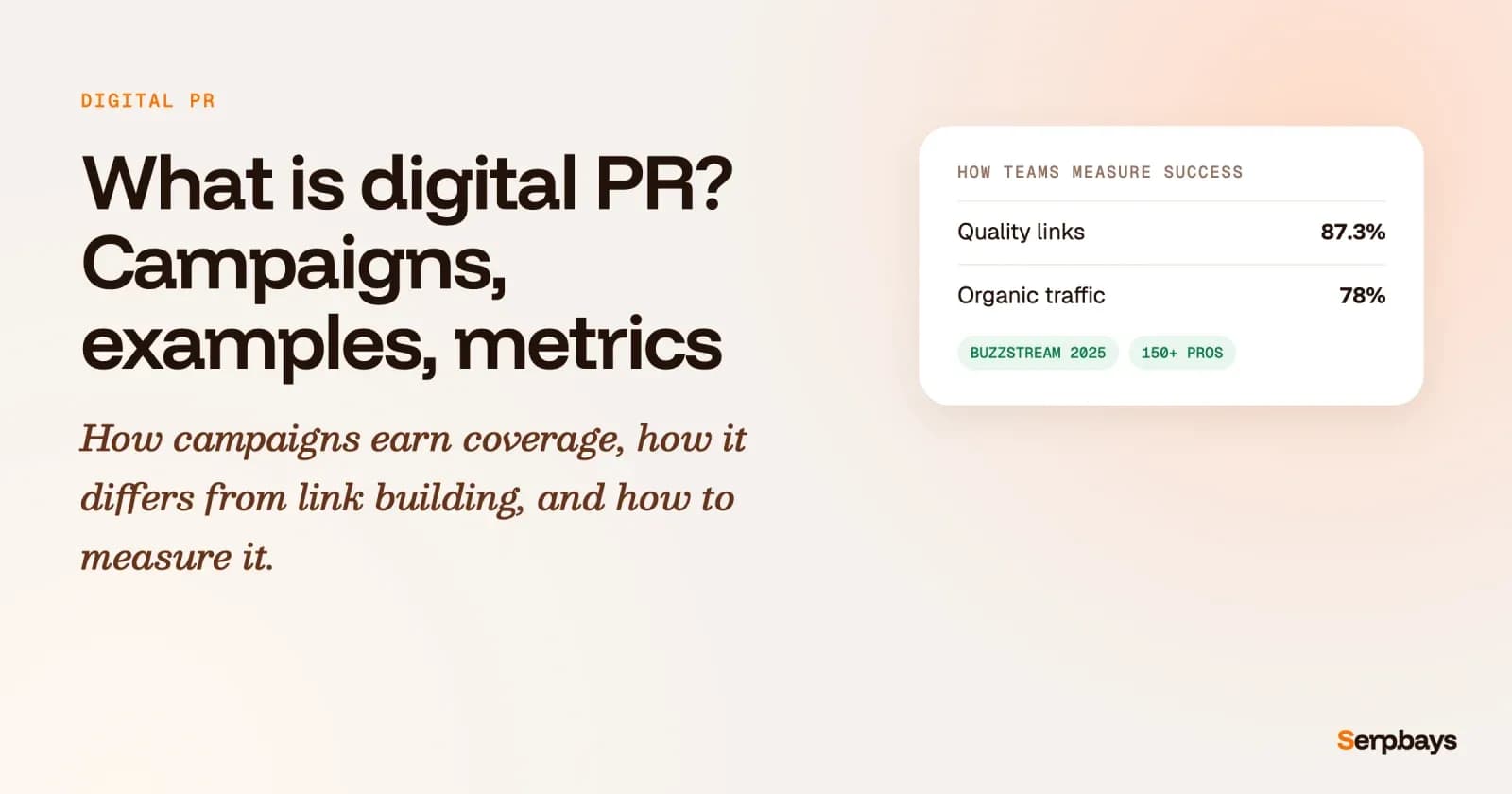
Start with what the industry already tracks. In the BuzzStream survey, practitioners measured success by quality links (87.3%), increase in organic traffic (78%), total number of links (73.4%) and total mentions, linked or unlinked (72.3%).
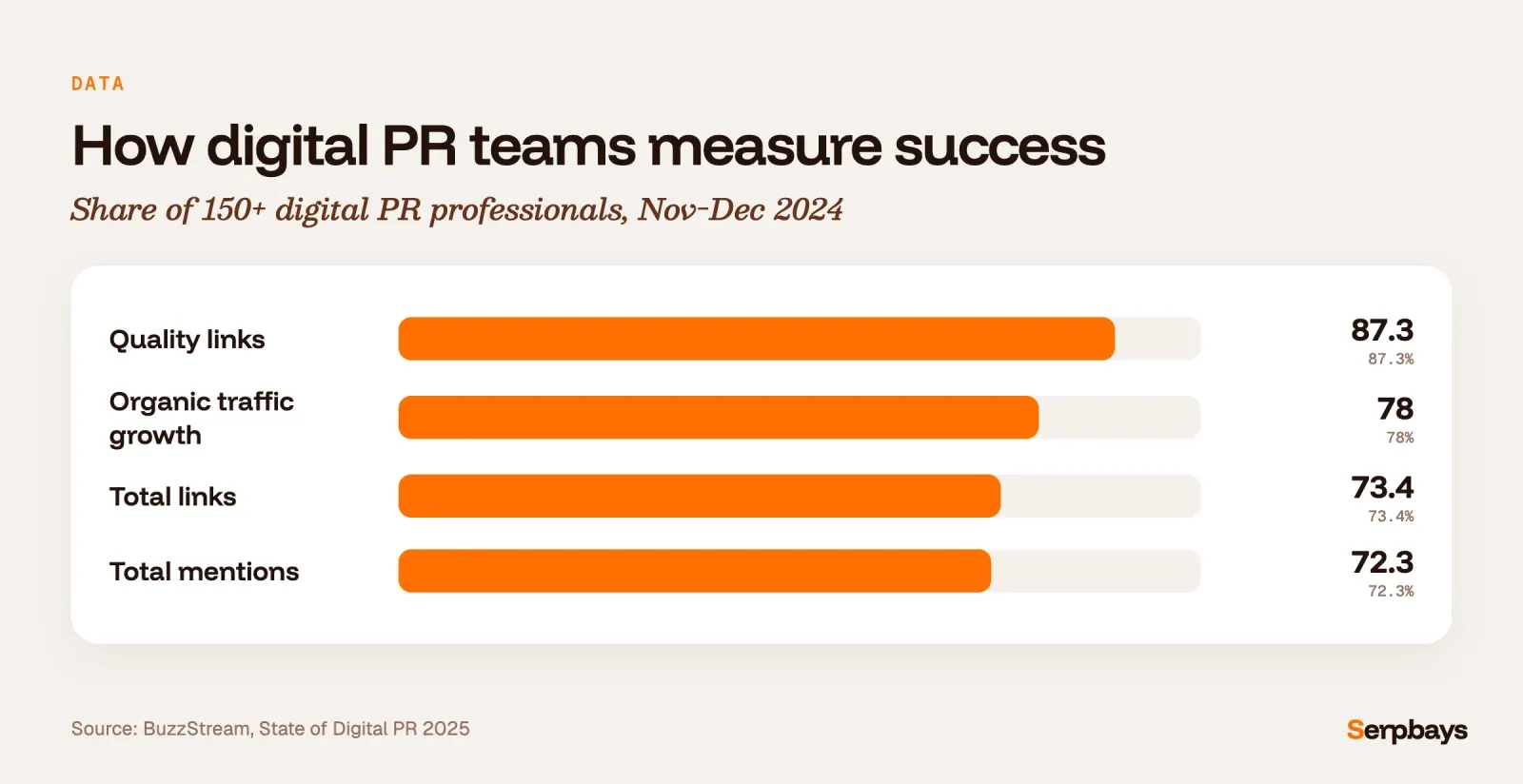
Here is the scorecard I'd use for any campaign:
- Coverage count and outlet list. Every article, with date and URL.
- Link rate. Linked articles divided by total coverage. Note followed and nofollowed separately.
- Link quality. Run the coverage domains through the bulk DR checker. If you're unsure what the number means, read our explainer on what domain rating measures.
- Referral traffic. Sessions from the coverage URLs in your analytics.
- Organic movement on the target pages. Give it time. In the BuzzStream survey, almost half of respondents said measurable results take 3-6 months, and 35.8% said 1-3 months.
- Branded search. Search Console impressions for your brand name before and after.
One thing to leave out: advertising value equivalents (AVEs), the old trick of pricing coverage as if it were bought ad space. AMEC's Barcelona Principles 3.0 (2020), the best-known measurement framework in PR, state plainly that "AVEs are not the value of communication." If an agency report leads with an AVE figure, ask for the link list instead.
Be realistic about sales, too. In the same survey, only 24.9% said it was most effective for qualified leads and 18.5% for increased sales, against 89.6% for backlinks. It's an authority and awareness channel. Judge it on that.
Should you run digital PR in-house, hire an agency, or pay for placements?
In-house works if someone on the team can find stories in data and write a tight pitch. Your cost is time. A digital PR strategist on staff pays off once you run campaigns every quarter.
A digital PR agency brings journalist relationships and a creative process. The catch is outcome risk: you pay for the campaign whether it lands or not. BuzzStream found 66.5% of respondents work with budgets under $10,000 a month, so set expectations against that range.
Paying for placement is a different product. Our own digital PR service works this way: you pay per published article on a named outlet, starting at $500, with three outlet tiers, writing included, and you're invoiced only after the article goes live. It suits brands that need a feature in a known publication by a known date. It doesn't replace earned coverage, and the two do different jobs.
One rule applies to any paid article, whoever sells it: Google's spam policies expect a link you paid for to carry rel="sponsored" or rel="nofollow". So judge a paid feature on the audience, the byline and the credibility of appearing on that outlet, not on ranking credit from the link. For context, 87.3% of BuzzStream's respondents said they never pay for link placements.
My honest take: if you have something genuinely new to say, earn it. If you need a specific outlet on a deadline, pay for the placement and treat it as what it is.
FAQ
What is digital PR and how does it contribute to marketing?
Digital PR earns editorial coverage on online publications by giving journalists stories, data or expert comment. It contributes brand awareness, referral traffic and authoritative backlinks, which support organic rankings and, in my experience, how often AI search tools see your brand.
What does a digital PR strategist do?
A digital PR strategist finds story angles in data and the news, builds the campaign asset, pitches named journalists, and reports on coverage, links and traffic. The best ones understand both newsrooms and SEO.
How long does digital PR take to show results?
Coverage can land within days of a pitch, but SEO results take longer. In BuzzStream's 2025 survey of 150+ practitioners, almost half said measurable results take 3-6 months and 35.8% said 1-3 months.
Where to start this week
Write down five questions your customers ask that nobody has hard numbers for. Pick the one with the most surprising possible answer, and check whether you can get the data from your own product, a short survey or a public dataset. If one of the five survives the "would this be a story without our name?" test, you have your first digital PR campaign. If none do, start with expert commentary and build from there.
Vinayak Gupta is the founder of Serpbays and Wordscloud, with hands-on experience in SEO, content marketing, publisher outreach, and link building. He has worked with SEO agencies, SaaS companies, and digital brands to plan content strategies, evaluate backlink opportunities, and build authority through high-quality placements. At Serpbays, he focuses on making link building more transparent, reliable, and easier for agencies and businesses.
View profile →