What Is a Sponsored Post? Disclosure Rules, Links and What It Pays
What a sponsored post is, how to disclose it under FTC rules, why links need rel="sponsored", and what Serpbays publishers are paid per post by DR.
· · 11 min read
A brand emails you: they'll pay $150 to publish an article on your blog, with one link back to their product page. You say yes, publish it, and get paid. That article is a sponsored post, and how you label it and how you code that link decide whether it's a clean deal or a problem for your site.
So what is a sponsored post, exactly, and what should a publisher charge for one? This guide covers the definition, how it differs from a guest post and an advertorial, the FTC disclosure rules, Google's rel="sponsored" attribute, and what 24,356 live listings on the Serpbays marketplace are paid per post.
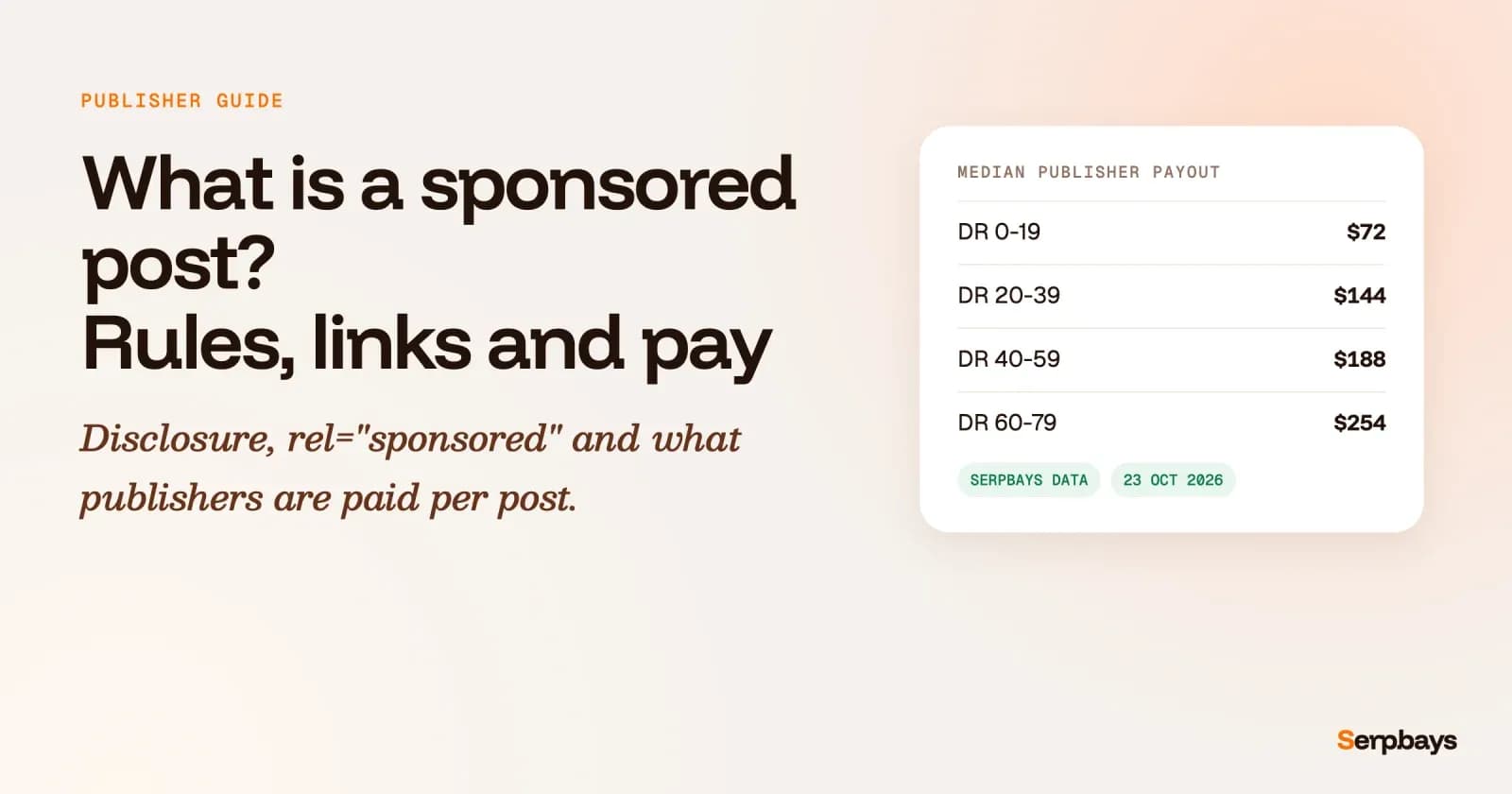
Short answer: A sponsored post is an article on a blog or website that a brand pays for, with money or anything else of value, to promote its product or to get a link. The FTC expects the payment to be disclosed clearly, close to the content, and Google expects any link in it to carry rel="sponsored" (or rel="nofollow"). On Serpbays, the median publisher payout for a post is $144 for sites under DR 80 (13 Nov 2026).
What is a sponsored post?
A sponsored post is content that appears on your site because someone paid for it to be there. The payment is usually cash, but a free product, a free trip or a discount counts too. The FTC's influencer guide, Disclosures 101 (November 2019), puts it simply: "Disclose the relationship if you got anything of value to mention a product."
Sometimes the brand sends a finished article; sometimes you write it to their brief. Either way, it's a sponsored post the moment value changes hands.
One thing to clear up: the term has two meanings online. A social media sponsored post is usually an ad a brand pays a platform to boost, or a paid influencer mention on Instagram or TikTok. That's what most of the search results for "sponsored post" are about. This guide is about the other kind: a blog sponsored post, published as an article on a website, often with a link in it.
For blog owners, that second kind is a real income line, and it's where most rule-breaking happens, because it looks exactly like your editorial content.
Sponsored post vs guest post vs advertorial: what's the difference?
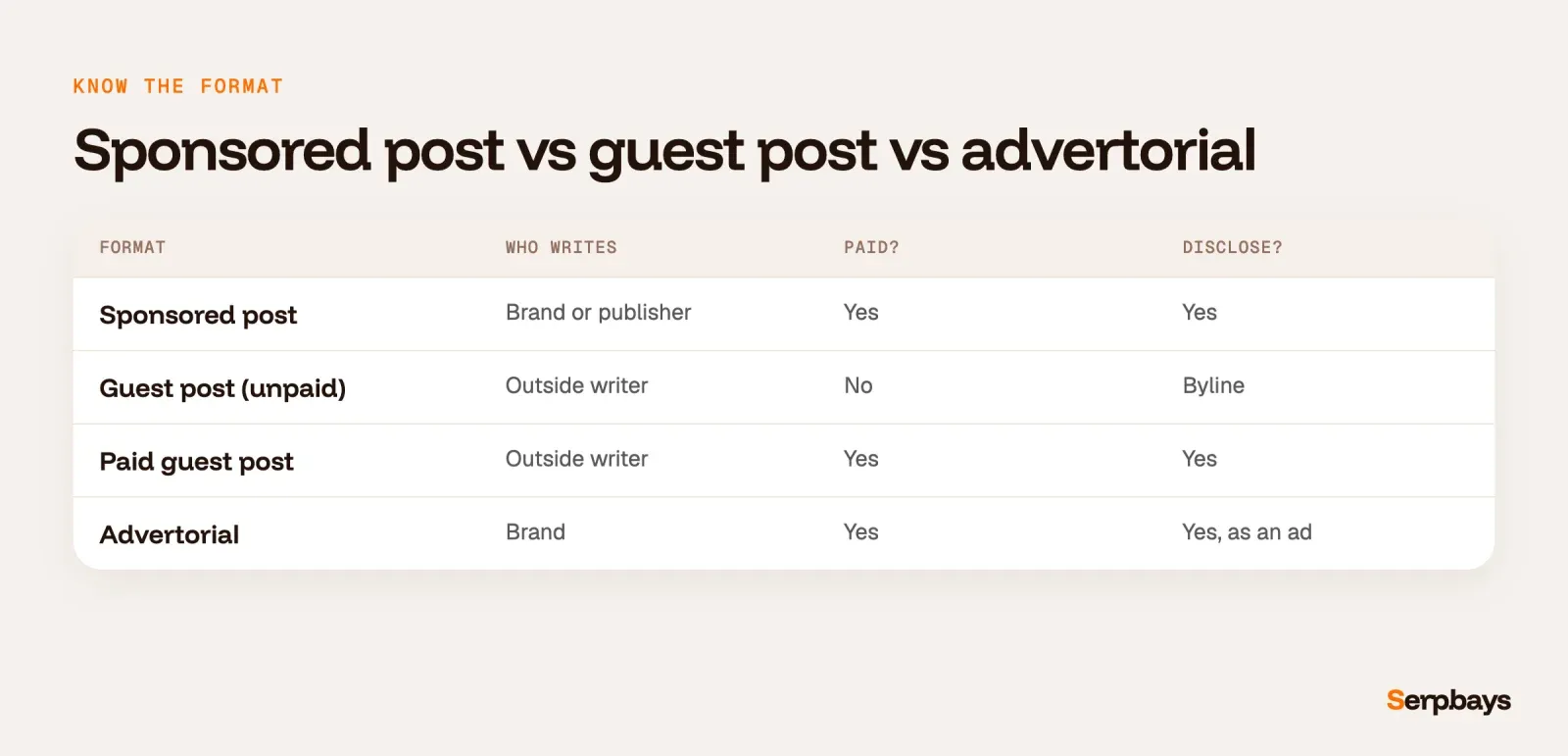
People use these three terms loosely. Here's how I separate them.
| Format | Who writes it | Money involved? | Who controls the message | Disclosure |
|---|---|---|---|---|
| Sponsored post | Brand or publisher | Yes, paid by the brand | Shared, brand sets the brief | Required |
| Guest post (unpaid) | Outside writer | No | Publisher's editor | Normal byline |
| Guest post (paid placement) | Outside writer | Yes | Publisher approves, buyer writes | Required, it's a sponsored post |
| Advertorial | Brand, in the site's style | Yes | Brand | Required, labelled as an ad |
The paid guest post row is the one people argue about. A guest post that a buyer paid for is a sponsored post, whatever the invoice calls it. If you want the format side of this, our post on guest posts vs niche edits compares the two most common paid placements.
The UK regulator draws the advertorial line in a useful way. The ASA's 2023 guidance on advertisement features says content made in exchange for a payment or "other reciprocal arrangement" is likely to fall under consumer protection law, and when the brand also has editorial control, it falls under the CAP Code too. That content must be obviously recognisable as marketing (CAP rules 2.1 and 2.4).
Do sponsored posts need to be disclosed?
Yes. In the US, the FTC's Endorsement Guides apply to blog posts as well as social media. The FTC's Q&A page, FTC's Endorsement Guides: What People Are Asking, says the guides were revised in 2023, and that the FTC Act applies to product recommendations and endorsements made on behalf of a sponsoring advertiser. That includes a blogger who gets paid or gets free products.
The trigger is a "material connection". Disclosures 101 defines it as a personal, family or employment relationship, or the brand paying you or giving you free or discounted products. The same page says to disclose "even if you think your evaluations are unbiased."
Where the disclosure goes
Placement is where most blogs get it wrong. The FTC's Q&A makes three points that matter for a website:
- Readers might overlook a disclosure at the very top of the page, outside the blog itself.
- Consumers may miss a disclosure at the bottom of a blog post.
- A hyperlinked disclosure (a button or link that says DISCLOSURE) is "easily avoidable", so it isn't clear and conspicuous.
The FTC's native advertising guide for businesses (December 2015) is more specific for article-style content. It says the disclosure should sit "in front of or above the headline", and on the article page itself, close to the headline.
Which words to use
This is where the rules get messy. The FTC's native advertising guide lists "Ad", "Advertisement", "Paid Advertisement" and "Sponsored Advertising Content" as terms consumers are likely to understand. It calls "Promoted" "at best ambiguous", and warns that "Sponsored by [X]" can suggest the brand paid for the content without shaping it.
Disclosures 101, written for influencers, accepts "sponsored". The UK ASA goes the other way: it says "sponsored" is open to varied interpretation and it "would generally advise against using this label", preferring "Advertisement Feature" or a prominent "Ad".
My position: don't rely on the single word "Sponsored" on a blog. A line above the headline that reads "Advertisement" or "Paid post: this article was paid for by Acme" works under both the FTC and ASA wording, and it costs you nothing. I've only checked US and UK guidance here, so if your readers are elsewhere, read your own regulator's rules.
Does a link in a sponsored post need rel="sponsored"?
Google's answer is yes. Its page on qualifying outbound links says: "Mark links that are advertisements or paid placements (commonly called paid links) with the sponsored value." It adds that nofollow "is still an acceptable way to flag them, though sponsored is preferred." You can combine values, so rel="sponsored nofollow" is valid.
The Google spam policies name sponsored posts almost word for word. One listed example of link spam is "Advertorials or native advertising where payment is received for articles that include links that pass ranking credit." The same page says buying and selling links "is a normal part of the economy of the web for advertising and sponsorship purposes", and that it isn't a violation when the links are qualified with nofollow or sponsored.
So the FTC label is about readers and the rel attribute is about search engines. A sponsored post needs both, and one doesn't replace the other. Our guide to the types of backlinks explains how sponsored, nofollow and UGC links differ.
There's a second risk for publishers. Google's site reputation abuse policy says normal advertorial content shared directly with readers is fine, but low-quality third-party pages placed on a host site to borrow its ranking signals are not. In my experience, a blog that turns into a stream of off-topic paid articles gets hurt long before anyone thinks about link attributes.
In practice, many buyers ask for followed links and many publishers sell them. Google's rule is still the one above, and it's your site carrying the risk.
How much can publishers charge for a sponsored post?
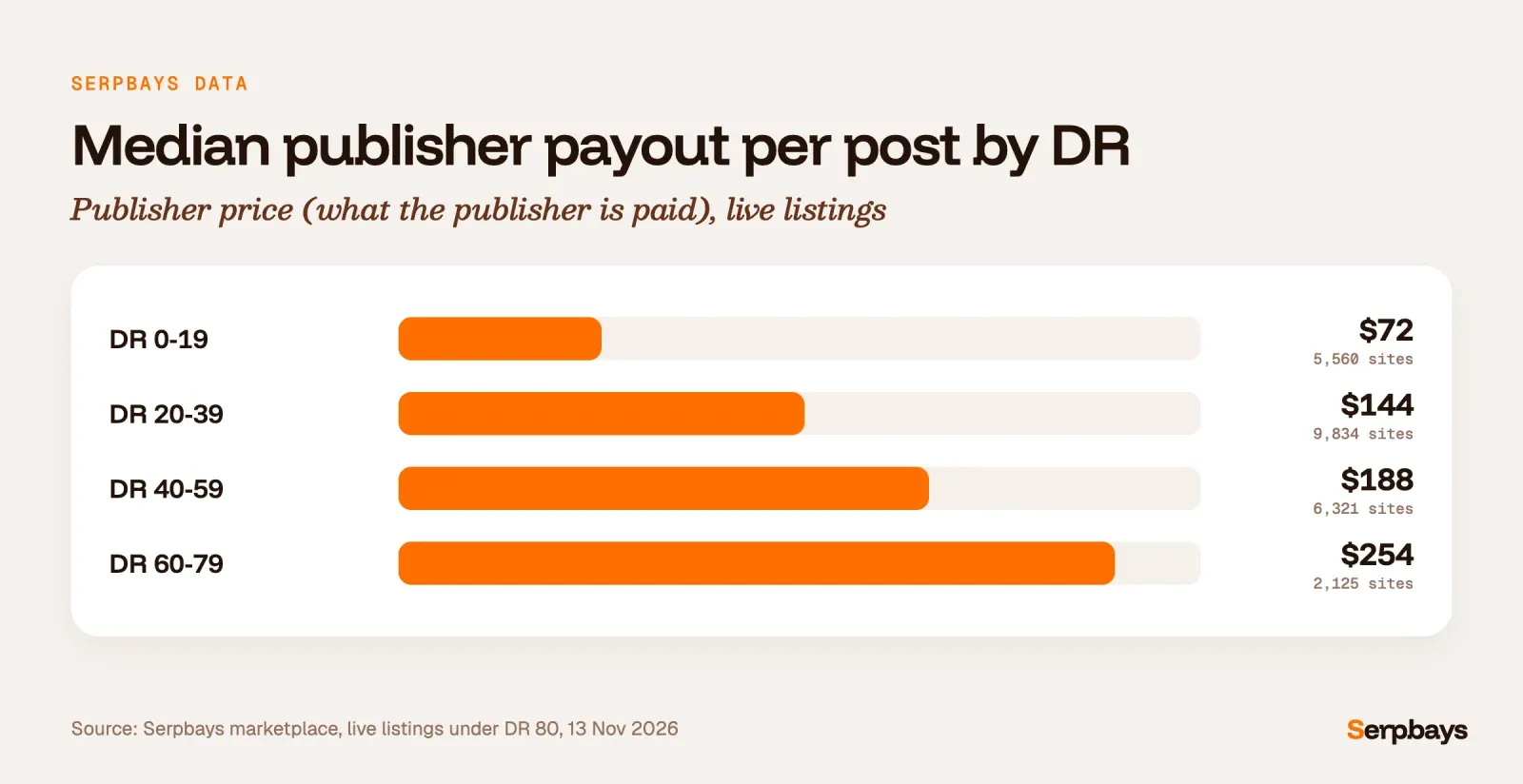
Most pricing advice on sponsored posts is anecdotal. Here's real data instead. We pulled every live listing on the Serpbays marketplace on 13 November 2026 and the publisher price: the amount the publisher is paid for a guest post order, not the price the buyer sees.
Across 23,840 listings under DR 80, the median publisher payout is $144. The middle half sits between $56 and $284. 61% of those listings are paid $100 or more per post, and 8% are paid $500 or more.
Authority and traffic both move the number. By Ahrefs Domain Rating:
- DR 0-19: median $72 (5,560 sites)
- DR 20-39: median $144 (9,834 sites)
- DR 40-59: median $188 (6,321 sites)
- DR 60-79: median $254 (2,125 sites)
By estimated monthly organic traffic, the jump is sharper at the top: sites under 1,000 visits are paid a median $88, 1k-10k visits $160, 10k-100k visits $195, and 100k+ visits $400 (454 sites).
One caveat. We left out DR 80+, because 331 of those 516 listings are subdomains of one Polish regional news portal (naszemiasto.pl), and 307 of them pay the publisher $60, which drags that band's median down to $60. Every payout figure in this section covers the 23,840 listings under DR 80.
Two more points help when you set a price for a sponsored post for bloggers. For link insertions (a link added to an existing article), publishers are paid a median $144, and 22,244 of the 22,450 listings that offer both formats set the same payout for each. And only 1,125 listings set a separate writing fee for the publisher (median $25), so decide up front whether your price includes writing the article. If you're not sure where your site sits, check your number with our free domain rating checker and read what Domain Rating means before you price off it.
What does a good sponsored post example look like?
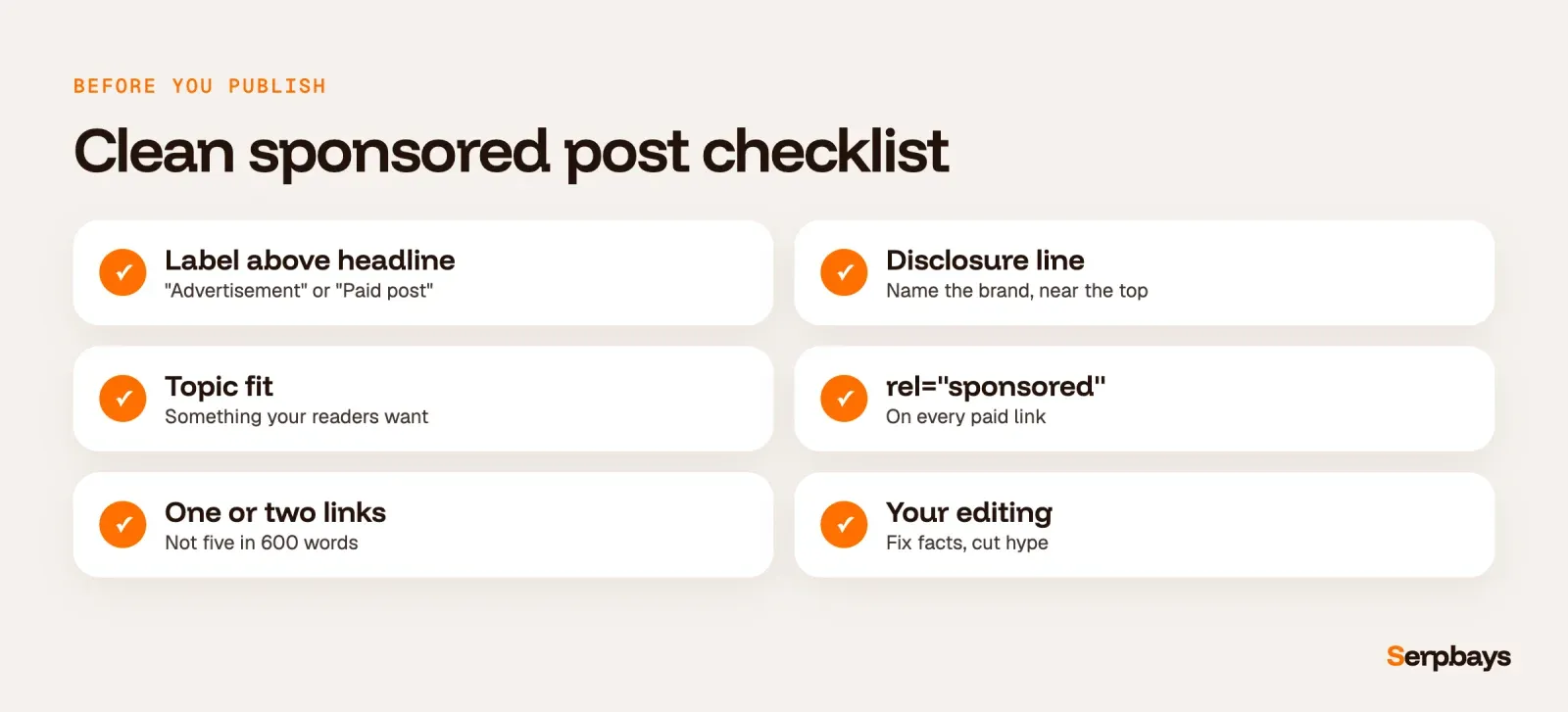
Here's a simple sponsored post template I'd use on a blog. It isn't a legal document, just the parts that every clean sponsored post has:
- A label above the headline. "Advertisement" or "Paid post", in the same size as your normal metadata, not in grey 9px text.
- A disclosure line in the first paragraph. For example: "This post was paid for by Acme. Acme reviewed it before publishing." Name the brand.
- A topic your readers actually want. A cooking blog publishing a sponsored post about a knife set is fine. The same blog publishing one about payday loans is not.
- One or two links, marked rel="sponsored". Not five links stuffed into 600 words.
- Your editing. Fix the facts, cut the hype and keep your formatting. Check length and repetition with our word counter before it goes live.
If a buyer refuses the label, that tells you what they're really paying for.
Is selling sponsored posts worth it for a publisher?
It can be, if it stays a side line. The best-paid sites have real organic traffic, and the fastest way to lose it is to publish anything anyone pays for. In my experience, publishers who say no to off-topic orders earn more over a year than those who accept everything in month one.
The other cost is time: finding buyers and chasing payment one email at a time is slow. Marketplaces cut that out, but read the terms before you list. Ours are on the publisher revenue model page and the publisher guidelines. If you also sell link insertions, our post on link insertion covers how buyers judge them.
FAQ
Is it illegal to not disclose sponsored content?
In the US, failing to disclose a paid relationship can be a deceptive practice under the FTC Act, which the FTC says applies to sponsored endorsements, blog posts included. The FTC says its enforcement usually focuses on advertisers and their agencies, but it can seek civil penalties in some cases, for example after a company has received a Notice of Penalty Offenses. This is general information, not legal advice.
Is a sponsored post the same as a guest post?
Not always. An unpaid guest post is editorial content from an outside writer. Once the writer or brand pays for the placement, it's a sponsored post, and it needs a disclosure and a rel="sponsored" or rel="nofollow" link.
Do sponsored posts help SEO?
For the buyer, a sponsored post brings referral traffic and brand exposure, but Google says paid links should not pass ranking credit, so it expects them to be marked sponsored or nofollow. For the publisher, a few relevant, well-edited sponsored posts are fine. A site full of off-topic paid articles risks Google's spam policies.
Next step: price your first sponsored post
Check your site's DR and organic traffic, then find your band in the payout figures above and set a price near its median rather than at the bottom. Write your disclosure line and add rel="sponsored" to your editor's link settings now, before the first order arrives. When you're ready to get orders without cold email, become a Serpbays publisher: it's free to join, you set your own prices for guest posts and link insertions, and you review every order before you accept it.
Vinayak Gupta is the founder of Serpbays and Wordscloud, with hands-on experience in SEO, content marketing, publisher outreach, and link building. He has worked with SEO agencies, SaaS companies, and digital brands to plan content strategies, evaluate backlink opportunities, and build authority through high-quality placements. At Serpbays, he focuses on making link building more transparent, reliable, and easier for agencies and businesses.
View profile →