What Is Generative Engine Optimization (GEO)? How It Differs From SEO
What generative engine optimization really is, what the 2023 GEO paper tested (and found), how GEO differs from SEO and AEO, and how to apply it on-page.
· · 11 min read
In March 2025, Google users who saw an AI summary clicked a normal search result in 8% of visits. Users who saw no summary clicked in 15% of visits. That is from Pew Research Center's 2025 study of browsing data from 900 US adults, and the link inside the summary itself got clicked in just 1% of visits.
So the answer is now the product. Generative engine optimization (GEO) is the work of getting your page into that answer. The term has a precise origin, a measurable definition and a short list of tested methods. The top-ranking guides I read skip most of that.
Short answer: Generative engine optimization (GEO) is rewriting and structuring content so AI answer engines such as Google AI Overviews, ChatGPT search and Perplexity quote and cite it. The term comes from a 2023 Princeton and IIT Delhi paper, which found that adding statistics, quotations and cited sources raised a page's visibility in AI answers by up to 40%, while keyword stuffing did not help. SEO gets you into the pool of pages an engine reads; GEO decides how much of the answer you take.
What is generative engine optimization (GEO), exactly?
The term was coined in "GEO: Generative Engine Optimization" by Pranjal Aggarwal, Vishvak Murahari, Tanmay Rajpurohit, Ashwin Kalyan, Karthik Narasimhan and Ameet Deshpande (arXiv 2311.09735). It was first posted in November 2023 and published at KDD 2024, a major data mining conference.
The paper defines a generative engine as a search engine paired with a large language model: it retrieves sources for a query, then writes one answer with inline citations. Google AI Overviews, ChatGPT search and Perplexity all fit.
GEO, in the authors' words, is "a flexible black-box optimization framework for optimizing web content visibility." You can't see how the engine picks sources, so you change what you control (your text) and measure whether your share of the answer grows.
That is the real shift. In SEO, visibility means a position. In GEO, it means how much of the answer is built from your page, and how early your citation appears.
How did the GEO paper measure visibility in AI answers?
None of the top-ranking GEO guides I checked explain this.
The authors built two metrics. The first, Position-Adjusted Word Count, adds up the words in every sentence that cites your source, gives more weight to citations that appear earlier in the answer, and divides by the answer's total length. The second, Subjective Impression, has an LLM judge score seven things: relevance, influence on the answer, uniqueness, subjective position, subjective count, likelihood of a click, and diversity.
To test methods at scale they built GEO-bench: 10,000 queries drawn from nine datasets (including MS MARCO, Natural Questions, ELI5 and Perplexity's Discover feed), covering 25 domains. About 80% are informational queries, with 10% each transactional and navigational.
The test engine was simple and telling. For every query it fetched only the top 5 Google results, then had gpt-3.5-turbo write the answer from those five pages.
Keep that in mind: a page outside the top results never entered the test. I come back to it in the GEO vs SEO section.
Which GEO methods worked, and which failed?
The authors rewrote source pages nine ways, using GPT-3.5 with a prompt per method:
- Authoritative: a more persuasive, confident tone.
- Statistics Addition: numbers in place of vague claims.
- Keyword Stuffing: more query keywords, classic old-school SEO.
- Cite Sources: references to credible sources.
- Quotation Addition: quotes from credible people or sources.
- Easy-to-Understand: simpler language.
- Fluency Optimization: smoother, cleaner prose.
- Unique Words: distinctive vocabulary.
- Technical Terms: more jargon.
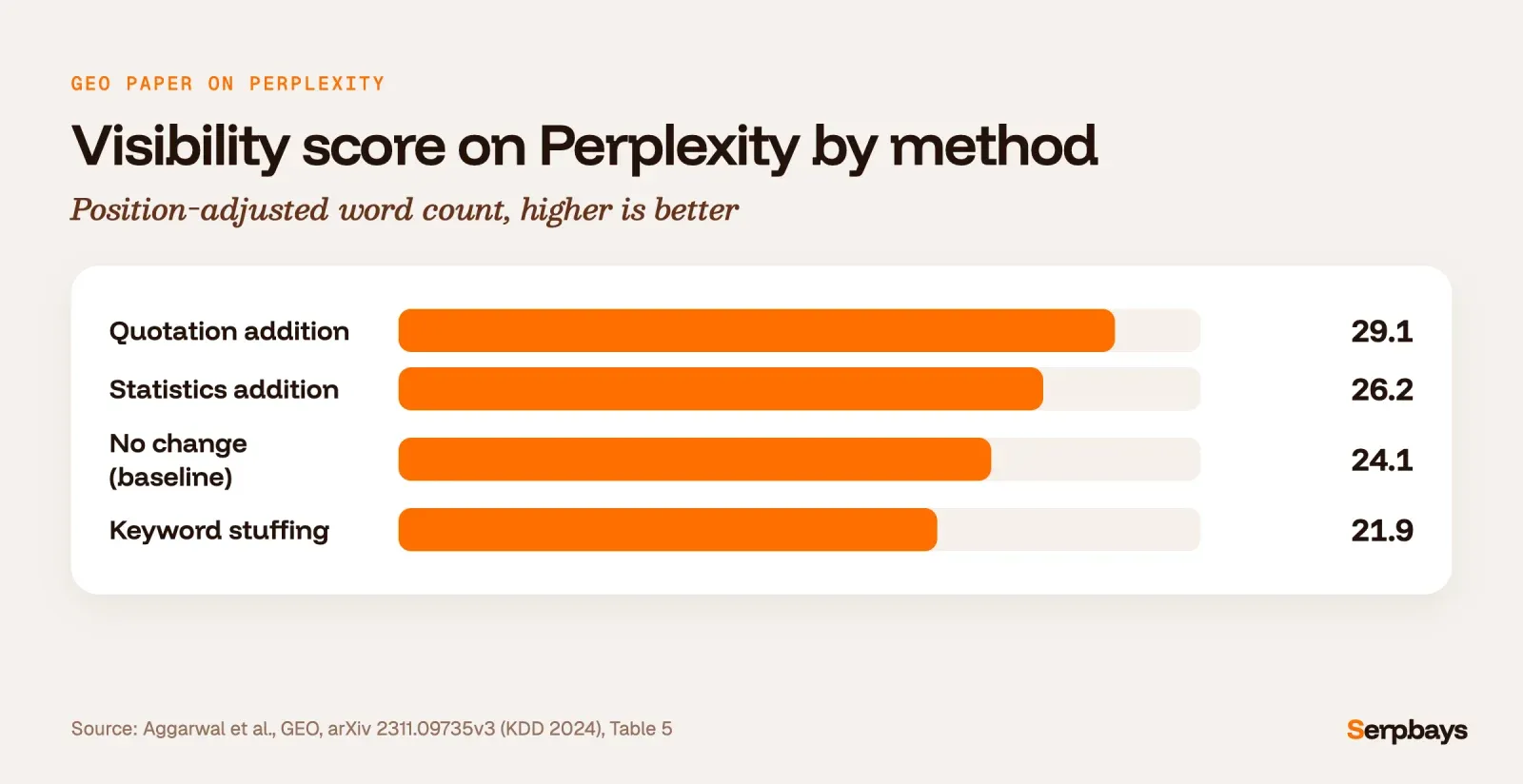
Quotations, statistics and cited sources won, with a 30-40% relative gain on the word-count metric. Keyword stuffing and unique words did little or nothing. Our LLM SEO guide charts those scores, so here are three findings it skips.
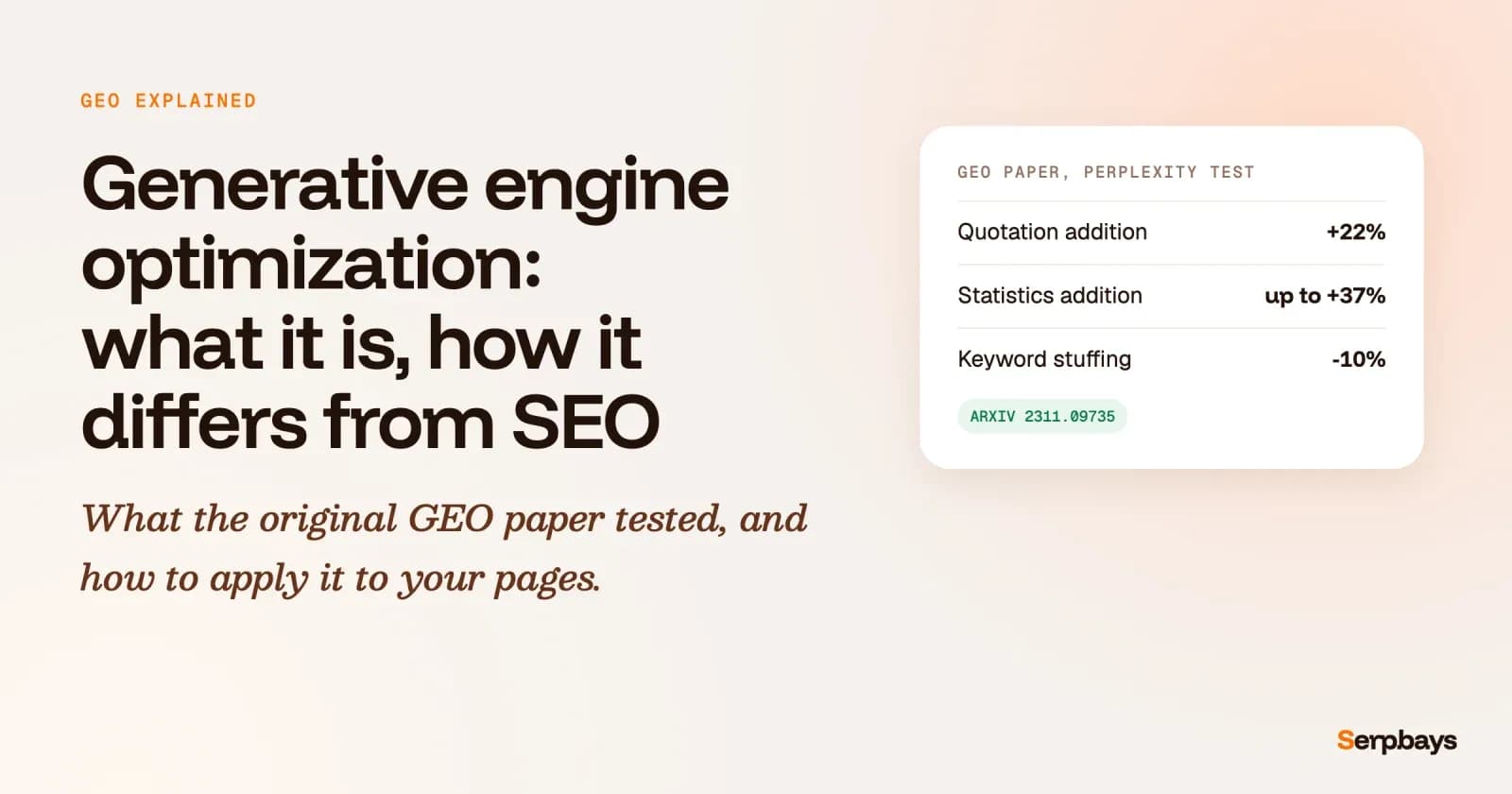
It held up on a live engine, with a caveat. On a 200-query sample run through Perplexity, Quotation Addition gained 22% on position-adjusted word count and Statistics Addition up to 37% on the subjective metric. Keyword stuffing came in 10% worse than doing nothing on position-adjusted word count.
The caveat: the authors uploaded the source texts as files, because Perplexity doesn't let you pick which URLs it searches. That tests how it writes answers, not how it retrieves pages.
Methods stack. The best pair was Fluency Optimization plus Statistics Addition, which beat any single method by more than 5.5%. Cite Sources was weaker alone but averaged a 31.4% gain when combined with other methods.
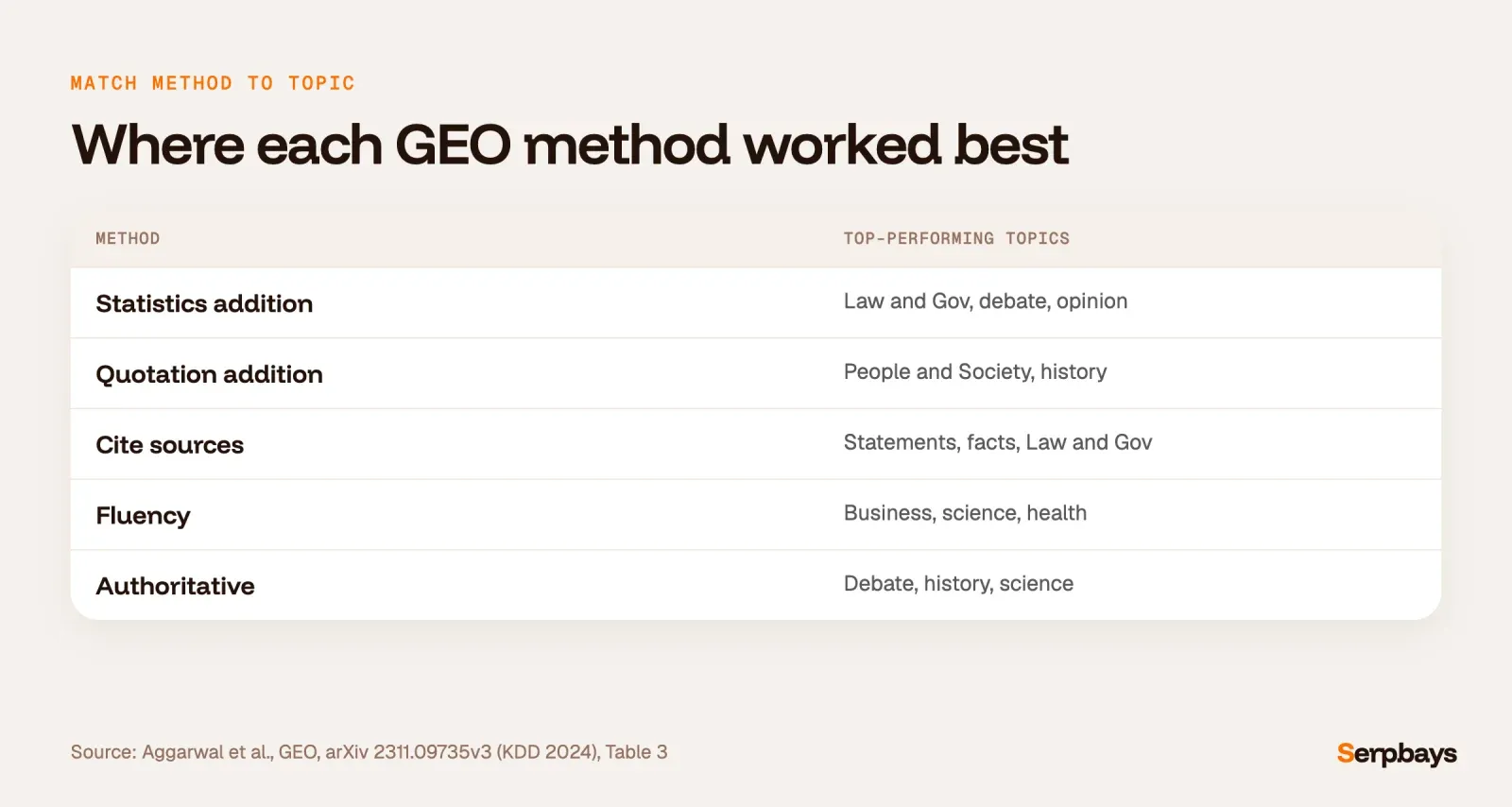
The best method depends on the topic. Table 3 of the paper (v3, June 2024) lists where each method worked best. Statistics did best for Law and Government and for opinion questions. Quotations did best in People and Society, Explanation and History. Fluency did best in Business, Science and Health.
What do generative engine optimization examples look like?
The paper's Table 4 shows three before-and-after edits. They are small, and that is the point.
- Cite Sources, +132.4% visibility. For "What is the secret of Swiss chocolate", the edit added an attribution to a consumption survey after a sentence about Swiss per-capita chocolate consumption.
- Statistics Addition, +65.5%. For "Should robots replace humans in the workforce?", the edit added a percentage figure about the rise in robotic involvement.
- Authoritative, +89.1%. For a question about the Jacksonville Jaguars, the edit only changed tone, adding emphasis and confident phrasing.
The authors' own caption: "Without adding any substantial new information, GEO methods significantly increase the visibility of the source content."
Here is where I part ways with how this gets sold. These rewrites were machine-generated for a benchmark.
On your site, a statistic you can't source is a liability, not an optimisation. Every number you add needs a real origin you can link to, or you are teaching AI engines to repeat something false under your name.
GEO vs SEO: what is actually different?
The honest answer to "what is the difference between SEO and GEO" is: the goal and the measurement change, the foundation does not.
| SEO | GEO | AEO | |
|---|---|---|---|
| Goal | Rank a page in a list of links | Be quoted and cited inside a generated answer | Be the single direct answer |
| Unit of success | Position and clicks | Share of the answer and citation position | Featured snippet or spoken answer |
| Main levers | Relevance, links, technical health | Sourced statistics, quotes, citations, clear prose | Question-and-answer formatting |
| Where it shows | Google and Bing results | AI Overviews, ChatGPT search, Perplexity | Snippets, voice assistants, AI answers |
| Origin | 1990s search | 2023 academic paper | Featured snippet and voice era |
Now the misunderstood point. The paper's engine only read the top 5 Google results, and live engines also retrieve before they write. If your page is not retrieved, no rewrite can help it.
So GEO SEO is not a choice between two things: SEO gets you into the room, GEO decides how loudly you speak once you are there.
Google says much the same in its guidance on AI features: "The best practices for SEO remain relevant for AI features in Google Search." It adds that there are no additional requirements or special optimisations needed to appear in AI Overviews or AI Mode, beyond being indexed and eligible for a snippet. Its newer guide to generative AI features (May 2026) adds one condition: the site must be included under the Search generative AI control in Search Console. That is the default; since 31 August 2026 owners can opt a site out.
There is good news for smaller sites. Lower-ranked sources gained the most from GEO edits, and the authors called it a way to "democratize the digital space". In other words, position 5 is not the dead end in an AI answer that it often is in a list of links.
One limit: the authors did not test whether GEO edits change Google rankings. In my experience sourced numbers and named quotes don't hurt rankings, but that is opinion, not a finding.
Where does AEO fit in (GEO vs AEO)?
Answer engine optimization (AEO) is the older label. It grew out of featured snippets and voice assistants, where one source wins the answer and everyone else gets nothing.
GEO describes a different result: an answer stitched from several sources, where you can own a big or small slice. The tactics overlap almost completely, so I don't run separate AEO and GEO programmes for clients. I run one, with GEO's measurement, because "share of the answer" is a better question than "did we win the box".
How do you apply GEO to your own pages?
Here is the on-page process I use, built from the paper and Google's guidance. It assumes crawler access is sorted; if not, start with the robots.txt section of the LLM SEO guide linked above.
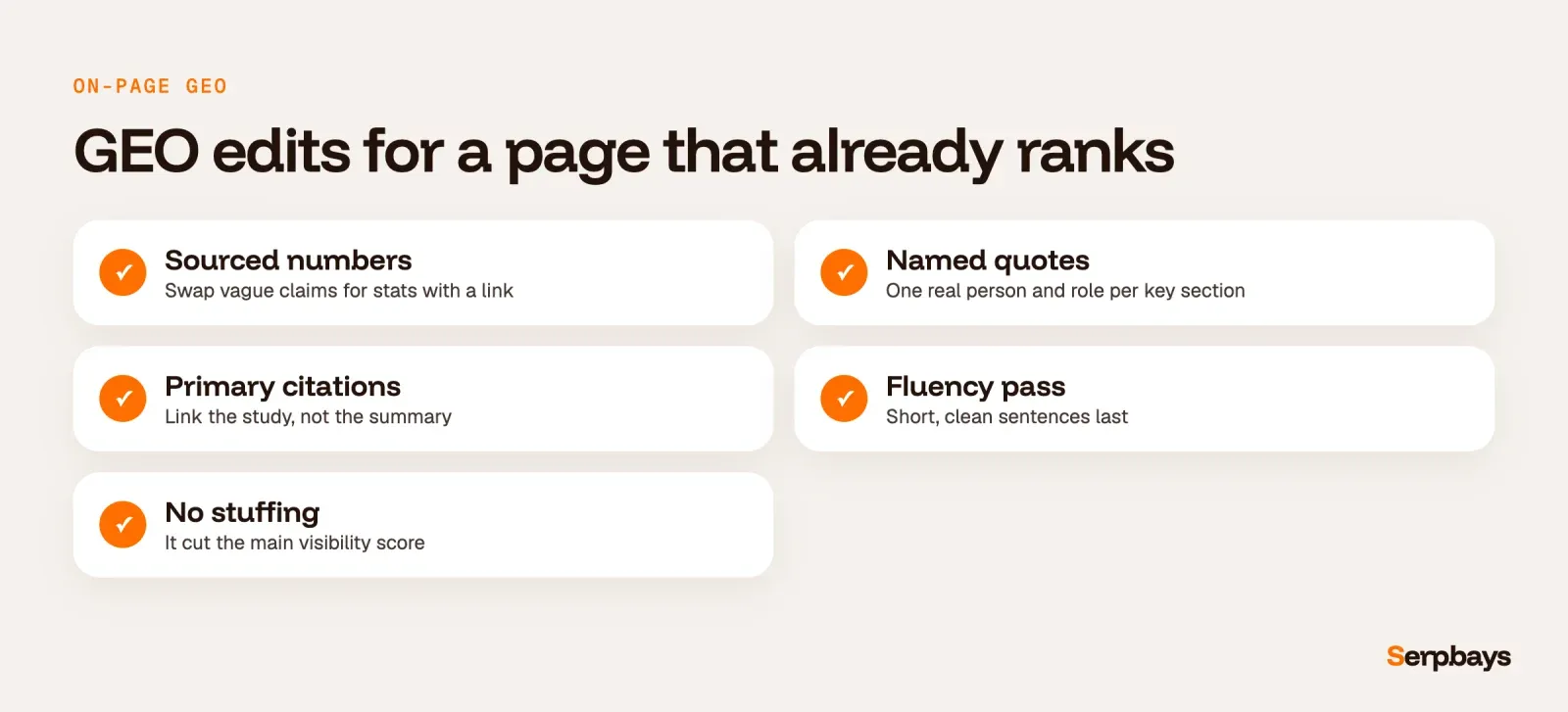
- Pick pages that already rank 3 to 10. They are likely to be retrieved, and the paper found lower-ranked sources gained the most.
- Replace vague claims with sourced numbers. "Prices vary a lot" becomes a median with a source and a date.
- Add one named quote per key section. A real person, their role, their words.
- Cite the primary source, not the blog that summarised it.
- Edit for fluency last. Fluency plus statistics was the best pair in the paper. Our free readability checker flags long, tangled sentences.
- Match the method to the topic. Legal and policy pages lean on statistics; people and history pages on quotes.
- Don't stuff keywords. It lowered the main visibility score, both on the paper's own engine and on Perplexity.
- Keep structured data honest. Google asks that markup match the visible text. The JSON-LD schema generator helps, and the bulk noindex checker catches pages that are blocked from indexing.
Google's own May 2025 post by John Mueller points the same way: "Focus on making unique, non-commodity content." A page that only restates what nine other pages say gives an engine no reason to quote it.
Does GEO happen off your site too?
Yes, and this is where GEO meets link building. A generative engine writes from several sources. If a publication that ranks for your topic quotes your data or names your product, you are inside the answer even when your own page isn't retrieved.
So the paper's methods double as an off-site brief: give publishers a sourced statistic or a quotable line from a named person at your company.
On the Serpbays marketplace, the topic tags line up with the paper's domains. As of 18 Nov 2026 there are 4,378 live listings tagged Technology, 5,891 tagged Business and 2,787 tagged Law and Government (Serpbays data; publishers choose the tags and a site can carry several). Excluding DR 80+ listings, the median link insertion price is $144 for Technology and Business and $196 for Law and Government.
My opinion: pick publications that already get cited when you run your buyer's questions through AI search, not the highest-DR ones. Our AI backlinks service works from that list, and the guide to brand mentions covers the unlinked side.
How do you measure GEO results?
Borrow the paper's idea, not its maths. Write 20 questions your buyers ask and run them in the engines you care about each month.
For each answer, note whether you are cited, how many sentences draw on your page, and whether your citation appears near the top or the bottom.
That is a hand-run version of position-adjusted word count, and it tells you more than a yes-or-no "were we mentioned". For Google, Search Console's Generative AI performance report (live for all sites since 31 August 2026) adds AI Overview and AI Mode impressions by page, though no clicks. For paid tracking tools, see how to get cited by ChatGPT.
FAQ
What is the difference between SEO and GEO?
SEO ranks a page in a list of links, measured by position and clicks. GEO gets a page quoted and cited inside an AI-generated answer, measured by how much of the answer draws on it. GEO depends on SEO, because engines only write from pages they retrieve.
What is answer engine optimization (AEO), and is it the same as GEO?
AEO is the older term from featured snippets and voice search, focused on being the one direct answer. GEO, named in a 2023 research paper, focuses on your share of an answer built from several sources. The tactics overlap so much that most teams treat them as one discipline.
Is generative engine optimization replacing SEO?
No. Google says SEO best practices still apply to its AI features, and the GEO paper's own test engine only read the top 5 Google results. GEO is a layer on top of SEO, not a substitute for it.
Your next step
Open the page that brings you the most leads and find its three vaguest claims. Replace each with a sourced number, a named quote or a citation to the original study. Then run your top five buyer questions through Perplexity and Google, note who gets cited, and check again in a month.
Vinayak Gupta is the founder of Serpbays and Wordscloud, with hands-on experience in SEO, content marketing, publisher outreach, and link building. He has worked with SEO agencies, SaaS companies, and digital brands to plan content strategies, evaluate backlink opportunities, and build authority through high-quality placements. At Serpbays, he focuses on making link building more transparent, reliable, and easier for agencies and businesses.
View profile →