Brand Mentions: How to Track Them and Turn Unlinked Ones Into Links
Brand mentions explained: linked vs unlinked, how to track them with Google Alerts and other tools, how to turn unlinked mentions into links, and what the AI search data really shows.
· · 11 min read
Search your brand name in quotes on Google, leave out your own domain, and count how many of those pages link back to you. In my experience, a fair share of them won't. Every one of those pages is a publisher who already likes you enough to write your name, and who forgot the link.
That gap is what this guide is about. We'll cover what brand mentions are, how linked and unlinked mentions differ, how to track them with Google Alerts and four other tools, how to turn unlinked ones into links, and what the evidence actually says about mentions and AI search.
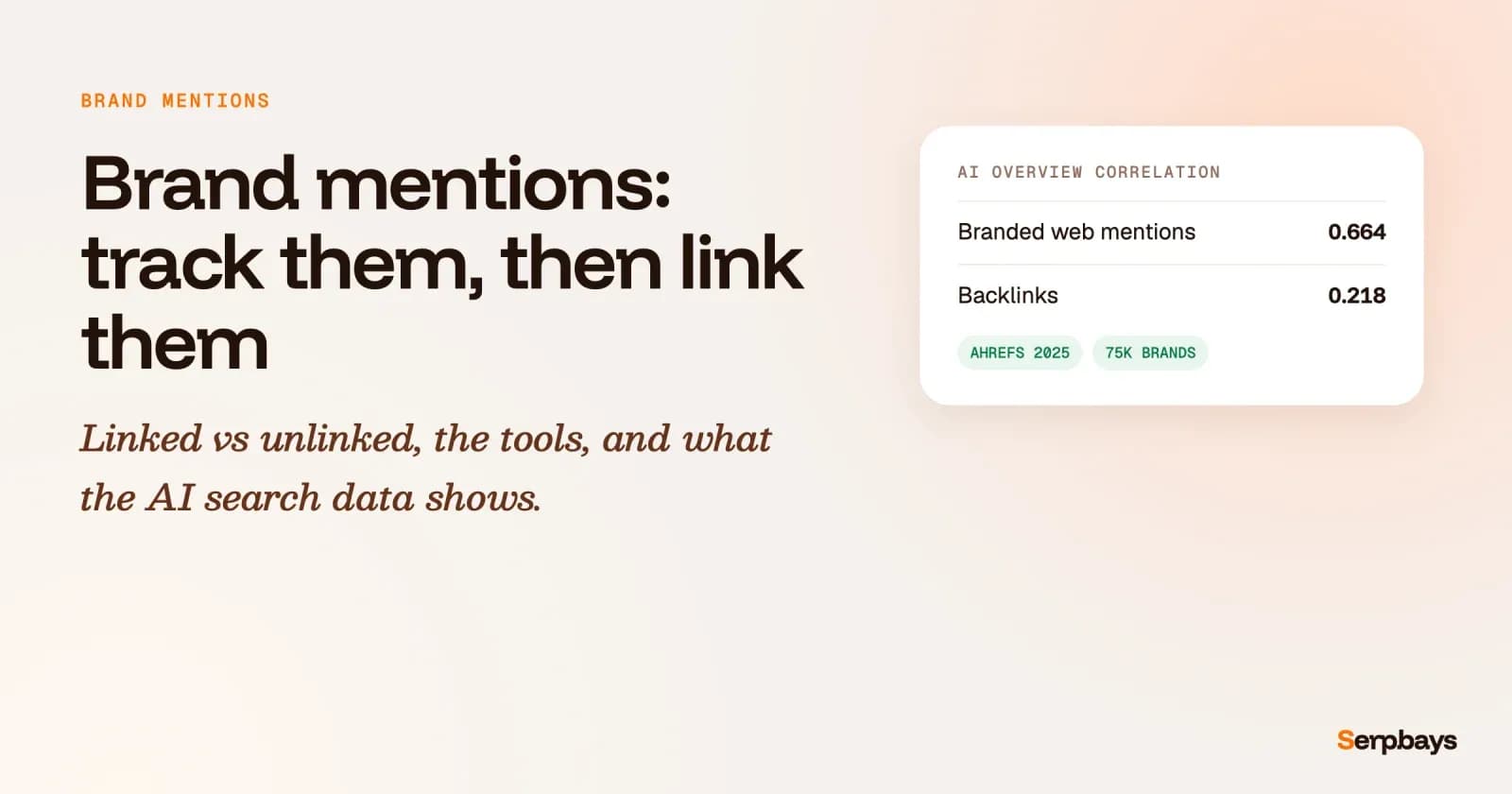
Short answer: Brand mentions are any reference to your company, product or founder on a page you don't own, with or without a hyperlink. Linked mentions are backlinks, and Google says it uses links as a signal of relevance. Unlinked mentions pass no link, but you can often get them converted with a short, polite email, and a 2025 Ahrefs study of 75,000 brands found web mentions correlated more strongly with AI Overview visibility than backlinks did.
What are brand mentions?
A brand mention is any place on the web where someone names your brand. That includes a news article quoting your CEO, a review of your product, a "best tools" listicle, a forum thread or a podcast show notes page.
So the answer to "what are brand mentions" is simple. The useful part is the split:
- Linked mentions: your brand name appears and the page links to your site. This is a backlink.
- Unlinked brand mentions: your brand name appears with no link. The reader can find you, but no link signal passes.
- AI brand mentions: your brand appears inside an answer from ChatGPT, Perplexity, Gemini or a Google AI Overview. Sometimes with a cited source, sometimes not.
Each type needs a different kind of tracking, and only the first two are things you can directly ask a person to change.
Do brand mentions help SEO, or only backlinks?
Start with what Google actually documents. Its link best practices page on Search Central (last updated December 2025) says: "Google uses links as a signal when determining the relevancy of pages and to find new pages to crawl." That's a statement about links. The page doesn't describe unlinked mentions as a signal.
So for brand mentions SEO, here's my position. A linked mention is a backlink and should be treated like one: check the site, the page and the anchor.
An unlinked mention is a lead. It may help indirectly (people search your name after reading it, and AI systems read the text), but nobody outside Google can show you how much it counts for rankings. Anyone who gives you a precise number for it is guessing.
That's also why "brand mentions backlinks" is a reasonable search. The fastest backlink most brands will ever get is the one where the publisher already wrote the sentence and only the link is missing.
One caution. If a publisher asks for money to add the link, it stops being a correction and becomes a paid link. Google's same page says paid links should be qualified with rel="sponsored" or rel="nofollow". Decide up front if this is free reclamation or a paid placement, and don't mix the two in one email thread.
How to track brand mentions: Google Alerts and four other tools
If you're asking how to track brand mentions, the honest answer is to use two layers: a free alert for new mentions and a manual search for old ones. Alerts only catch what gets published after you set them up.
Google Alerts for brand mentions
Google Alerts is still the place most people start. According to Google's own help page, you enter a topic, click "Show options" and choose how often you get notifications, the types of sites, the language, the region, how many results you want and which account gets the alert. Then Google emails you when it finds matching results.
Set up one alert per variant: the exact brand name in quotes, the product names, and the founder's name. Add misspellings if people get your name wrong.
The manual search that alerts miss
To find unlinked brand mentions that already exist, use Google search operators. Google's search operators help page lists quotes for exact match, a minus sign to exclude a word, site: for one domain, and before: and after: for dates.
A query like "Serpbays" -site:serpbays.com after:2026-01-01 shows pages updated since 1 January 2026 that name us and aren't on our own domain.
Paid and free tools compared
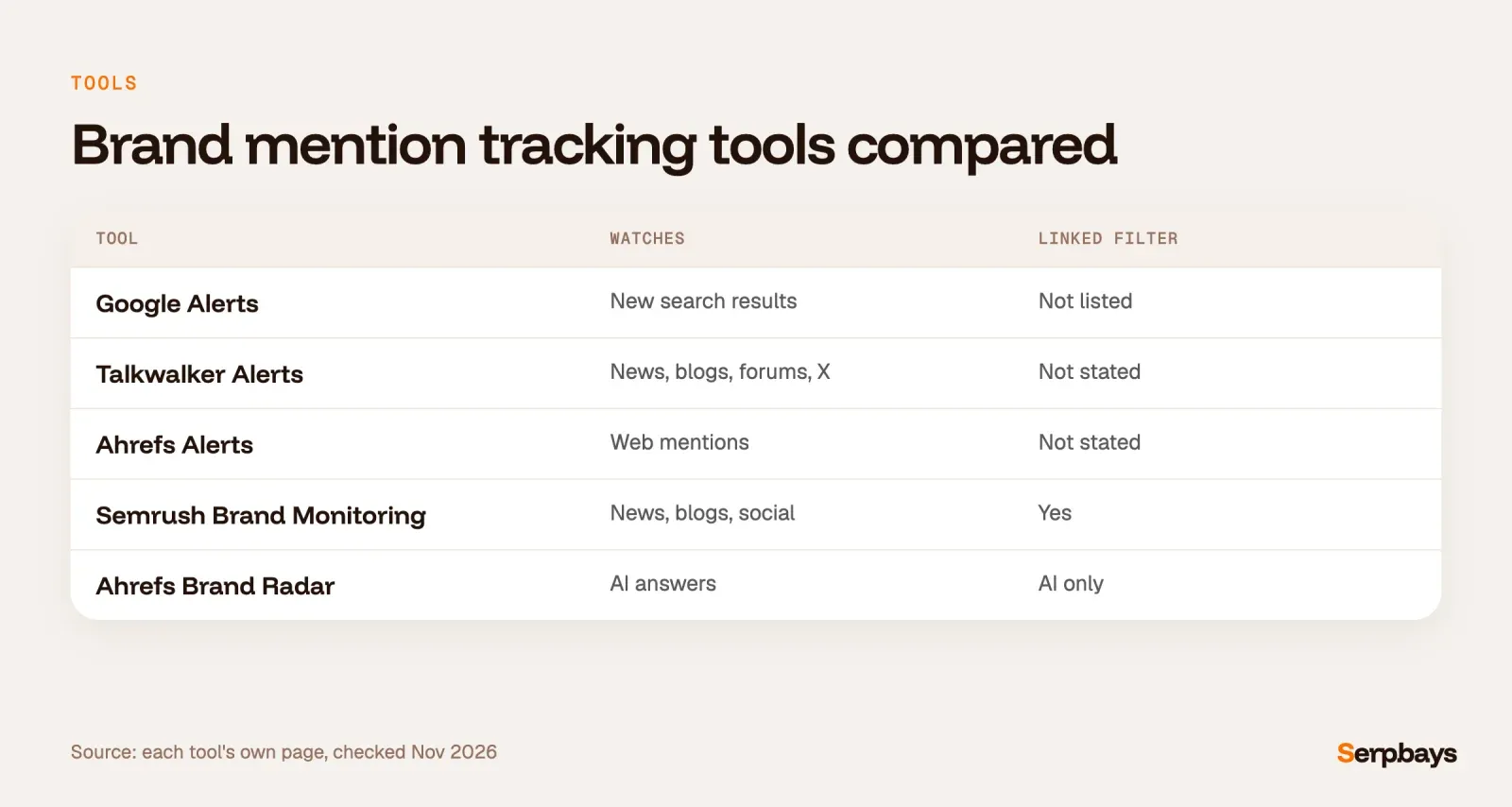
Here's what each tool says about itself on its own page, checked in November 2026:
| Tool | What it watches | Linked vs unlinked filter |
|---|---|---|
| Google Alerts | New Google search results for your topic, by email | No such option listed |
| Talkwalker Alerts | News, blogs, forums, websites and X; free, by email, RSS or Slack | Not stated |
| Ahrefs Alerts | Web mentions of your brand, competitors or keywords | Not stated |
| Semrush Brand Monitoring | News, blogs, discussions and social channels; paid app, $79 a month with 3 queries | Yes, a backlinks filter shows mentions with or without a link to your URL |
| Ahrefs Brand Radar | Mentions and citations inside AI Overviews, AI Mode, ChatGPT, Perplexity, Gemini and Copilot | Tracks AI answers, not web pages |
If you only want to monitor brand mentions for link reclamation, the linked vs unlinked filter is the feature that saves you hours. Without it, you open every result and search the page source for your domain yourself.
How to find unlinked brand mentions and turn them into links
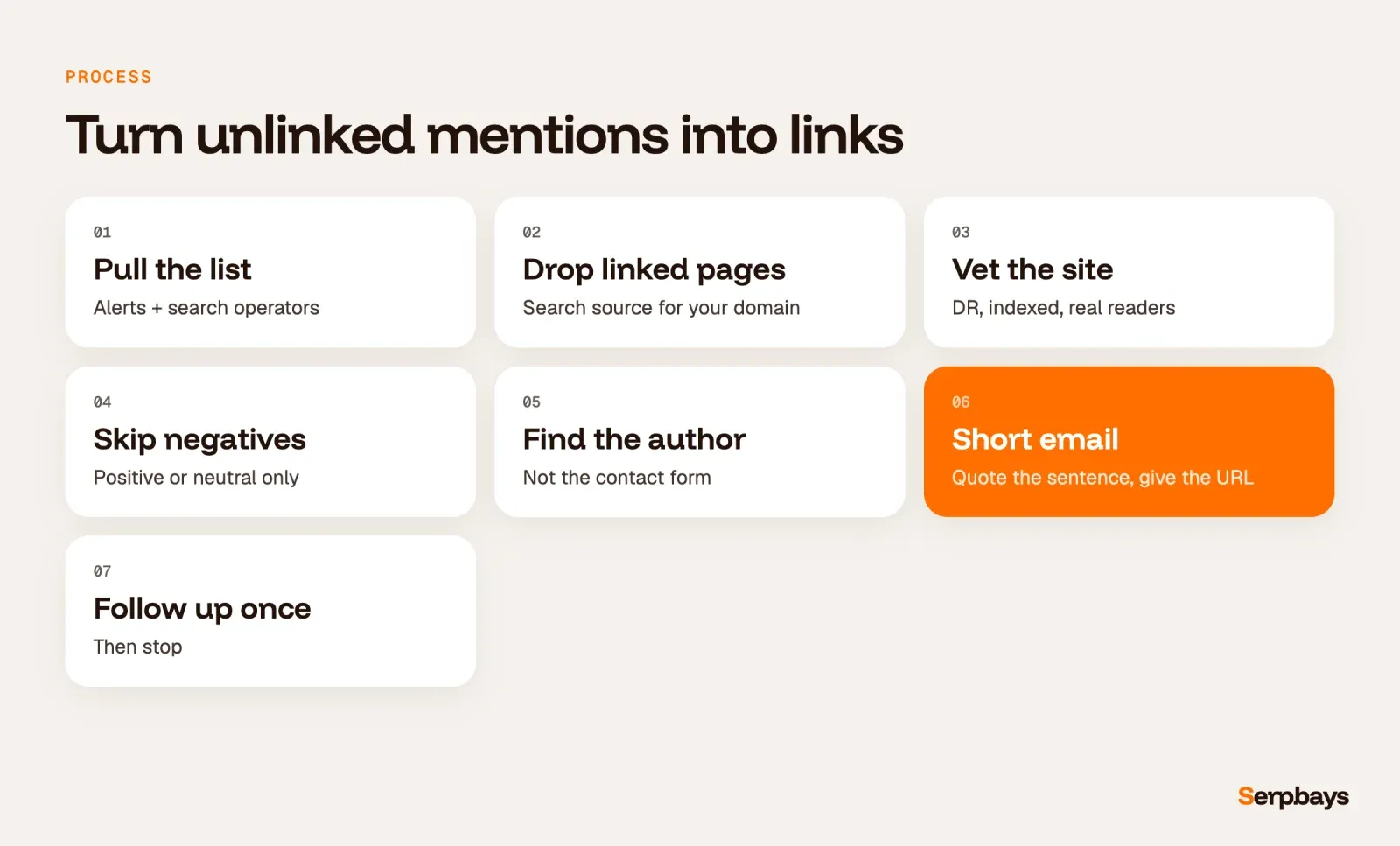
This is the part most guides skip. Here's the process we use, step by step:
- Pull the list. Export results from your alerts and the manual operator search into one sheet. One row per URL.
- Remove the ones that already link. Open each page, view the source and search for your domain. Drop anything that already links to you.
- Vet the site. Check the domain's strength with our free Domain Rating checker, and look at whether the page is indexed and has real readers. A mention on a scraper site isn't worth an email.
- Skip negative context. If the article criticises you, asking for a link reads badly. Reply to the substance first, or leave it.
- Find the right person. The author of the article, not the generic contact form. Bylines and author pages usually show how to reach them.
- Send a short email. Thank them, name the article, quote the sentence, and suggest the exact URL. Make it a 10-second edit for them.
- Follow up once, then stop. One polite reminder after a week. More than that burns the relationship.
On the link itself: ask for your brand name as the anchor, since it's already the word on the page. Exact-match keyword anchors on a converted mention look odd and are hard to justify. Our guide to safe anchor text ratios explains why branded anchors should carry most of your profile anyway.
If you'd rather not run this yourself, that's exactly what our brand mention link building service does: scan the web for your brand, filter for unlinked mentions worth chasing, and contact the publishers. It's a brand mentions service for teams that don't have time for weekly outreach.
Do brand mentions matter for AI search visibility?
This is where the hype is loudest, so I'll stick to what I could verify.
The best public data point is a May 2025 Ahrefs study by Louise Linehan, with data science by Xibeijia Guan. They looked at 75,000 brands (domains above DR 40) and used Ahrefs Brand Radar to count mentions across millions of AI Overview responses. About 26% of the brands had no mentions at all, so the analysis covered the rest.
The Spearman correlations they report:
- Branded web mentions: 0.664
- Branded anchors: 0.527
- Branded search volume: 0.392
- Domain Rating: 0.326
- Number of referring domains: 0.295
- Number of backlinks: 0.218
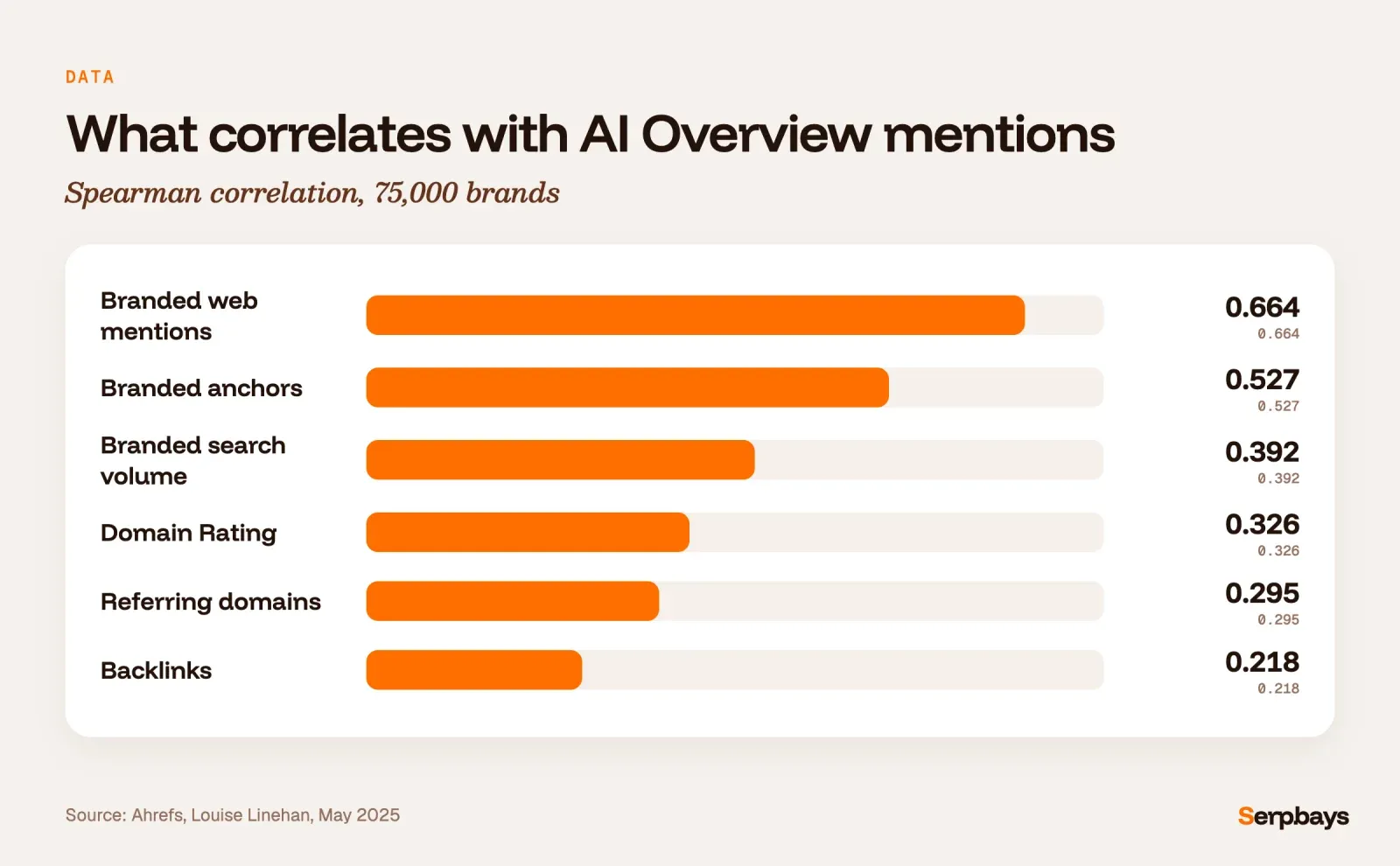
Two things to read carefully. First, the authors themselves say correlation is not causation, and that engineering brand visibility in AI search is "not a perfect science right now". Big brands get mentioned more and also appear in AI answers more; the study can't separate those.
Second, it measured Google AI Overviews only. It doesn't tell you how ChatGPT or Perplexity pick brands.
Notice that branded anchors (0.527) sit second. That's a link signal that carries your brand name, which is one more reason to ask for your brand as the anchor when you reclaim a mention.
Google's own page on AI features says a page must be indexed and eligible to show in Search with a snippet to be used as a supporting link. So a mention on a page Google hasn't indexed won't help here either. Google's 2026 guide to generative AI features adds a warning: seeking inauthentic "mentions" across the web "isn't as helpful as it might seem".
My take: AI brand mentions are worth building, but as a by-product of being written about on real sites, not as a separate trick. How AI engines crawl, retrieve and cite pages is a different topic, covered in our guides to generative engine optimization, LLM SEO and getting cited by ChatGPT.
How do you track brand mentions in AI answers?
To track brand mentions in AI, there are two routes.
The free route: write 10 to 20 prompts your buyers would actually type ("best X for Y", "X vs Y"). Run them in ChatGPT, Perplexity, Gemini and Google once a month, and log if you're named and which sources are cited.
The paid route: a tracker. Ahrefs Brand Radar, for example, says on its product page that it covers AI Overviews, AI Mode, ChatGPT, Perplexity, Gemini and Copilot, and that each prompt is checked daily. Run the manual version for a month first so you know which prompts matter.
The cited sources column is the useful one for mention building. If an assistant keeps citing the same three review sites and listicles, those go to the top of your outreach list.
Where do new mentions come from?
Reclamation only works on mentions you already have. To get new ones, you need to be written about, and that mostly means news, industry and review sites.
For a sense of supply: on 5 November 2026, 10,060 of the 24,356 live listings on the Serpbays marketplace were tagged News & Media (a site can carry more than one category).
Excluding DR 80 and above, where 307 of the 386 news listings are subdomains of one Polish regional news portal, the median listed guest post price in that category was $223, with the middle half between $98 and $380 (Serpbays data, 5 November 2026). You can browse them on the news and media backlinks page.
Earned routes still work too. Journalist request platforms are covered in our guide to HARO alternatives, and original data is still the most reliable way to get cited without asking, as our post on content marketing for link building shows. If you want it handled end to end, our digital PR service writes the article and places it with a publication, and you pay only when it's published.
What I'd avoid: buying hundreds of thin "brand mention" placements on sites nobody reads. If a page has no traffic and isn't indexed, no person and no AI system will see your name on it.
FAQ
What are some effective brand monitoring tools?
For new mentions, Google Alerts and Talkwalker Alerts cover most needs. For link reclamation, Semrush Brand Monitoring has a backlinks filter that separates linked from unlinked mentions. For AI answers, Ahrefs Brand Radar tracks AI Overviews, ChatGPT, Perplexity, Gemini and Copilot.
How do I monitor brand mentions for free?
Set up Google Alerts or Talkwalker Alerts for each brand and product name, run a monthly search like "YourBrand" -site:yourdomain.com, and test a fixed list of buyer prompts in AI assistants each month.
Are unlinked brand mentions worth chasing?
Yes, when the site is real, indexed and positive about you. The publisher already wrote the sentence, so the ask is small. Skip scraper sites and negative articles.
Your next step
Today, run one search: your brand name in quotes, minus your own domain. Open the first 20 results, mark which ones don't link to you, and email the author of the best one. If the list is longer than you have time for, send it to us and our team will work through it with you.
Vinayak Gupta is the founder of Serpbays and Wordscloud, with hands-on experience in SEO, content marketing, publisher outreach, and link building. He has worked with SEO agencies, SaaS companies, and digital brands to plan content strategies, evaluate backlink opportunities, and build authority through high-quality placements. At Serpbays, he focuses on making link building more transparent, reliable, and easier for agencies and businesses.
View profile →