LLM SEO in 2026: How to Get Cited by ChatGPT, Claude, Gemini and Perplexity
How each AI engine finds content, the robots.txt settings that decide if you can appear, what research says gets cited, and a 30-day LLM SEO plan.
· · 12 min read
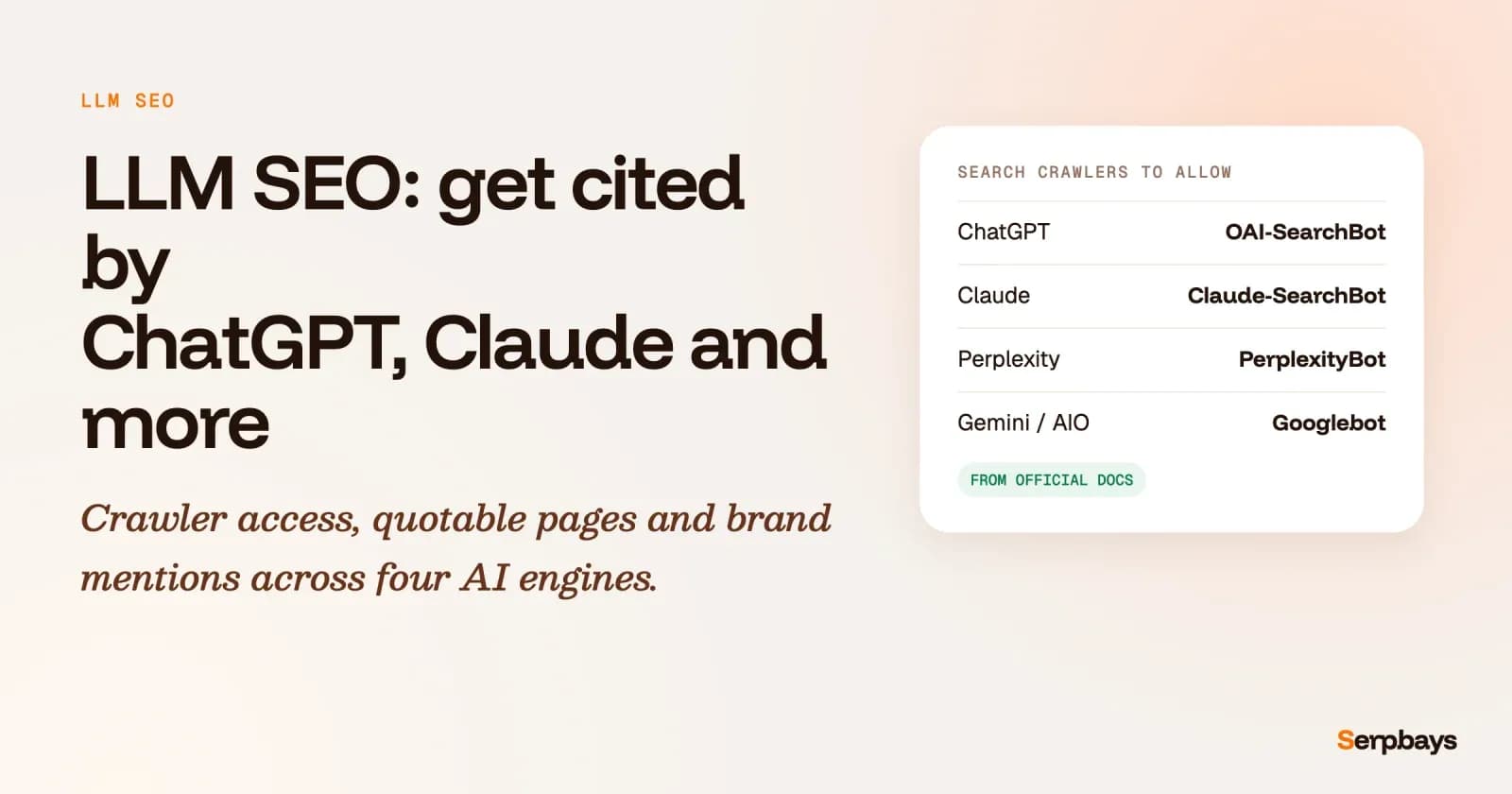
You can rank on page one of Google and still never be named by ChatGPT. I see it all the time: a site with solid rankings, a robots.txt that blocks every AI crawler "to be safe", and almost no one outside its own blog writing the brand name.
That is the whole problem LLM SEO tries to solve. Your Google rankings do not carry over automatically to ChatGPT, Claude, Gemini or Perplexity, because each engine finds, reads and trusts sources through its own pipeline. This guide covers all four engines, from crawler access to what gets cited and how to track it.
Short answer: LLM SEO is the work of getting your brand mentioned and cited in answers from ChatGPT, Claude, Gemini and Perplexity. It rests on three things: letting each engine's search crawler reach your pages, publishing pages with specific, quotable facts, and getting your brand named on third-party sites the models already trust. Off-site brand mentions showed the strongest correlation with Google AI Overview visibility in Ahrefs' study of 75,000 brands.
What is LLM SEO, and how is it different from Google SEO?
LLM SEO (you will also see it called SEO for LLMs, LLM optimization, generative engine optimization or GEO, and answer engine optimization or AEO) is optimising for answers instead of a ranked list. In classic search you win a position and hope for a click. In an LLM answer you either get named, or get cited as a source, or you are invisible.
The labels overlap so much that I treat them as one discipline. The useful split is not GEO versus AEO. It is training data versus live retrieval:
- Training data is what a model learned before its cutoff. You influence it slowly, mostly by being written about across the web.
- Live retrieval is when the engine searches the web at answer time and cites what it finds. You influence it in weeks, through crawl access and page quality.
Most of the brand-level wins come from retrieval, because that is where citations with links appear. That is why the crawler settings below matter more than any content trick.
If you only care about one engine, our guide on how to get cited by ChatGPT goes deeper on ChatGPT SEO specifically. This post is the wider map.
How do ChatGPT, Claude, Gemini and Perplexity find your content?
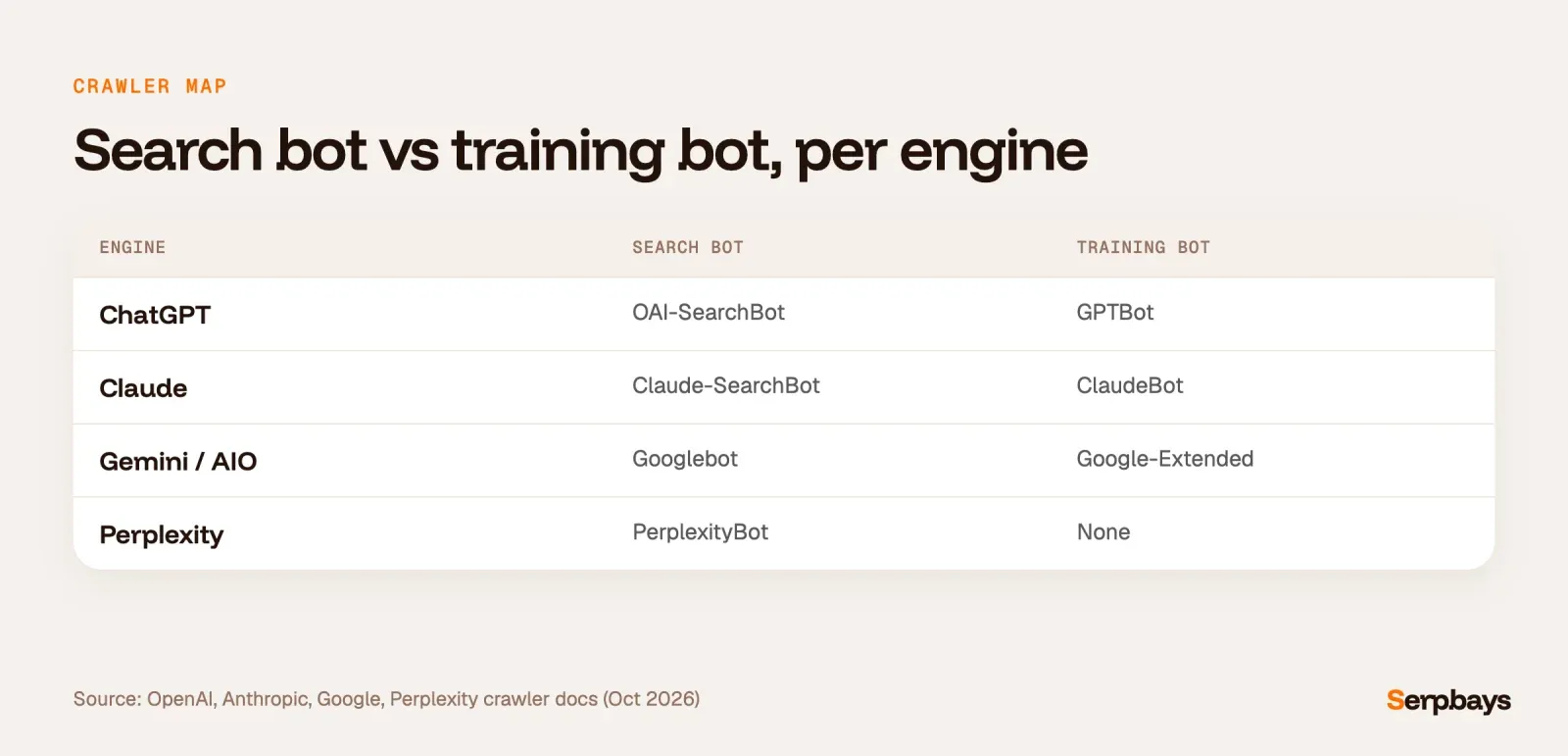
Every major engine now lets you control search access separately from training (Google does it with a robots.txt token rather than a separate bot). This is the single most misunderstood part of LLM SEO.
People block "AI bots" to protect their content and remove themselves from AI search by accident.
What each company's own documentation says, as of October 2026:
| Engine | Search / answer crawler | Training crawler | What the docs say about blocking |
|---|---|---|---|
| ChatGPT (OpenAI) | OAI-SearchBot | GPTBot | Sites opted out of OAI-SearchBot "will not be shown in ChatGPT search answers" (they can still appear as navigational links). Each setting is independent. |
| Claude (Anthropic) | Claude-SearchBot, Claude-User | ClaudeBot | Blocking Claude-SearchBot "may reduce your site's visibility and accuracy in user search results". |
| Gemini and AI Overviews (Google) | Googlebot (normal Search index) | Google-Extended token (also covers grounding in Gemini Apps) | Google-Extended "does not impact a site's inclusion in Google Search" and is not a ranking signal. |
| Perplexity | PerplexityBot, Perplexity-User | None (PerplexityBot is not used for foundation model training) | Allow PerplexityBot to appear in Perplexity search results. |
Sources: OpenAI's crawler documentation, Anthropic's crawler help article, Google's common crawlers page and Perplexity's bot guide.
OpenAI says its user-triggered fetcher, ChatGPT-User, is not used to decide whether content can appear in search, and robots.txt rules "may not apply" to it because a person asked for the page.
Perplexity says its user-triggered fetcher, Perplexity-User, generally ignores robots.txt for the same reason. So the bots you can actually control for AI search are OAI-SearchBot, Claude-SearchBot and PerplexityBot, plus Googlebot for Google.
Which robots.txt settings matter for LLM SEO?
My default for a business site is simple. Allow every search crawler. Make the training decision separately, on purpose.
- Allow OAI-SearchBot, Claude-SearchBot, Claude-User, PerplexityBot and Googlebot. Blocking any of these removes you from that engine's live answers or shrinks your visibility in them.
- Decide on GPTBot, ClaudeBot and Google-Extended. These control training (and for Google-Extended, grounding in Gemini Apps and Vertex AI). Blocking them does not remove you from ChatGPT search or Google Search, per the docs above.
- Check your CDN. A bot-protection rule at the firewall can block crawlers your robots.txt allows. Test from the outside, not from your own dashboard.
OpenAI says robots.txt changes take about 24 hours to reach its search systems, and Perplexity says up to 24 hours too. If you want a clean file, our free robots.txt generator builds one with per-bot rules.
What about llms.txt? For Google, skip it: its generative AI guide says Google Search ignores llms.txt, so it "will neither harm nor help". Our llms.txt generator makes one in five minutes for other systems, but don't expect it to move citations.
Beyond being indexed and eligible for a snippet, Google adds one condition: the site must be included under Search Console's Search generative AI control. That is the default; since 31 August 2026 owners can opt out.
What kind of content do LLMs actually cite?
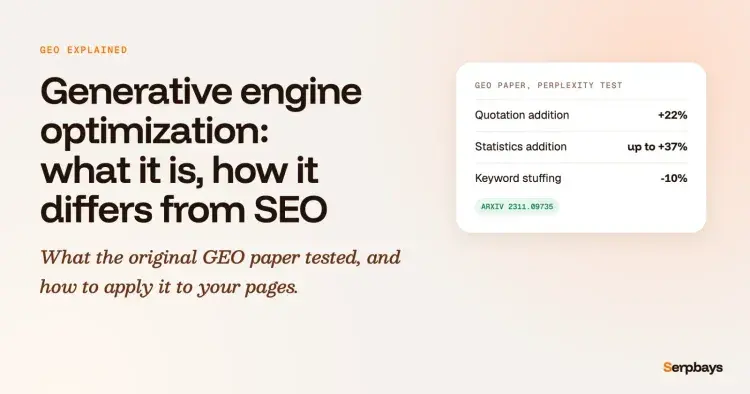
The best controlled test is still the GEO paper by Pranjal Aggarwal and five co-authors (arXiv 2311.09735, first posted November 2023 and accepted at KDD 2024). The authors rewrote source pages in different ways and measured how visible each source became inside generated answers.
Their headline: optimisation can boost visibility "by up to 40%" in generative engine responses. The methods that worked were boring and editorial. Adding quotations, adding statistics and citing sources gave the biggest gains, which the authors put at 30-40% on their main visibility measure. Keyword stuffing scored below the unedited baseline on that measure.
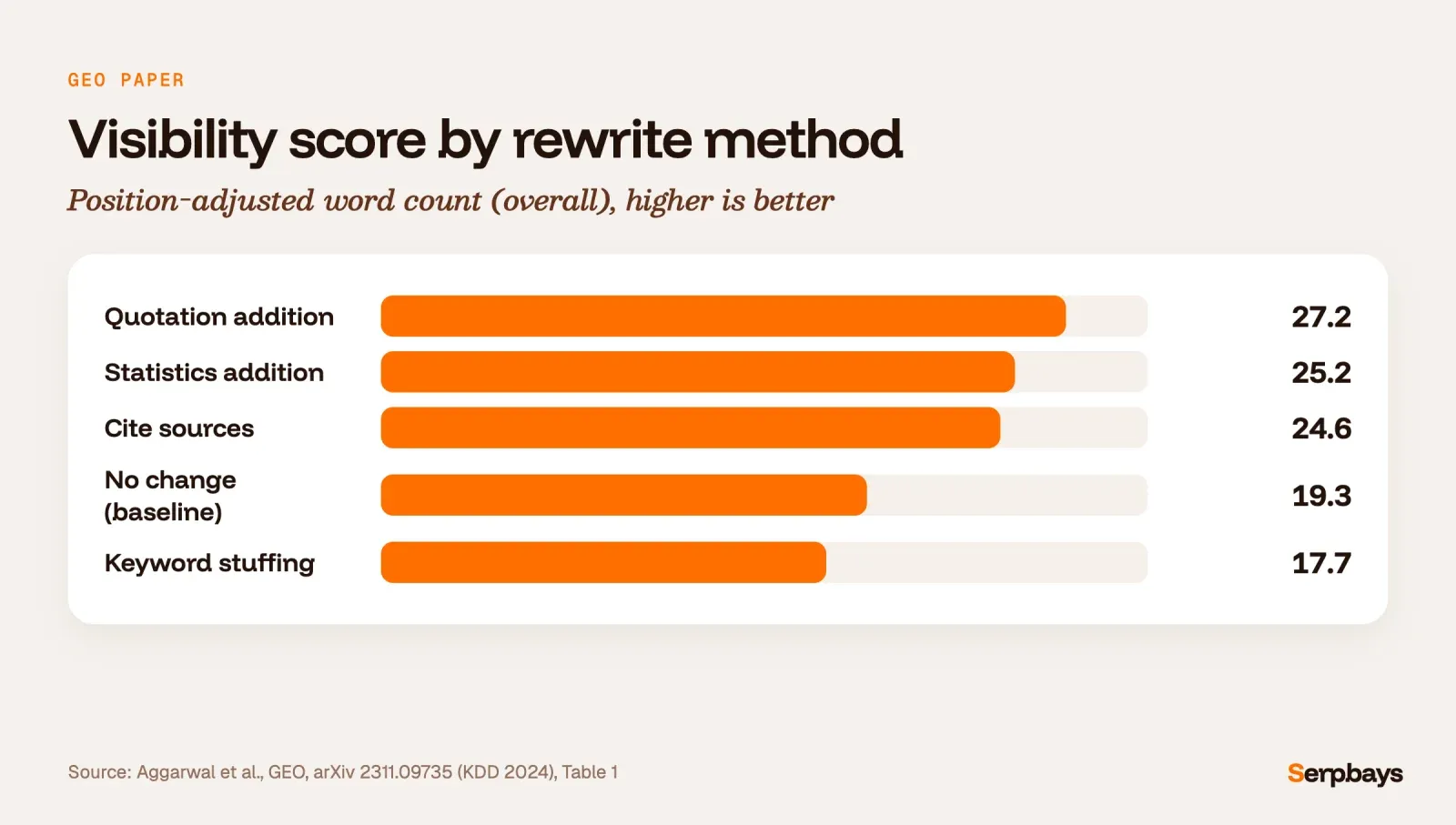
The part I find most useful: lower-ranked sources gained the most. In the paper's tests, the fifth-ranked source roughly doubled its visibility with these edits (+98% to +115%), while the top-ranked source lost some.
For a smaller brand, that is the opening. You do not need to be the biggest site. You need the most quotable page.
In practice, for each page you want cited:
- Answer the question in the first two or three sentences under each H2.
- Put a number with a named source in every section where one exists.
- Quote a real person (yours or a named expert), with their role.
- Keep one claim per sentence, so the engine can lift it cleanly.
Also keep in mind how Google builds AI answers. Its documentation says AI Overviews and AI Mode may use "query fan-out", running several related searches across subtopics to assemble one response. That rewards pages that cover the sub-questions around a topic, not only the head term.
Why do AI brand mentions matter more than backlinks?
This is where LLM SEO and link building meet. In a 2025 Ahrefs study of 75,000 brands (Louise Linehan, May 2025), the factor most correlated with being mentioned in Google AI Overviews was branded web mentions, at 0.664. Branded anchors came next at 0.527. Domain Rating scored 0.326, referring domains 0.295 and raw backlink count only 0.218.
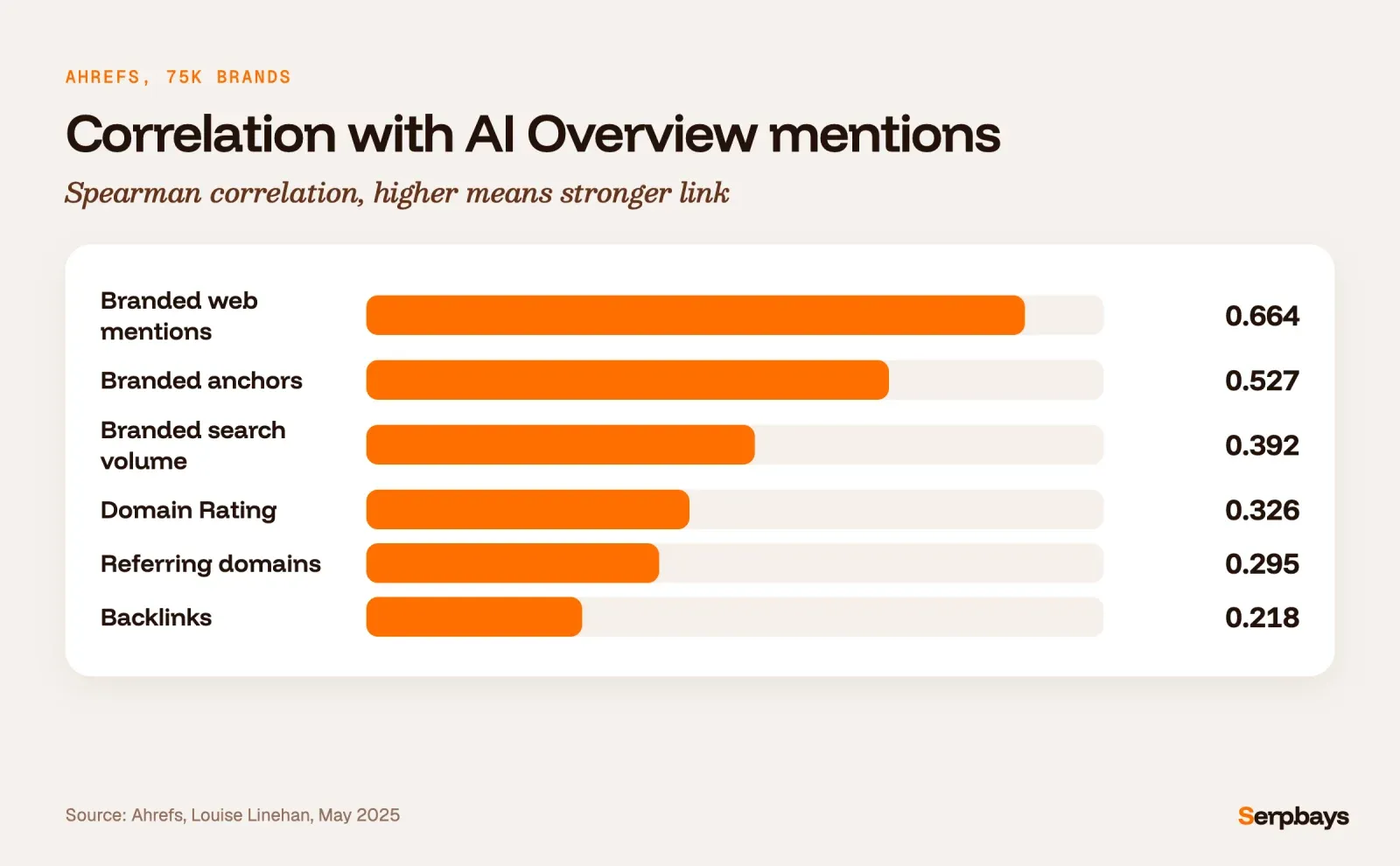
The gap at the top is huge. Brands in the top quarter for web mentions averaged 169 AI Overview mentions. Brands in the 50-75% band averaged 14.
These are correlations for one engine, not proof of cause, but they fit with how the models work: a brand that many trusted pages discuss is a brand the model "knows".
So AI brand mentions are the asset. A link is still useful, because it is usually a mention with an address attached. But a bare DR number is not the goal.
What you want is your brand name, in context, on publications that already show up in AI answers for your category. The types of backlinks guide covers how linked and unlinked mentions differ.
Where do those mentions come from? Mostly news and industry publications.
On the Serpbays marketplace, 10,058 live listings are tagged News and Media and offer a guest post (Serpbays data, 29 Oct 2026). Publishers choose these tags, and a site can carry several.
I left out the 386 listings at DR 80+, because 307 of them are subdomains of one Polish regional news portal listed cheaply, which drags the price down. Without them, the median listed guest post price is $223. By Ahrefs DR band, it runs $216 for DR 20-39, $270 for DR 40-59 and $360 for DR 60-79.
If a publication already appears in AI answers for your category, a link insertion into one of its existing articles is often quicker than a new guest post, in my experience.
My opinion, after running these campaigns: ten placements on real publications your buyers read beat fifty on generic "write for us" blogs, for Google and for LLMs. Expert-quote platforms also work; our HARO alternatives post lists the ones still producing editorial mentions.
How do you measure LLM SEO results?
There is no Search Console for ChatGPT yet. Google has its Generative AI performance report (impressions only, since 31 August 2026). Otherwise, measure three ways:
- A fixed prompt panel. Write 20-30 questions a buyer would ask ("best X for Y", "X vs Y", "is X worth it"). Run them monthly in ChatGPT, Claude, Gemini and Perplexity with search on. Log whether you are named, cited, or absent, and who is named instead.
- Referral traffic. Check analytics for visits from chatgpt.com, perplexity.ai, claude.ai and gemini.google.com.
- Branded search. If AI answers name you, more people search your name. Watch branded impressions in Search Console.
Paid trackers exist, and the ChatGPT guide compares them. For most brands I would run the manual panel for three months before paying for anything. It shows you which publications the engines lean on in your niche, and that becomes your outreach list.
For the on-page side, run your key pages through our free bulk noindex checker to catch indexing problems, and check your markup with the JSON-LD schema generator, before you start building mentions.
What is overrated in LLM SEO right now?
A few things I'd stop spending time on:
- Rewriting every page "for AI". Google says no special optimisation is needed for its AI features. Fix only the pages you want cited.
- Chasing schema as a magic switch. Google states no special schema is needed for AI Overviews. Structured data helps machines read pages; it does not make an engine trust you.
- Buying links on sites nobody reads. They might nudge a DR metric. In the Ahrefs data, link counts were the weakest of the signals measured.
And one thing that is underrated: consistency. If your pricing, category and positioning read differently on your site, your review profiles and your directory listings, an engine has three versions of you to choose from.
A 30-day LLM SEO plan
- Days 1-3: Audit robots.txt and your CDN rules. Allow OAI-SearchBot, Claude-SearchBot, Claude-User, PerplexityBot and Googlebot. Make a written decision on the training bots.
- Days 4-7: Build your 20-30 prompt panel and record a baseline across all four engines.
- Days 8-14: Pick your five most commercial pages. Add a direct answer under each H2, sourced numbers and one named quote.
- Days 15-25: List the publications the engines cited in your baseline. Pitch, or place content on, the ones that fit your brand.
- Days 26-30: Re-run the panel. Compare named, cited and absent counts against the baseline, then repeat monthly.
Expect the content and crawler fixes to show first. Off-site mentions take longer, because engines have to find and re-crawl those pages. SaaS teams can pair this with the listicle tactics in our SaaS link building playbook.
FAQ
Is LLM SEO the same as answer engine optimization (AEO) or GEO?
In practice, yes. All three describe getting your brand into AI-generated answers. GEO comes from the 2023 academic paper (we unpack it in our explainer on what generative engine optimization is), AEO from voice and featured-snippet work, and LLM SEO is the marketer's term. The tactics are the same.
Does blocking GPTBot remove my site from ChatGPT search?
No. OpenAI's documentation says GPTBot controls training and OAI-SearchBot controls search, and each setting is independent. Block OAI-SearchBot instead and you will not be shown in ChatGPT search answers, apart from navigational links.
Which AI tool is best for SEO tracking in LLMs?
Start with a manual prompt panel in a spreadsheet; it is free and shows you which sources each engine trusts. Move to a paid tracker once you know which prompts and competitors matter.
How long does LLM SEO take to work?
Crawler fixes reach OpenAI and Perplexity in about a day, per their docs. Page edits show once pages are re-crawled. New brand mentions and training-data influence take months.
Your next step
Open your robots.txt today and check five names: OAI-SearchBot, Claude-SearchBot, PerplexityBot, Googlebot and Claude-User. If any of them is blocked, nothing else in this guide can work for that engine. Once access is clean, start on mentions: our AI backlinks page shows how we approach placements built for AI visibility, and the brand mention service covers unlinked mentions in relevant stories.
Vinayak Gupta is the founder of Serpbays and Wordscloud, with hands-on experience in SEO, content marketing, publisher outreach, and link building. He has worked with SEO agencies, SaaS companies, and digital brands to plan content strategies, evaluate backlink opportunities, and build authority through high-quality placements. At Serpbays, he focuses on making link building more transparent, reliable, and easier for agencies and businesses.
View profile →