Cheap Backlinks in 2026: What $50, $100 and $200 Actually Buy
What cheap backlinks really buy at under $20, $20-49, $50-99 and $100-199, using live Serpbays marketplace data, plus which cheap links to avoid and a vetting checklist.
· · 11 min read
When I checked in November 2026, the page ranking first on Google for cheap backlinks sold a package of "750+ backlinks" for about $12. That's under two cents a link. No real publisher on earth edits, hosts and indexes an article for two cents, so you already know what those links are.
But cheap doesn't always mean junk. On the Serpbays marketplace, 5,079 live listings charge under $50 for a guest post, and 1,960 of them get at least 1,000 organic visits a month by Ahrefs' estimate. This guide shows what each budget really buys, using our own listing data, where cheap is fine, where it's dangerous, and how to vet a cheap site before you pay.
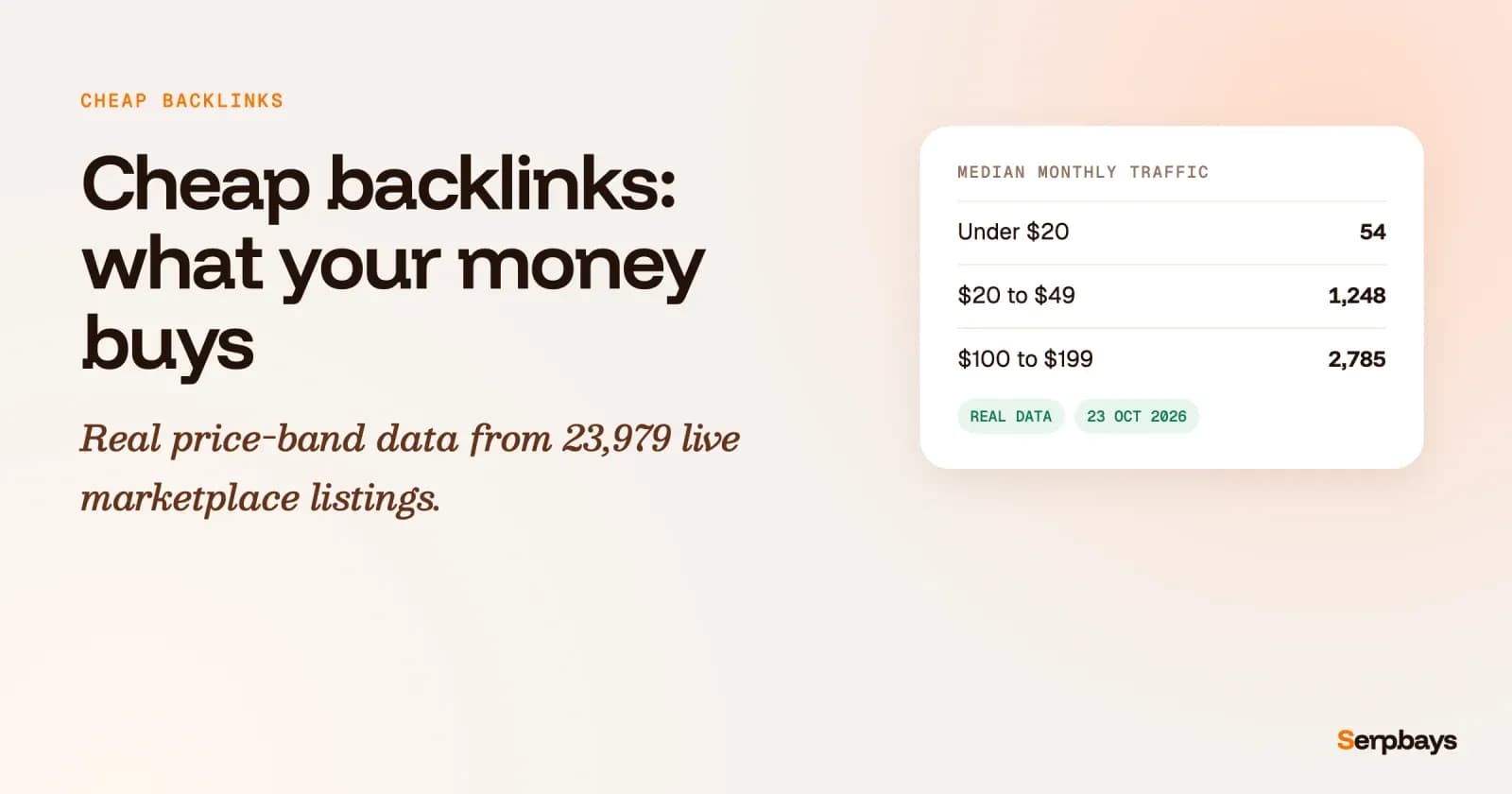
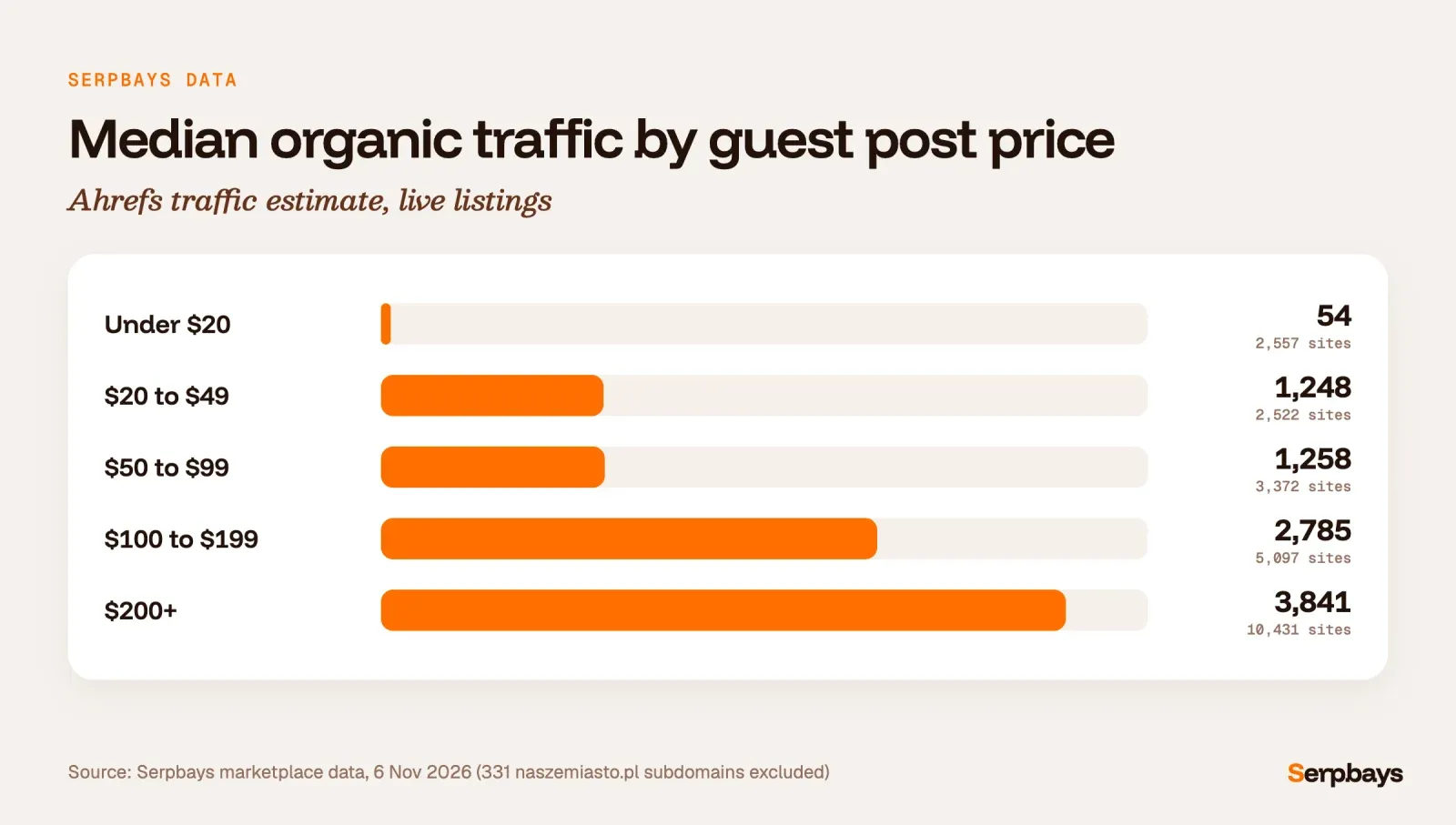
Short answer: You can buy backlinks cheap and still get real sites, but the cut-off is sharp. On Serpbays, listings under $20 have a median of just 54 monthly organic visits, while the $20 to $49 band jumps to 1,248, about the same as $50 to $99. Bulk packages, PBNs, link farms and hacked sites are never worth it at any price, and no paid link is risk-free.
What do cheap backlinks actually cost in 2026?
"Cheap" means different things to different people. For one buyer it's $5. For an agency used to paying $500 a placement, $150 feels cheap.
For context, a 2026 Editorial.Link survey of 518 SEOs put the average acceptable cost of one high-quality link at $508.95 (412 people answered that question). So anything under $200 sits well below what working SEOs say they expect to pay.
Here's what the market looks like below and above that line. I pulled every live listing on Serpbays with a guest post price on 6 November 2026 and grouped them by price.
| Guest post price | Live listings | Median DR | Median monthly traffic | Share with 1,000+ visits | DR 30+ but under 100 visits |
|---|---|---|---|---|---|
| Under $20 | 2,557 | 21 | 54 | 24.0% | 21.3% |
| $20 to $49 | 2,522 | 28 | 1,248 | 53.4% | 6.7% |
| $50 to $99 | 3,372 | 30 | 1,258 | 52.7% | 7.8% |
| $100 to $199 | 5,097 | 31 | 2,785 | 63.7% | 3.9% |
| $200 and up | 10,431 | 38 | 3,841 | 72.0% | 2.1% |
Source: Serpbays data, 6 November 2026. 23,979 live listings with a guest post price. DR and traffic are Ahrefs estimates stored on each listing. I excluded 331 subdomains of one Polish regional news portal that all list at DR 81 (307 of them at $75), because they would distort the $50 to $99 row on their own.
Two things jump out. First, DR barely moves between $20 and $199: the median goes from 28 to 31. Second, traffic is what you're paying for. That matches how Ahrefs itself describes DR: it's a relative score, and its own help page says "You should never judge the quality of a website on site-wide "authority" alone."
What can you honestly get under $50?
This is really two different markets.
Under $20 is the bottom of the barrel. Over half of these 2,557 listings (56.2%) get fewer than 100 visits a month. And 544 of them show DR 30 or higher with under 100 visits. That combination usually means a subdomain borrowing its parent's rating, or a site with almost no search presence of its own.
One pattern from our own data: a cluster of 11 subdomains under one shared parent domain all show DR 36 at $2 each, and none gets more than five visits a month. Eleven different sites with the identical rating is a hint that the metric belongs to the parent, not to them. The pages you'd be linking from have no readers.
So here's how I filter cheap listings on any marketplace, ours included. Sort by traffic first and ignore the DR column until a site passes. Then check index status: search site:theirdomain.com in Google and make sure real pages come back. An approved listing means the publisher exists and the details are filled in. Matching a site to your campaign is still your job.
$20 to $49 is where low cost backlinks get interesting. Median traffic is 1,248, and 1,380 listings under $50 combine 1,000+ visits with DR 20 or more. In my experience, sites in this range are often small niche blogs and regional sites whose owners price low because they want volume or don't know the market rate.
This band is fine for new sites, local businesses and low-competition niches, as long as you vet each site one by one. It won't move a competitive money keyword by itself.
What does $50 to $100 buy, and what about $100 to $200?
The $50 to $99 band looks almost identical to $20 to $49 on paper: median DR 30, median traffic 1,258, about half above 1,000 visits. You're mostly paying more for the same kind of site.
My take: if you're on a tight budget, the $20 to $49 range often gives you the same quality per dollar, so search there first and only move up when you can't find a relevant site.
The real step up comes at $100 to $199. Median traffic more than doubles to 2,785, and the share of high-DR, no-traffic sites falls to 3.9%. More of our inventory sits at $100 and up (15,528 listings) than below it, and in my experience the editorial bar is usually higher too.
A practical way to split a small budget: for $300, two vetted $100 to $150 placements on relevant sites will do more than fifteen $20 links. If you want that broken down by format, our link insertion guide shows how niche edit pricing compares by DR band.
Where can you buy backlinks cheap without getting burned?
Cheap is fine when the low price has an honest reason. These are the ones I'd buy:
Small niche blogs with real readers. A hobby blog with 2,000 visits a month about home espresso machines is a great link for a coffee grinder store. The owner charges $40 because nobody has told them to charge more.
Regional and local sites. City news sites, local business blogs and regional magazines often price low. For a local business, a relevant local link is worth more than a generic one with a higher DR.
Marketplace listings you can check before paying. The advantage of a marketplace over a $12 backlinks package is that you see the exact domain, the price and the metrics up front. On the Serpbays buy backlinks marketplace every listing shows its price, DR and traffic, so you can shortlist by budget and then check each site yourself. The same Editorial.Link survey found 63.1% of SEOs would place links on marketplace sites if the quality were right. That "if" is the whole job.
If you're comparing an affordable link building service against a self-serve marketplace, our roundup of the best places to buy backlinks covers where each model fits.
Which cheap backlinks are dangerous?
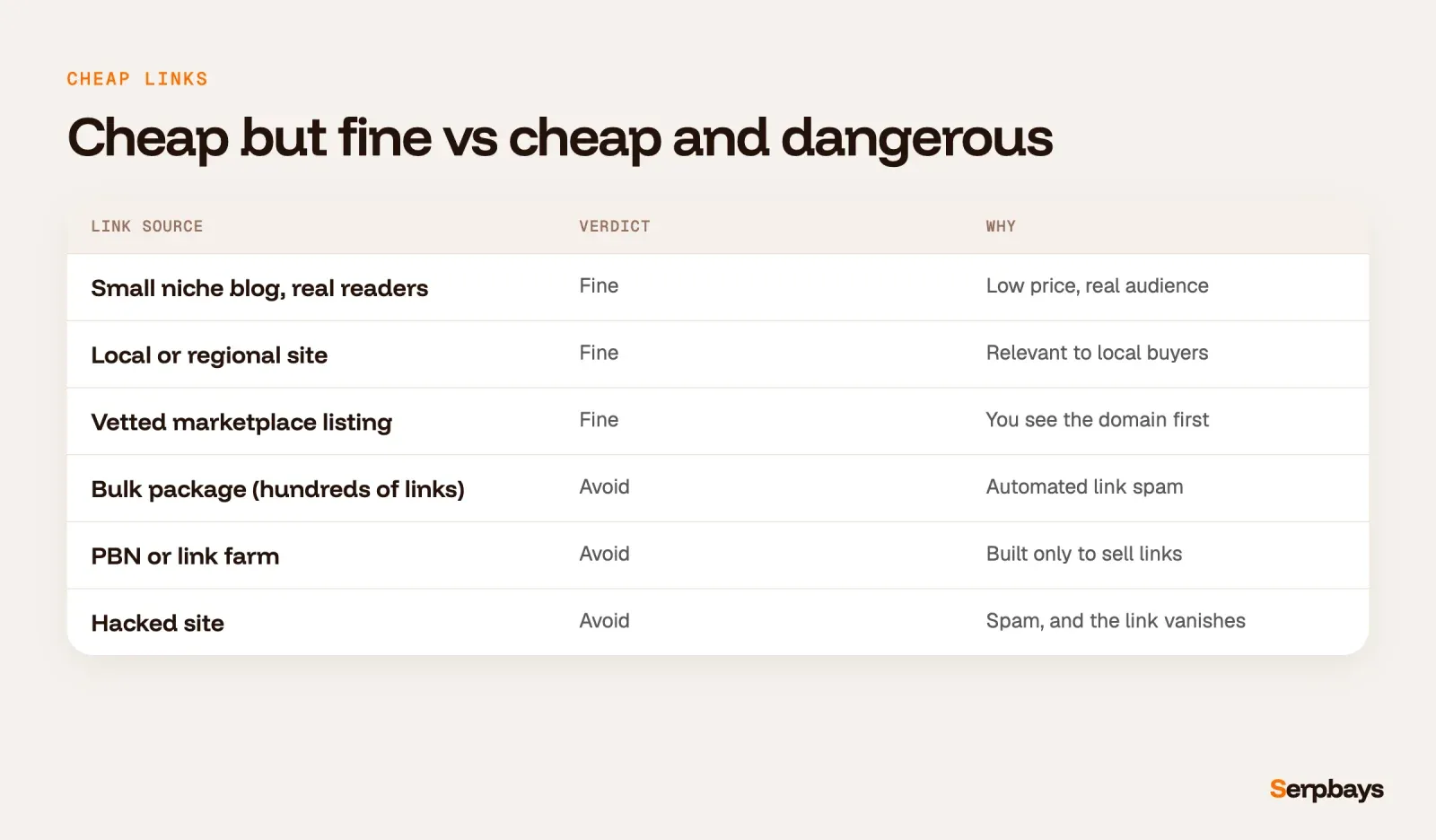
Google's spam policies define link spam as creating links "primarily for the purpose of manipulating search rankings". The examples it lists include "Buying or selling links for ranking purposes", "Using automated programs or services to create links to your site" and "Low-quality directory or bookmark site links".
Here's what to avoid at any price:
Bulk packages. If you buy bulk backlinks, hundreds or thousands at once, they come from automated tools, scraped directories, profile spam or comment spam. That's the "automated programs" example word for word.
PBNs. Private blog networks are sites run by one operator purely to sell links. They often sit on expired domains with leftover DR. We cover how they work in our piece on tiered link building, where they're usually sold.
Link farms. Sites that publish anything for anyone, with ten outbound links per post and no audience. The giveaway is a decent DR with almost no traffic, which is exactly what sorting by traffic screens out.
Hacked sites. Some sellers put links on sites they've broken into. Google treats hacked content as spam: "content placed on a site without permission". If a seller can place you on a big brand's site for $15, assume it's hacked, and assume the link disappears once the owner cleans up.
What happens if you buy them? Since the December 2022 link spam update, Google says SpamBrain "can now detect both sites buying links, and sites used for the purpose of passing outgoing links", and that "any credit passed by these unnatural links are lost". Google adds that its "algorithms and manual actions aim to nullify these unnatural links at scale". Most of the time that means the links are simply ignored and your money is gone. Our post on toxic backlinks explains when that's worth worrying about.
How do you vet a cheap backlink before you pay?
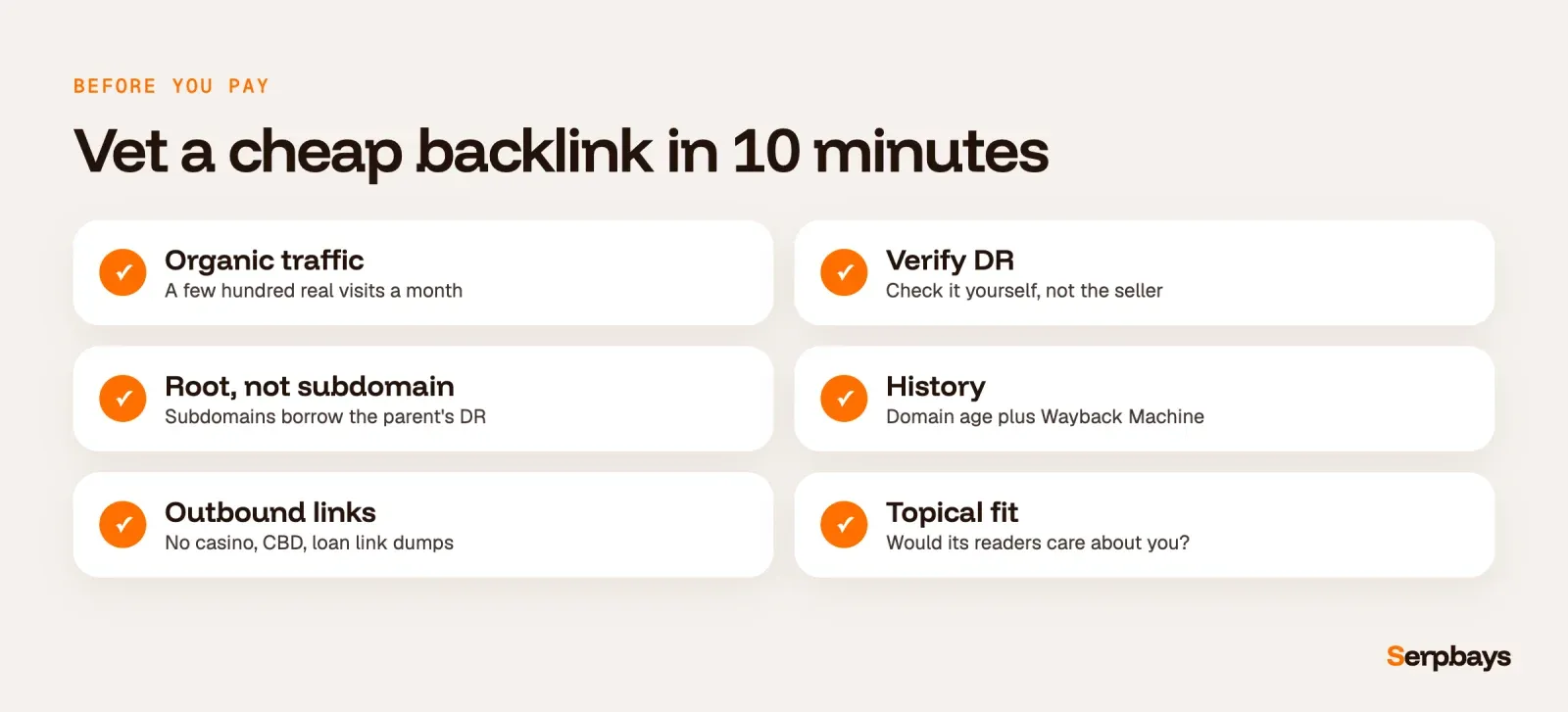
Cheap sites need more checking, not less. Budget about ten minutes per site:
- Check organic traffic first, DR second. Ahrefs' own help page asks the right question: "Does it get any organic traffic?" I'd want at least a few hundred real visits a month, and a trend that isn't falling off a cliff.
- Confirm the DR yourself. Sellers' numbers can be stale. Run the domain through our free domain rating checker, or paste a whole shortlist into the bulk DR checker.
- Is it a subdomain? If the URL is something.bigsite.com, the DR you see is probably the parent's (our guide on what Domain Rating means explains why). Judge the subdomain on its own traffic.
- Check its history. A domain age check plus a look at the site in the Wayback Machine shows whether it was a different business, or in a different language, a year ago. That's a common expired-domain PBN sign.
- Read three recent posts. Is the writing for humans? Count the outbound links. If every post links to casinos, CBD and loan sites, walk away.
- Check topical fit. Would a reader of this site plausibly care about your page? If not, the link will look bought, because it was.
- Agree the anchor and the link type. Use a branded or natural anchor, not an exact-match commercial phrase. Our anchor text distribution guide has safe ratios. Ask whether the link will be dofollow or marked sponsored.
Google's guidance on qualifying outbound links says paid placements should carry rel="sponsored". Between 98% and 99.4% of listings in every price band on Serpbays are listed as dofollow, because that's what buyers ask for. Agree with the publisher how the link will be marked before you pay. Google's position is clear: a link bought to influence rankings should be qualified, so any paid dofollow link carries some risk, cheap or not.
Are cheap backlinks worth it?
Sometimes.
Links under $20 are rarely worth it. Only 24% of them get 1,000+ visits a month, and finding that quarter takes longer than the money you save. The time cost is the hidden backlink price nobody puts on the sales page.
If you buy cheap backlinks in the $20 to $99 range, they're worth it when you vet each one. Half the sites in that range get 1,000+ visits, which is a decent hit rate if you check before buying.
A backlinks package that promises hundreds of links for a flat fee is never worth it. You can't vet what you can't see, and Google names automated link building in its spam policy. If you do want a bundle, our guide to link building packages shows what a legitimate one should spell out up front.
And no paid link is risk-free, including the expensive ones. The safest cheap campaign is a small number of relevant sites with real readers, natural anchors, and links you'd be comfortable showing a Google reviewer.
FAQ
Where can I buy backlinks for a low price?
Self-serve marketplaces show you the exact site, price and metrics before you pay, which matters more at low budgets. On Serpbays, 5,079 live listings charge under $50 for a guest post (6 November 2026), and 1,960 of those get 1,000+ monthly visits.
Is buying backlinks illegal?
Buying a link isn't a crime in itself. The problem is Google's rules: its spam policies list "Buying or selling links for ranking purposes" as link spam, and it asks for paid placements to be marked rel="sponsored". The realistic risk is that Google ignores the link or, in bigger cases, acts against it manually.
Are cheap guest posts safe?
Not automatically. Cheap guest posts on small, relevant blogs with real traffic carry about the same risk as expensive ones. Cheap posts on PBNs, link farms or hacked sites are the ones most likely to be ignored or flagged. Vet traffic, history and outbound links on every site.
What should you do next?
Pick one page you want to rank. Write down five sites in your niche that a real customer of yours would read. Then open the Serpbays marketplace, filter to your category and a $20 to $150 price range, and shortlist ten sites with at least a few hundred monthly visits. Run the shortlist through the vetting steps above and buy the best two or three. Start small and measure before you spend more.
Vinayak Gupta is the founder of Serpbays and Wordscloud, with hands-on experience in SEO, content marketing, publisher outreach, and link building. He has worked with SEO agencies, SaaS companies, and digital brands to plan content strategies, evaluate backlink opportunities, and build authority through high-quality placements. At Serpbays, he focuses on making link building more transparent, reliable, and easier for agencies and businesses.
View profile →