Link Building Packages: What to Expect, What to Pay and Red Flags
What a link building package should include, how to check price per link against real publisher data, which red flags to avoid, and when monthly plans make sense.
· · 11 min read
A vendor offers you ten DR 50+ links for $500 a month. Another wants $1,750 for five. On paper the first one is seven times better value. In practice, the first one is usually the expensive mistake.
Link building packages are sold on link counts and Domain Rating because those are easy to compare. Neither tells you what you're buying. Below I'll cover what a package should contain, how to test its price per link against real marketplace data, the red flags I walk away from, and when a monthly plan beats a one-off order.
Short answer: A good link building package spells out the exact number of links, the link type, minimum organic traffic (as well as DR), who approves each site, what content is included and what happens if a link disappears. To judge the price, divide the package cost by the number of links and compare that figure to what publishers actually charge. On Serpbays, the median guest post on a DR 50 to 79 site with 5,000+ monthly visits costs $295. Only 7% of those listings are priced at $50 or less, so a package promising ten of them at $50 each needs hard questions.
What are link building packages?
A link building package is a fixed bundle of backlinks sold for one price. Some are one-off orders ("five guest posts, delivered in 30 days"). Others are monthly subscriptions where you get a set number of links every month until you cancel.
The seller is usually one of three types:
- Agencies that run outreach, write the content and report back.
- Marketplaces where you pick individual sites from a catalogue and the publisher places the link.
- Resellers who buy from marketplaces or networks and repackage the links under their own brand.
All three can sell a good backlink building package. All three can also sell junk. What's inside decides quality.
What should a link building package include?
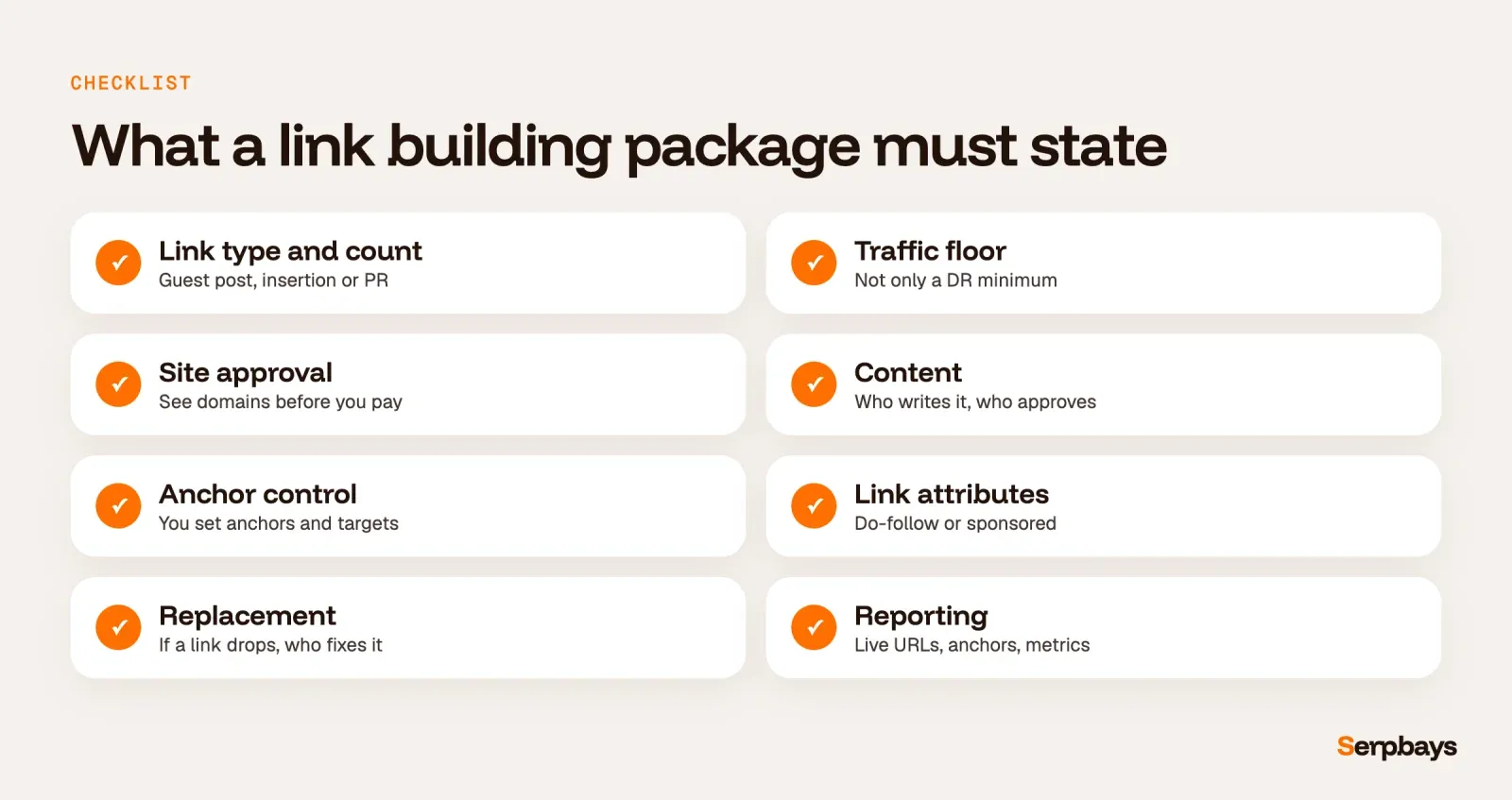
Before you compare prices, make sure you're comparing the same thing. In my experience, most bad purchases start with a buyer who never asked what was in the box. A complete link building package answers these points in writing:
- Link count and link type. Guest posts, link insertions in existing articles, or digital PR. If you're unsure which to buy, our comparison of guest posts vs niche edits covers when each one fits.
- Site quality floor. A minimum organic traffic figure, not only a DR or DA minimum. You'll see why below.
- Site approval. You see the domains before anything is bought, and you can reject any of them.
- Content. Who writes the article, how long it is, and whether you approve it.
- Anchor text control. You decide the anchors and target pages, or at least sign off on them. Our guide to anchor text distribution shows safe ratios.
- Link attributes. Do-follow or not, and whether the link is marked sponsored.
- Replacement terms. What happens if a link is removed in the first 6 or 12 months.
- A report. Live URLs, anchors, dates and the metrics of each site.
If a vendor won't put these in writing, the price doesn't matter. You can't judge value on a package you can't inspect.
How much do link building packages cost?
Link building packages prices only make sense once you know what single links cost. So here's the raw material. We pulled every live guest post listing on the Serpbays marketplace on 2 November 2026: 24,310 sites with a guest post price set.
The overall median is $156 per guest post. The middle half of listings sits between $60 and $316. That spread is the first lesson: "a backlink" is not one product with one price.
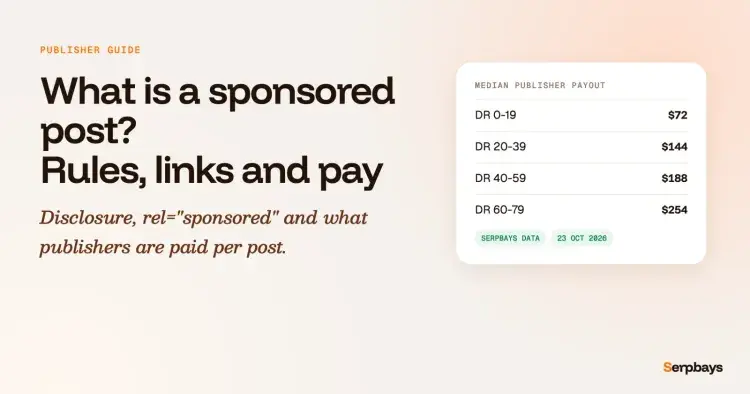
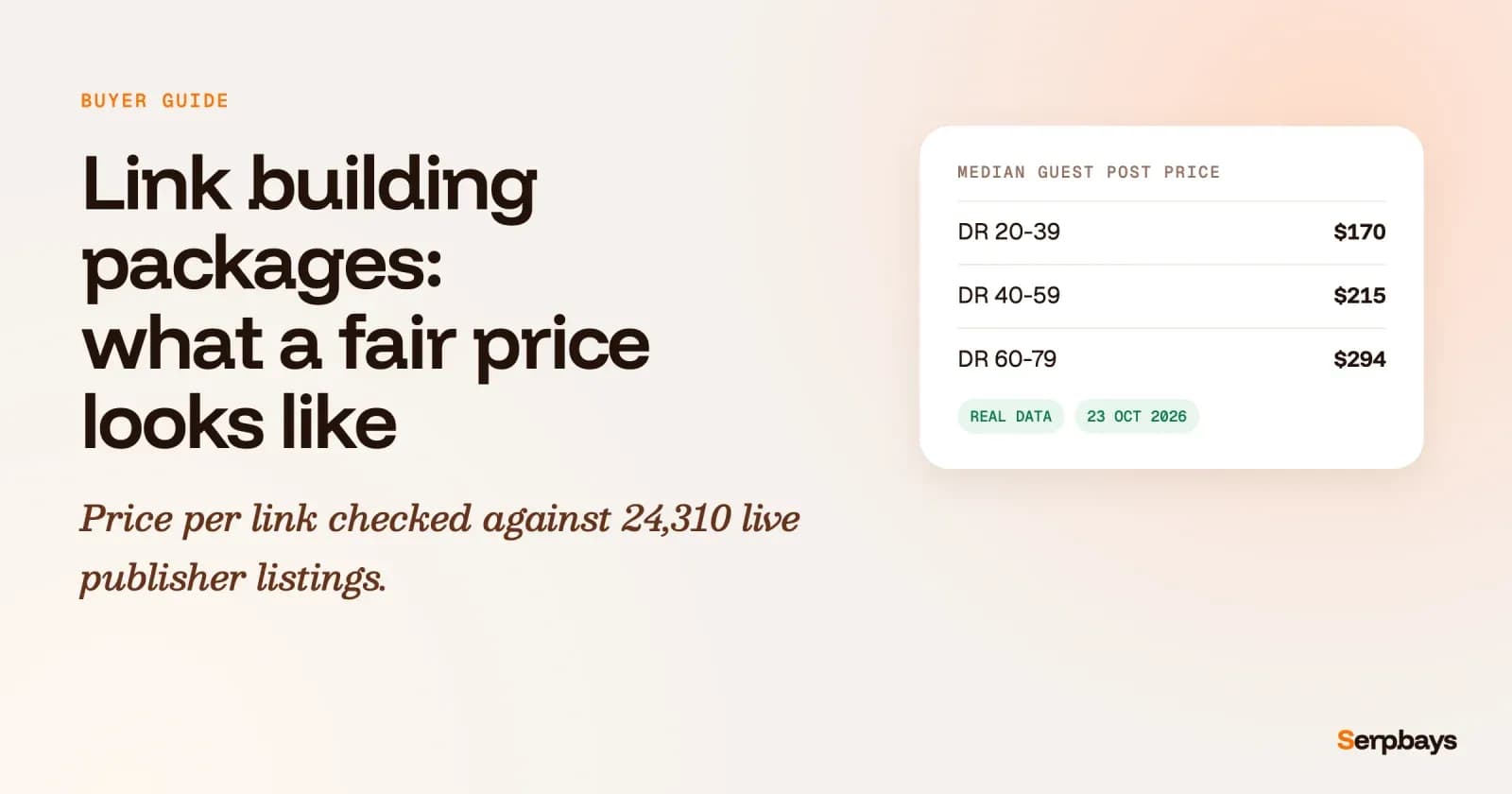
By Ahrefs Domain Rating, the median guest post price climbs from $81 (DR 0 to 19) to $170 (DR 20 to 39), $215 (DR 40 to 59) and $294 (DR 60 to 79). We leave DR 80+ out of price claims, because 331 of those 510 listings are subdomains of one Polish regional news portal, most of them priced at $75. That skews the band.
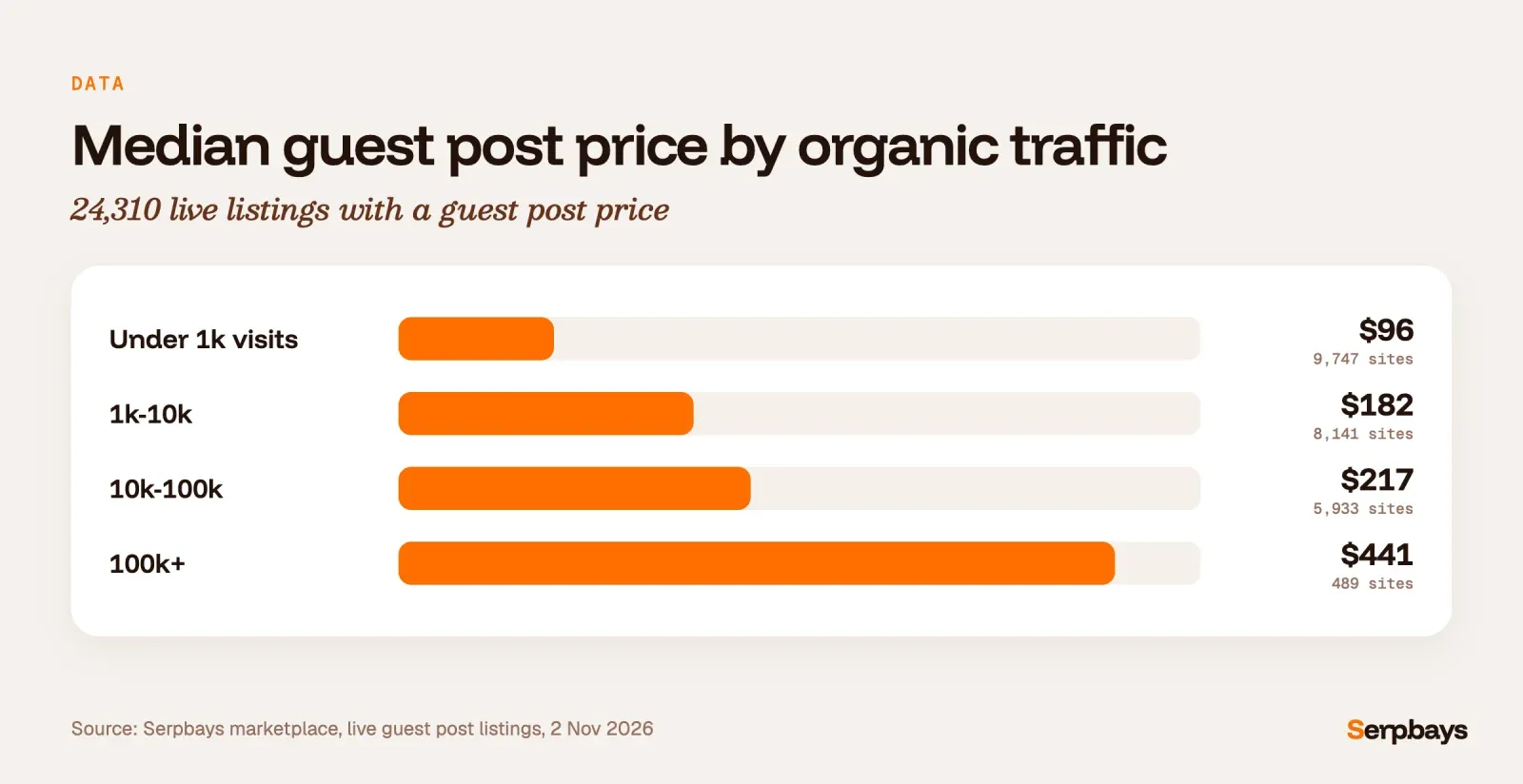
Traffic moves the price even more clearly:
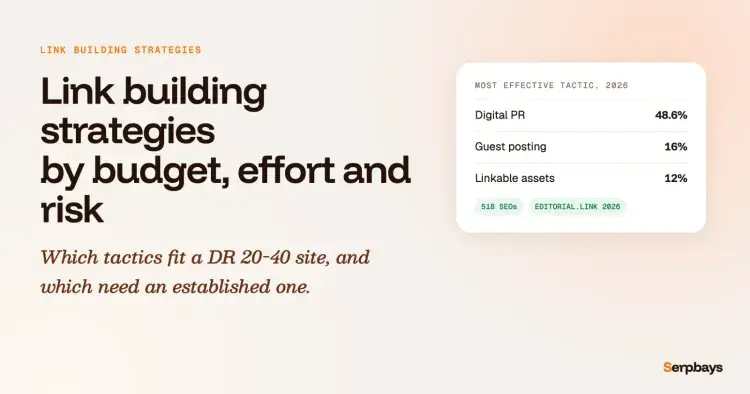
For outside context, Editorial.Link's 2026 link building statistics report, based on a survey of 518 SEO professionals, puts the average acceptable price for one high-quality backlink at $508.95. The same report gives $8,406 as the average minimum monthly budget respondents said they need to compete in highly competitive niches.
Now compare those numbers to a real package. Editorial.Link's own pricing page (opened 2 November 2026) lists a Startup package at $1,750 for 5 links, which it shows as $350 per link, and a Growth package at $6,000 for 20 links ($300 per link), both described as average DR 50 to 90 with traffic of 5k+. On Serpbays, the median guest post on a DR 50 to 79 site with at least 5,000 monthly visits is $295 (middle half $150 to $517, 2,664 listings). So a managed package at $300 to $350 per link is priced roughly at the going publisher rate, with the outreach and vetting folded in.
How do you judge link building package prices per link?
Ignore the headline price. Work out what each link costs and what it should cost. Here's the method I use:
- Divide the price by the number of links. A $2,000 package with 8 links is $250 per link. A "bonus" link that's really a directory listing doesn't count.
- Find the promised quality band. Write down the DR range and, more importantly, the traffic minimum the vendor commits to.
- Compare against real publisher prices. Use the medians above, or browse comparable sites yourself on a marketplace such as Serpbays' backlink catalogue.
- Price the service on top. If the package includes outreach, writing and reporting, paying above the publisher median is normal. If it's far below the median, ask what's being cut.
- Check the sample. Ask for 3 to 5 example domains at the promised tier and run them through a free bulk DR checker before you pay.
A quick worked example using our 2 November 2026 medians. A 10-link monthly package with 4 links at DR 20 to 39 ($170 each), 4 at DR 40 to 59 ($215 each) and 2 at DR 60 to 79 ($294 each) costs about $2,128 at marketplace prices alone. That's roughly $213 per link before anyone is paid for prospecting, vetting or reporting. A vendor offering that mix for $600 a month is not buying from the same sites.
Why traffic matters more than DR in a package
This is the part most package comparisons skip, and it's where cheap packages hide.
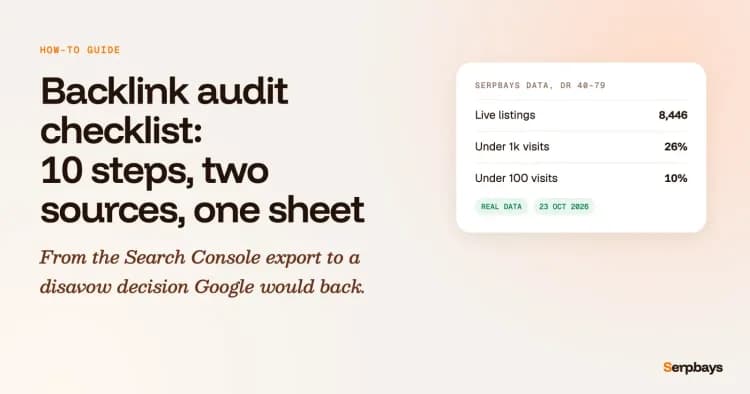
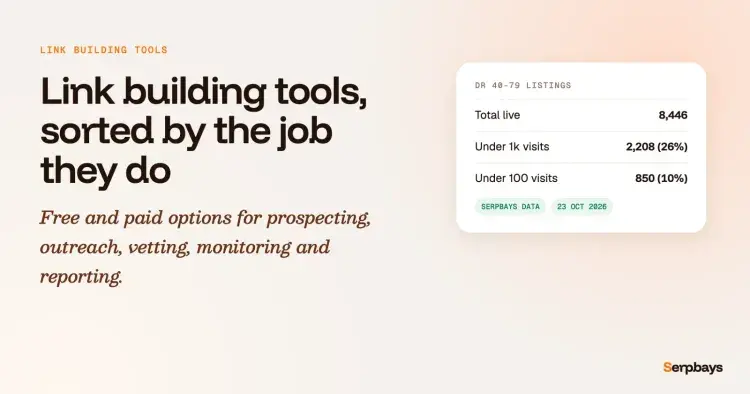
Of the 8,409 live listings on Serpbays with DR 40 to 79, 2,207 (26%) get fewer than 1,000 organic visits a month according to Ahrefs. Their median guest post price is $100. Sites in the same DR range with 1,000 to 10,000 visits have a median of $264. Above 10,000 visits: $280.
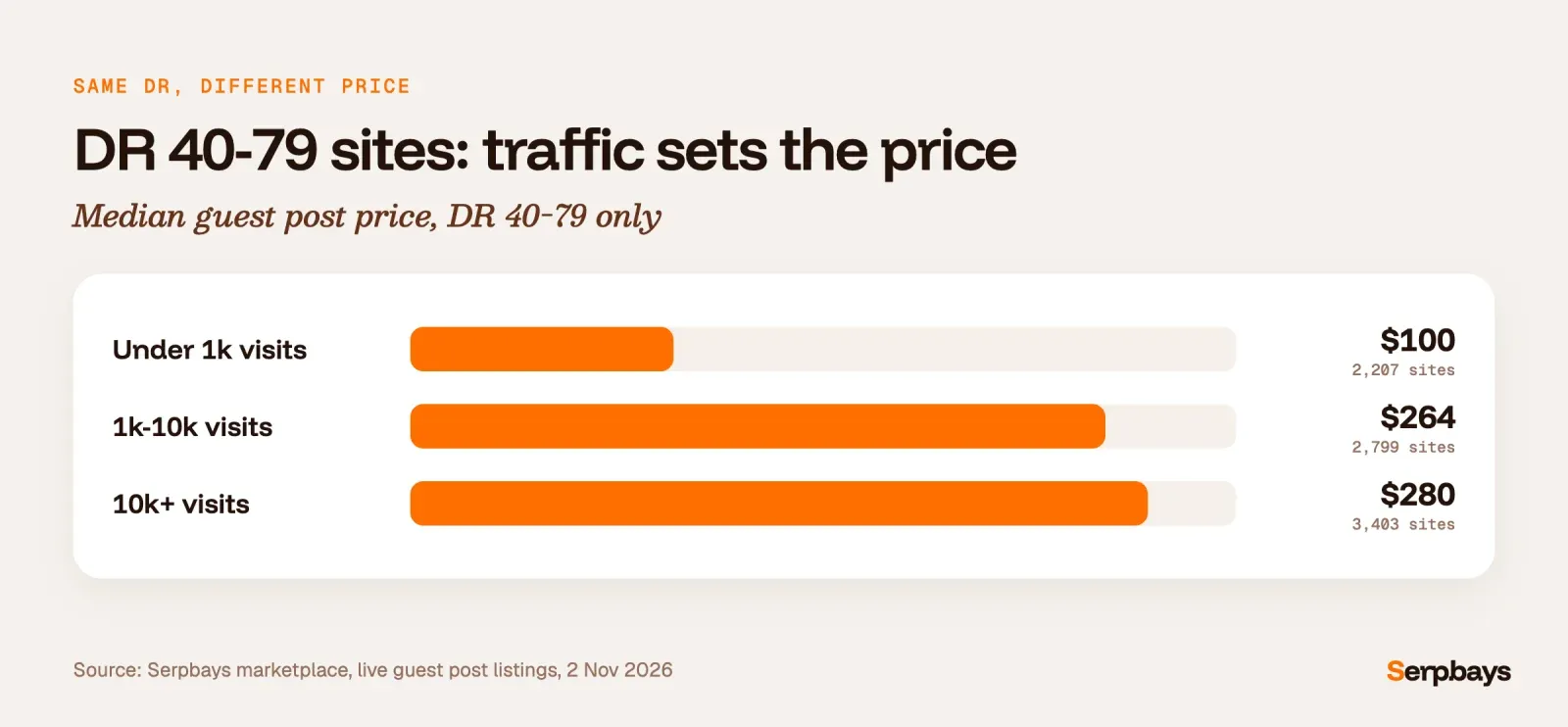
Publishers already price in what DR alone hides. A DR 50 site with almost no organic traffic usually means the authority comes from links, not readers. A package that sells "DR 50+" without a traffic floor is very likely filling up on that 26%.
The cheap end makes the point even harder. 949 DR 40 to 79 listings on Serpbays charge under $30 for a guest post. Their median organic traffic is 234 visits a month, against 7,010 for DR 40 to 79 sites priced at $30 or more. A $30 "DR 50" link and a $295 "DR 50" link are not the same product. Check a site's DR with our free Domain Rating checker, then confirm its organic traffic in Ahrefs or a similar tool before you trust the number.
What are the red flags in SEO link building packages?
- A link building price far below publisher medians for the quality band promised. Cheap is possible. Cheap and good at DR 50+ with real traffic is rare.
- DR or DA minimums with no traffic minimum. See the 26% figure above.
- No site list before payment. Google is blunt here: when you hire someone for SEO, you are responsible for the actions of any companies you hire, and you should be careful if a company is secretive or won't clearly explain what it intends to do.
- Ranking guarantees. The same Google page says no one can guarantee a #1 ranking on Google.
- The same domains in every report, or sites that publish on every topic for anyone. That's a network, not a publisher.
- No answer on link removal. If a link vanishes in month three, who replaces it?
- Silence on link attributes. Google's spam policies list exchanging money for links, or posts that contain links as link spam when done for ranking purposes, and say paid links are fine when qualified with rel="nofollow" or rel="sponsored". Google's guidance on qualifying outbound links says sponsored is the preferred value for paid placements. A vendor who pretends this isn't a question is not being straight with you.
My opinion: the riskiest packages aren't the obviously spammy ones. They're the mid-priced ones with nice-looking DR numbers and no traffic data, because buyers trust them. For a wider list of signals, our guide to toxic backlinks covers what's actually worth worrying about.
Monthly link building packages vs one-off orders: which is better?
| Question | Monthly package | One-off order |
|---|---|---|
| Best for | Ongoing campaigns, competitive niches, agencies with retainers | Testing a vendor, a single page push, fixed budgets |
| Link velocity | Steady, spread across months | A batch at once |
| Control | Depends on whether you approve each month's plan | Full, if you pick each site |
| Commitment | Check notice periods and minimum terms | None after delivery |
| Risk | Quality can drift as the vendor fills quotas | You may overpay without volume pricing |
My view: start with a one-off order to test any vendor, even if you plan to go monthly. Then move to a monthly plan once you've seen the sites, the content and the reporting. A monthly plan you can't cancel is a red flag of its own. The best link building packages I've seen let you approve every site, every month.
One thing works in your favour either way: placements are mostly sold as permanent. More than 99% of guest post listings on Serpbays are sold as "Lifetime", and 97% are do-follow (Serpbays data, 2 November 2026). Still ask the vendor to put the removal and replacement terms in writing.
Is it better to buy backlink packages or pick links yourself?
If you know your niche and have time to vet sites, picking individual links on a marketplace gets you closer to publisher prices and full control. Our list of the best places to buy backlinks compares the main platforms.
If you don't have the time, or you're an agency running links for many clients, a managed package makes more sense. You're paying for someone to prospect, negotiate, write and report. Agencies reselling this under their own brand should read our guide to white label link building before choosing a partner.
On Serpbays you can do either. Serpbays monthly plans are month-to-month: you approve each month's placement plan before anything goes live, content and anchor strategy are included, and links removed for editorial reasons within 12 months are replaced. The monthly report is white-label, so agencies can forward it to clients.
FAQ
How much does link building cost?
For single links, the median guest post on the Serpbays marketplace was $156 on 2 November 2026, rising to $295 for DR 50 to 79 sites with 5,000+ monthly visits. Managed packages add outreach, vetting and reporting on top, so expect to pay more per link than the marketplace price.
What is a good price per link in a backlink package?
One that sits near or above real publisher prices for the quality promised. Most link building pricing is quoted per package, so convert it first. Divide the package price by the link count, then compare it to marketplace medians for the same DR and traffic band. A big gap below the median means something is being cut.
Are link building packages safe?
Google treats paid links meant to manipulate rankings as link spam unless they carry rel="sponsored" or rel="nofollow". The practical risk is lower with real, relevant sites that have organic traffic and higher with networks built to sell links.
Your next step
Take the package you're considering, divide the price by the number of links, and ask the vendor for five sample domains at the promised tier. Run them through our bulk DR checker, confirm each one has real organic traffic, then compare the per-link price with the medians in this post. If the numbers line up and the vendor lets you approve sites, it's worth a test order. If you'd rather hand the work over with approval kept on your side, look at managed link building on Serpbays.
Vinayak Gupta is the founder of Serpbays and Wordscloud, with hands-on experience in SEO, content marketing, publisher outreach, and link building. He has worked with SEO agencies, SaaS companies, and digital brands to plan content strategies, evaluate backlink opportunities, and build authority through high-quality placements. At Serpbays, he focuses on making link building more transparent, reliable, and easier for agencies and businesses.
View profile →