DR in SEO: What Domain Rating Means and What a Good DR Is
DR in SEO explained: how Ahrefs calculates Domain Rating, what a good DR is, and what 24,356 marketplace listings show about DR, traffic and price.
· · 11 min read
We pulled every live listing on the Serpbays marketplace on 3 November 2026, all 24,356 of them, and lined up each site's Domain Rating against its Ahrefs organic traffic estimate. More than a quarter of the sites at DR 40 or higher are estimated at fewer than 1,000 organic visits a month. One DR 69 site is estimated at 41.
That's the problem with DR in SEO. It's the number everyone quotes on a sales call, and it's the number sellers inflate first. This guide explains what Domain Rating measures, how Ahrefs calculates it, what a good DR looks like, and where the number lies to you, using our own marketplace data.
Short answer: DR (Domain Rating) is Ahrefs' 0 to 100 score for how strong a website's backlink profile is compared with every other site in its index. It is not a Google metric and doesn't measure traffic. A good DR is one that is equal to or higher than the sites you compete with, and when you're buying links, real organic traffic tells you more than DR alone.
What is DR in SEO?
DR stands for Domain Rating. Ahrefs created it, and its help center describes it as a score that shows the strength of a website's backlink profile compared to the others in the Ahrefs database, on a 100-point scale.
Two words in that definition matter. "Backlink" means DR looks only at links: no content, no rankings, no traffic. "Compared" means it's relative. Your DR can fall even when you haven't lost a single link, because other sites gained more.
People also call it a "DR score" or "Ahrefs DR". Same thing. If someone says "DR" without naming the tool, they almost always mean Ahrefs Domain Rating.
DR also has a page-level sibling. URL Rating (UR) scores a single page's backlink strength, while DR scores the whole domain. Ahrefs says DR correlates with Google rankings, but less strongly than UR does. That makes sense: Google ranks pages, not domains.
How is Domain Rating calculated?
Ahrefs doesn't publish the formula, but it does explain the mechanics. In a 2022 article by Ahrefs CMO Tim Soulo, the company says it calculates DR in a way that's "somewhat similar" to how PageRank works, except between websites instead of pages. Combined with the help center page, the rules look like this:
- Referring domains, not raw links. Only the first link from a domain raises your DR. Fifty more links from the same site add nothing.
- Dofollow only. A site that links to you only with nofollow links won't increase your DR.
- Strong sites pass more. A link from a higher-DR domain transfers more value.
- The value gets split. A linking domain divides its rating equally among all the domains it links to. A small site that links out to ten domains can pass more than a big site linking out to thousands.
- The scale is logarithmic. Ahrefs' own example: the gap between DR 70 and DR 71 is much bigger than the one between DR 20 and DR 21.
Because the scale is logarithmic, moving from DR 20 to DR 30 is a very different job from moving from DR 60 to DR 70. Anyone who promises a fixed number of DR points per month is guessing, or doing something you won't like.
Ahrefs also lists why a DR can drop. Its help article on DR drops gives four reasons: other sites did better link building, you lost high-quality dofollow links (a backlink audit shows which ones), a dofollow link turned nofollow, or your referring domains themselves dropped in DR.
Does Google use DR score as a ranking factor?
No. DR is a third-party estimate built on Ahrefs' own crawl. Google has never used it.
What Google does say is that it "uses links as a signal when determining the relevancy of pages and to find new pages to crawl." That line is from Google's link best practices documentation. So links matter. A tool's summary of those links does not.
Google has been just as clear about site-wide authority scores in general. Search Engine Journal's 2023 review of Google statements quotes John Mueller in 2020: "We don't use domain authority at all in our algorithms." Gary Illyes said in 2016 that Google doesn't really have "overall domain authority".
So why does everyone track DR? Because it's a decent shorthand for link strength, and link strength does tend to travel with rankings. Ahrefs says DR "correlates strongly" with a website's search traffic. Our data says the relationship is real, but a lot looser than that phrase suggests.
What is a good DR?
Ahrefs' answer is that a DR is good if it's higher than or comparable to similar sites. There's no magic number. DR 30 is strong for a local plumber and weak for a national news site.
For your own site, that means checking the DR of the pages already ranking for your target keywords. If they sit at DR 25 to 40, a DR 30 site can compete. If they're all DR 80+, your content alone won't close the gap any time soon.
For a site you're buying a link from, "good" needs a second test: does real traffic back the number up? Here's what DR looks like across the Serpbays marketplace.
How does DR relate to traffic and price? Our marketplace data
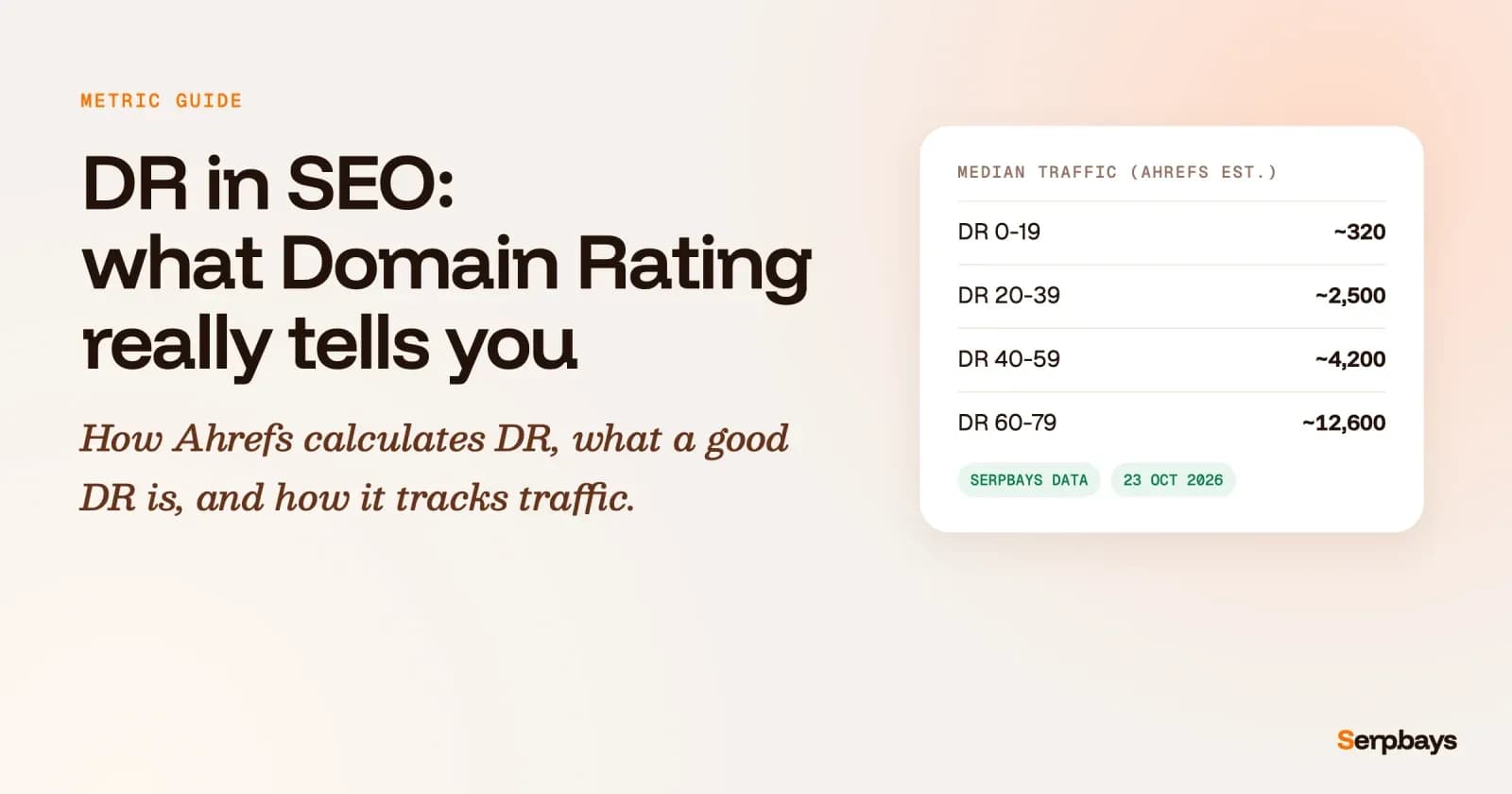
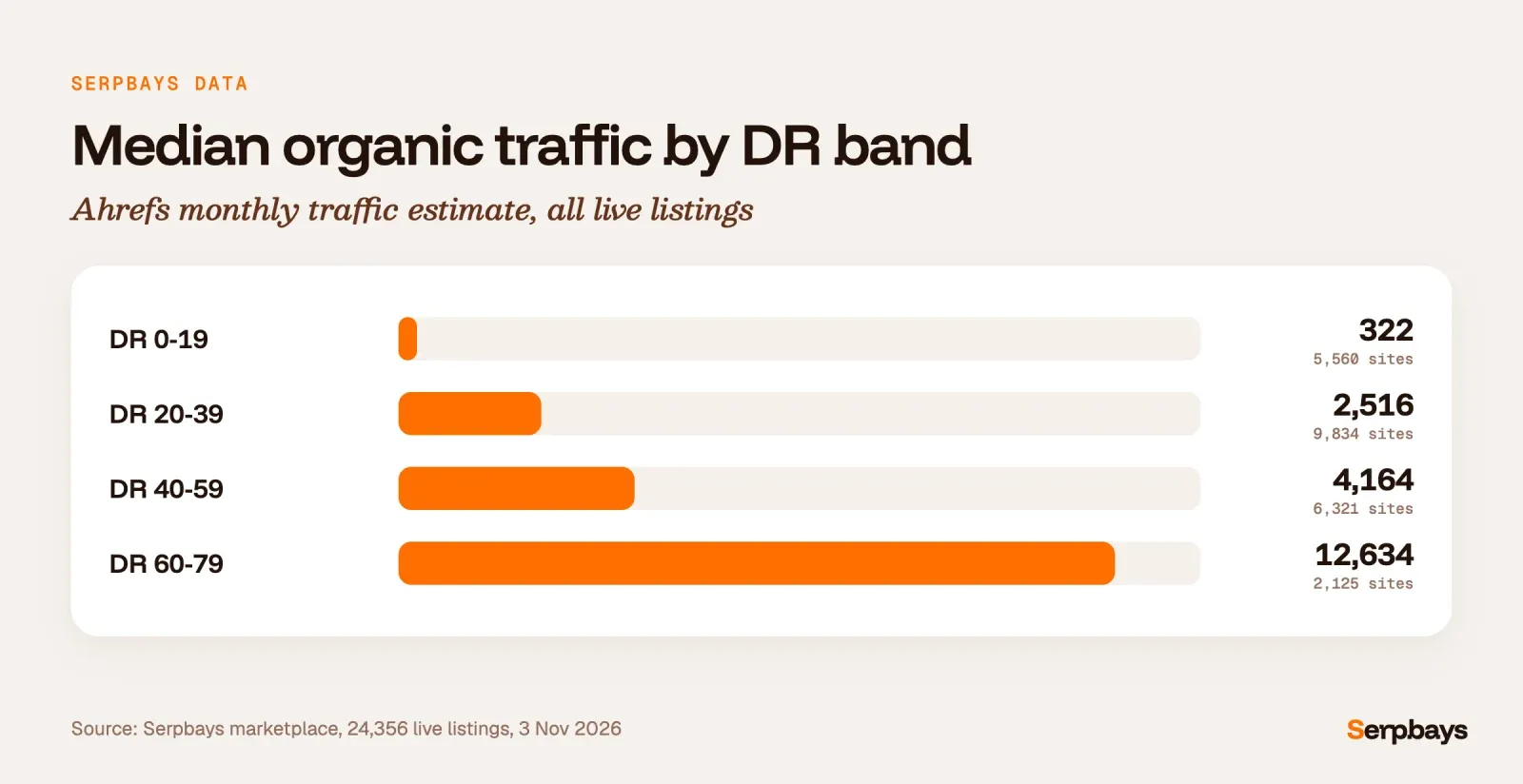
We grouped all live listings on Serpbays by Ahrefs DR band and looked at the Ahrefs organic traffic estimate stored on each listing, plus the median link insertion price. Data is from 3 November 2026. Traffic is Ahrefs' estimate, not the publisher's own analytics.
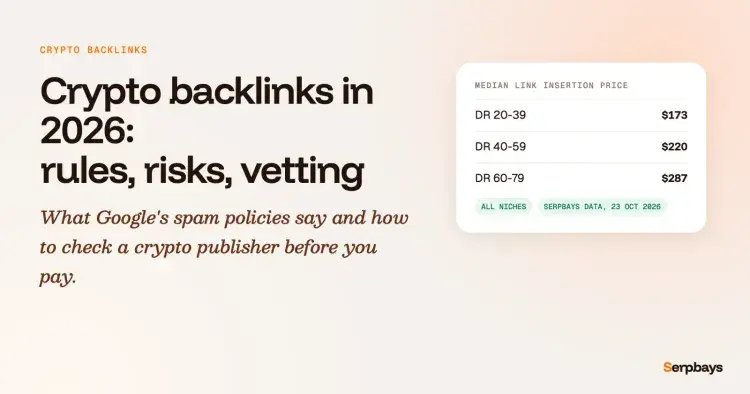
| DR band | Live listings | Median monthly organic traffic (Ahrefs estimate) | Share under 1,000 visits | Median link insertion price |
|---|---|---|---|---|
| DR 0-19 | 5,560 | about 320 | 68% | $80 |
| DR 20-39 | 9,834 | about 2,500 | 35% | $173 |
| DR 40-59 | 6,321 | about 4,200 | 29% | $220 |
| DR 60-79 | 2,125 | about 12,600 | 19% | $287 |
The medians climb neatly with DR. But high DR websites aren't automatically high-traffic websites, and the spread inside each band is the real story:
- Leaving out the subdomain cluster explained below, 2,255 of the 8,631 listings at DR 40 or higher (26%) are estimated at fewer than 1,000 organic visits a month.
- Even at DR 60 to 79, 407 sites sit under 1,000 estimated visits.
- Going the other way, 479 sites below DR 20 have an estimated 10,000+ visits a month. A low DR doesn't mean nobody reads the site.
- Across 24,025 listings, the rank correlation between DR and traffic is 0.38. That's a moderate link, not a strong one.
The good news: the market already prices this in. Inside the DR 40 to 59 band, sites under 1,000 visits have a median link insertion price of $95. Sites with 1,000 to 10,000 visits sit at $269.50, and sites above 10,000 at $250. Same DR band, nearly three times the price.
Publishers and buyers clearly price in traffic as well as DR.
My take: if you only filter by DR, you'll end up paying DR 50 prices for sites that Google sends almost nobody to. Filter by traffic first, then use DR as a tiebreaker.
Why can a subdomain show DR 81?
In my experience, this is the trap that catches the most buyers. Ahrefs calculates DR at the domain level, and its 2022 article says subdomains usually share the root domain's DR, with "some exceptions". Its own example: wordpress.org and codex.wordpress.org both show DR 98, while wordpress.com is DR 93 and discover.wordpress.com is DR 66.
When one company owns a big portal with hundreds of local subdomains, each small subdomain can carry the parent's DR. Our marketplace has three clear cases:
- 331 listings on naszemiasto.pl, a Polish regional news portal. Every one shows DR 81. Their median Ahrefs traffic estimate is 395 visits a month, and their median link insertion price is $75.
- 51 listings on the subdomains of a Dutch news network, all at DR 77, with a median of 257 estimated visits.
- 31 listings on the subdomains of a Latvian city portal, all at DR 68, with a median of 123 estimated visits.
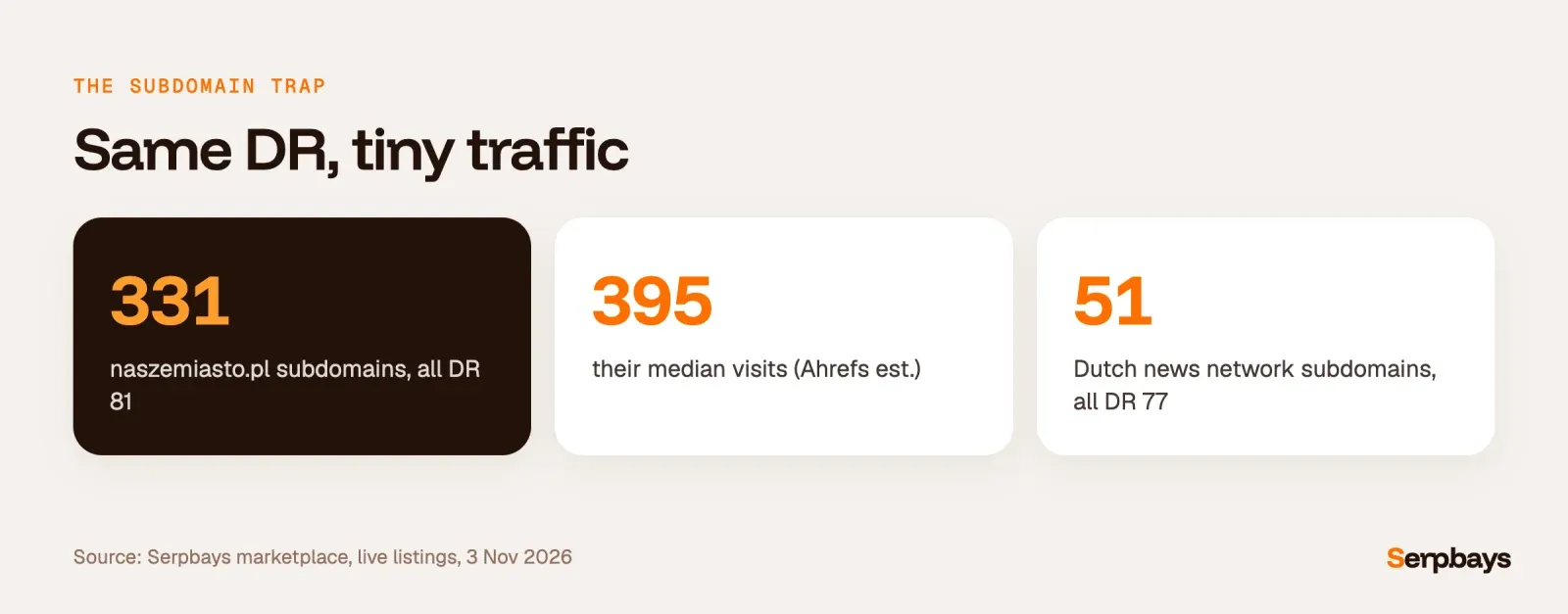
That's why the median traffic for DR 80+ on Serpbays is only 623, lower than the DR 20 to 39 band. Take out the 331 naszemiasto.pl listings and the remaining 185 DR 80+ sites have a median of about 5,400 estimated visits.
A cheap "DR 81 link" on a town subdomain isn't a DR 81 link in any useful sense. Look at the exact hostname before you pay. If it has a city or region in front of a big parent domain, judge it by its own traffic and content. We cover the same check from the buyer's side in our guide to link insertion.
Domain rating vs domain authority: which should you use?
Domain Authority (DA) is Moz's version of the same idea, and Semrush has a third one called Authority Score. Search Engine Journal's review concludes that none of these third-party metrics, DR included, has any effect on Google rankings. In my experience the same site often scores quite differently on each, because every tool crawls the web on its own.
The useful habit is to pick one metric, use it consistently, and never compare a DR from one seller with a DA from another. I default to DR because it's the number most sellers quote, which makes it easy to check their claims.
When a vendor only quotes DA, our free DA checker gives you a second opinion. It's an estimate based on OpenPageRank, not Moz's own DA, so use it as a sanity check, not as proof of the vendor's number.
Whichever score you use, it describes a link graph, not a business. For the full picture of what sits behind a score, read our guide to what a backlink profile is.
How to check the DR of a website for free
You don't need a paid Ahrefs plan to see a site's DR. Paste a domain into our free Domain Rating checker and it returns the Ahrefs DR with no login. If a vendor sends you a list of sites, the bulk DR checker handles up to 20 domains at once and sorts them by DR.
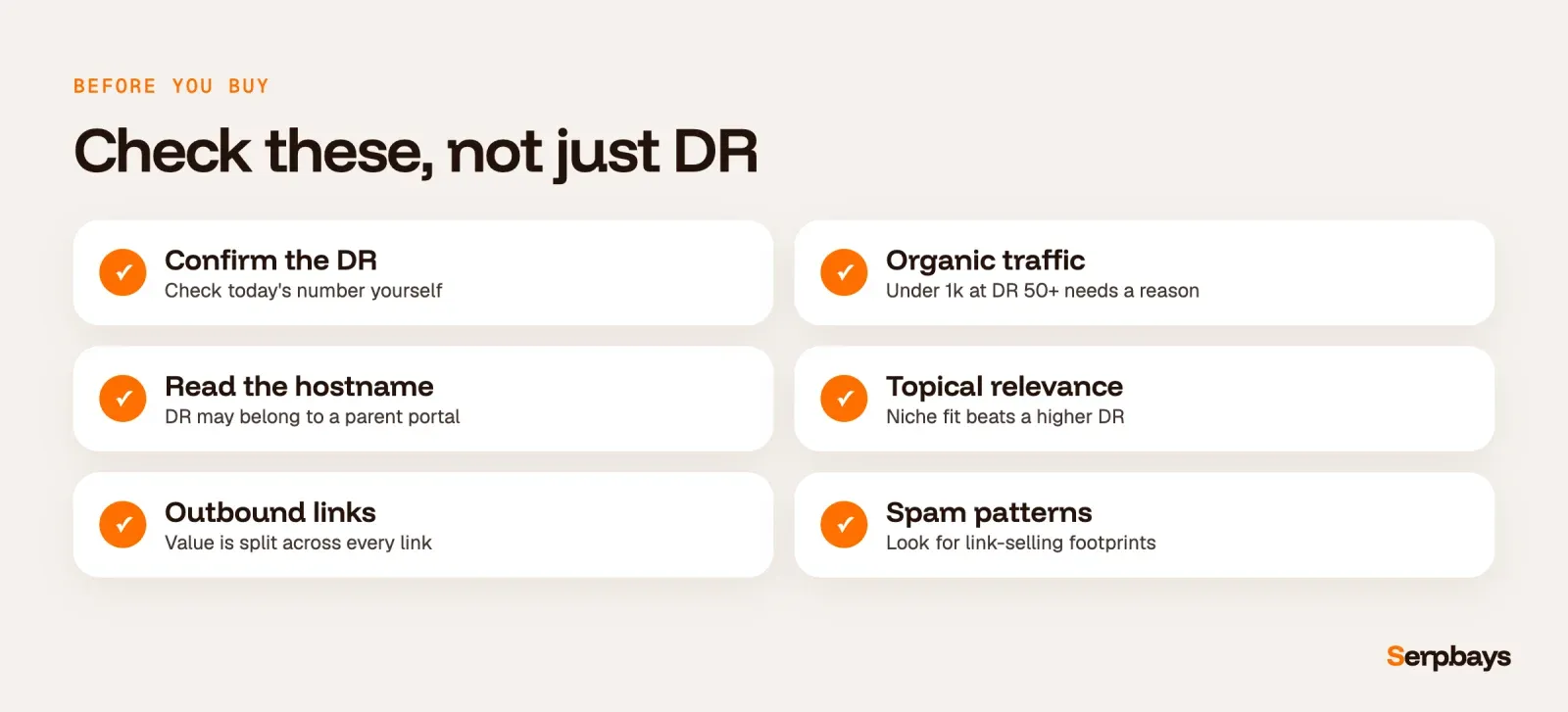
Checking the number is step one. Before you pay for a placement, run these checks too:
- Confirm the DR yourself. Sellers' spreadsheets go stale. Check today's number, not last quarter's.
- Look at organic traffic. Ahrefs itself says not to judge a site by DR alone and to consider organic traffic. Under 1,000 visits at DR 50+ needs an explanation.
- Read the hostname. Make sure the DR belongs to the site you're buying on, not to a parent portal.
- Check topical relevance. A DR 35 site in your niche usually beats a DR 70 general blog.
- Count outbound links. A site that links out to everything splits its value across everything, which is exactly how DR is calculated.
- Scan for spam patterns. Our toxic backlinks guide shows the footprints to avoid.
How to increase Domain Rating
Follow the calculation backwards. You need more unique referring domains, linking with dofollow links, from sites that themselves have decent DR and don't link out to everyone.
In practice that means links you earn with content people want to cite, digital PR, and carefully vetted placements on real sites. If you buy, buy fewer and better. Our roundup of the best places to buy backlinks compares where to do that, and our list of guest posting sites helps with outreach targets.
What not to do: chase DR for its own sake. Ahrefs notes that black-hat SEOs have found ways to inflate DR with link spam. A site with a pumped DR and no traffic is exactly the kind of site the data above warns you about. Don't become one.
FAQ
How can I check DR of a website for free?
Use a free Domain Rating checker such as the one at serpbays.com/tools/domain-rating-checker. It returns the Ahrefs DR for any domain without a login. For lists, a bulk DR checker can score up to 20 domains in one go.
Is a DR of 30 good?
It depends on who you compete with. Ahrefs says a DR is good if it's higher than or comparable to similar sites. On Serpbays, DR 20 to 39 is the most common band, with 9,834 live listings and a median Ahrefs traffic estimate of about 2,500 monthly organic visits.
Is high DR the same as high traffic?
No. In our 3 November 2026 data, 26% of sites at DR 40+ (excluding one subdomain network) are estimated by Ahrefs at fewer than 1,000 organic visits a month, while 479 sites under DR 20 are estimated at more than 10,000.
Your next step
Take the five sites ranking above you for your main keyword and run them through the bulk DR checker next to your own domain. That gap is your real target DR. When you're ready to close it, filter the Serpbays marketplace by organic traffic first and DR second.
Vinayak Gupta is the founder of Serpbays and Wordscloud, with hands-on experience in SEO, content marketing, publisher outreach, and link building. He has worked with SEO agencies, SaaS companies, and digital brands to plan content strategies, evaluate backlink opportunities, and build authority through high-quality placements. At Serpbays, he focuses on making link building more transparent, reliable, and easier for agencies and businesses.
View profile →