ChatGPT for SEO: 6 Prompts That Work and the Limits to Check
Six ChatGPT SEO prompts for clustering, briefs, titles, schema, outreach and audits, and why every number it gives you needs checking first.
· · 11 min read
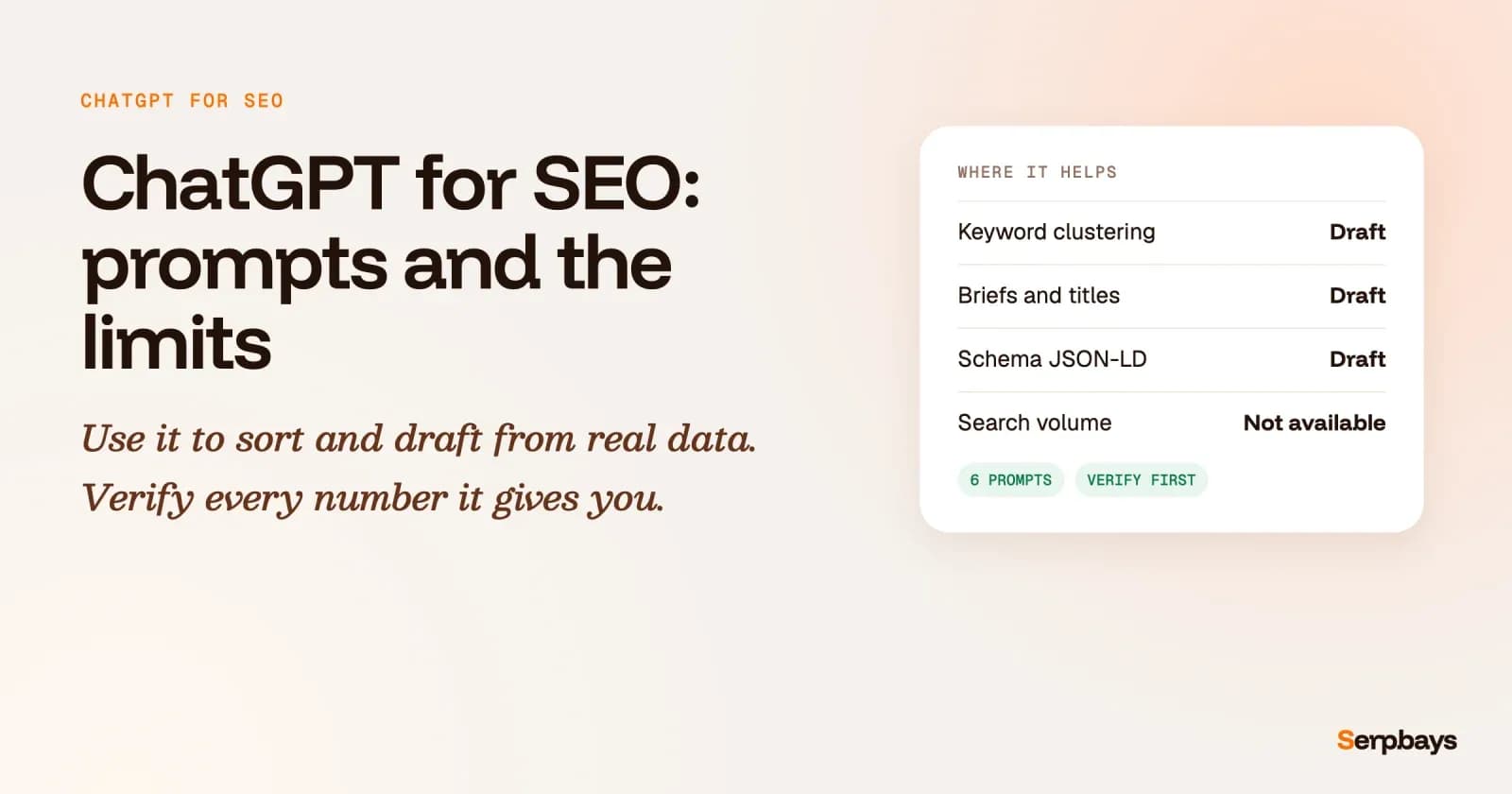
If a keyword list reaches me with a "search volume" column that came out of a chat window, I treat every number in it as made up until I see where it came from. ChatGPT is a language model. It does not have your Search Console data or Google's Keyword Planner data unless you paste them in.
That one fact decides how to use ChatGPT for SEO well. It is a fast assistant for turning data you already have into structure: clusters, briefs, titles, schema, outreach drafts and audit notes. It is a poor source of facts. Below are the prompts I would actually use for each job, and the checks that stop a draft from becoming a problem.
Short answer: Use ChatGPT for SEO as a drafting and sorting tool, not a data source. Paste in real data (keyword exports, page text, competitor headings) and ask it to cluster, outline, rewrite or format. Then verify every number, fact and line of markup yourself, because Google says AI content must be fact-checked and ChatGPT has no live search volume.
Can I use ChatGPT for SEO without risking a penalty?
Yes, and Google says so directly. Its page on using generative AI content (last updated October 2026) says generative AI "can be particularly useful when researching a topic, and to add structure to original content."
The same page sets two limits. First, publishing many AI pages "without adding value for users" may break the scaled content abuse rule in Google's spam policies, which applies "no matter how it's created." Second, it calls it "critical to manually factcheck and review all AI-generated content for accuracy and trustworthiness." That review explicitly covers titles, meta descriptions, structured data and image alt text.
So the risk is not the tool. It is publishing its output unchecked, at volume.
A scope note. This post is about using ChatGPT for SEO work on your own site. Getting ChatGPT to cite your brand is a different job, covered in our guides on how to get cited by ChatGPT, LLM SEO and generative engine optimization.
What can ChatGPT actually do for SEO work?
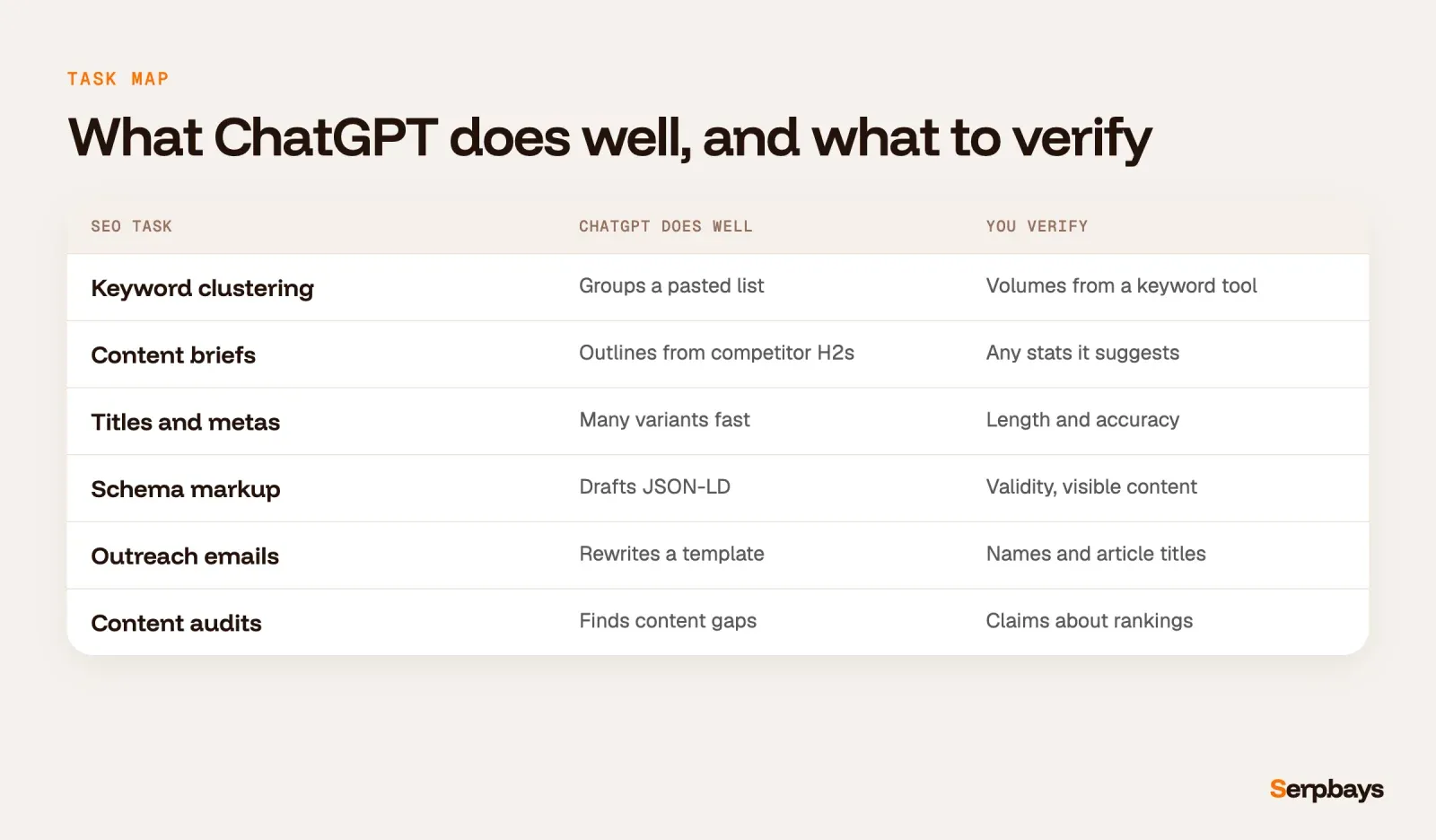
Here is how I split the work: where ChatGPT saves real time, and what you must check before anything ships.
| SEO task | What ChatGPT does well | What you must verify |
|---|---|---|
| Keyword clustering | Groups a pasted list by intent and topic | Volumes and difficulty from a keyword tool |
| Content briefs | Turns competitor headings into an outline | Facts, stats and sources it suggests |
| Titles and meta descriptions | Writes many variants fast | Length, accuracy, match with the page |
| Schema markup | Drafts JSON-LD from page details | Validity, and that it matches visible content |
| Outreach emails | Rewrites a template for one site | Names, article titles, claims about their site |
| Content audits | Spots gaps between your page and others | Anything it says about rankings or traffic |
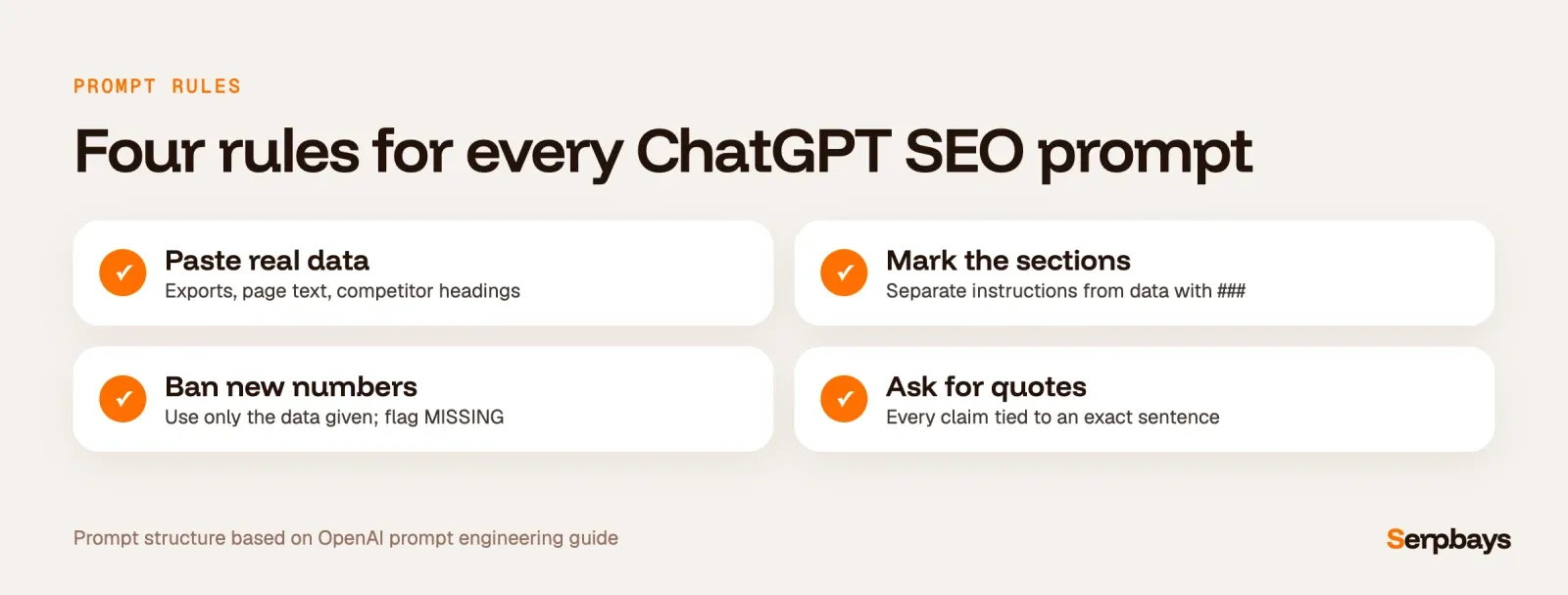
Every prompt below follows two points from OpenAI's prompt engineering guide: give the model the data it needs inside the prompt, and use Markdown headers or tags to "mark distinct sections of a prompt." I use simple ### lines to separate instructions from data. Words in capitals are what you fill in.
How to use ChatGPT for SEO keyword research
Do not ask ChatGPT to find keywords and tell you how many people search them. It has no live search volume. Google's Keyword Planner help page describes what a real source gives you: "estimates on the number of searches a keyword gets each month." Pull volumes from Keyword Planner or your paid tool, or impressions from Search Console, first.
Then use ChatGPT for the part that is slow by hand: grouping.
Prompt 1 (clustering): "You are helping me plan pages for a SITE TYPE. Below is a keyword export with volumes from TOOL. Group the keywords into clusters where one page could rank for every keyword in the cluster. Split clusters by search intent (informational, commercial, transactional). For each cluster give: the highest-volume keyword as the primary, the other keywords, the total volume and the intent. Use only the keywords and numbers in the data. Do not add keywords or change any number. List any keyword you could not place. ### DATA (paste keyword and volume rows) ### END"
The last three instructions matter most. Without them, expect "helpful" extra keywords with no source.
Then spot-check a few cluster totals, because language models are not calculators. If two "different" clusters return the same top pages in Google, treat them as one topic: build one page, not two.
Which ChatGPT SEO prompts work for briefs, titles and meta descriptions?
Briefs save the most hours, as long as you feed ChatGPT the live SERP instead of asking it to imagine one.
Prompt 2 (content brief): "I am writing a page targeting KEYWORD for AUDIENCE. Below are the H2 and H3 headings from the top 5 ranking pages, plus the People Also Ask questions. 1) List the subtopics at least 3 of the 5 pages cover. 2) List PAA questions none of them answer well. 3) Propose an outline with question-style H2s that covers both. Do not suggest statistics or studies; I will add sourced data myself. ### COMPETITOR HEADINGS (paste) ### PAA (paste) ### END"
The "do not suggest statistics" line is deliberate. A brief is where a made-up number enters a piece of content, and once it is in a brief, writers trust it.
Prompt 3 (titles and meta descriptions): "Here is the first 300 words of my page and its primary keyword. Write 8 title tags under 60 characters and 5 meta descriptions between 120 and 155 characters. Put the primary keyword near the start of each title. Only describe what the page contains; no claims about being the best, newest or most complete. ### PAGE (paste) ### END"
Check lengths in our meta tags generator, because ChatGPT's own character counts are often off. And remember Google does not have to use your title. Its title link documentation says Google may change it "if it determines that the page title doesn't reflect the page content." That is why Prompt 3 bans claims the page can't back up.
Can ChatGPT write schema markup?
It drafts JSON-LD well, and this is one of the more useful SEO prompts for ChatGPT because the format is strict and repetitive.
Prompt 4 (schema): "Write JSON-LD for the page below using the schema.org type TYPE (Article, Product, FAQPage or Organization). Use only facts that appear in the page text. If a required property is missing from the page, leave it out and tell me which one instead of guessing a value. ### PAGE (paste) ### END"
Validate the output in Google's Rich Results Test, and check it against Google's structured data policies, which say markup "must be a true representation of the page content."
The failure I'd watch for with AI-drafted schema is not broken syntax. It is invented values: a review rating, an author or a price that is nowhere on the page. If you'd rather not prompt for it at all, our free JSON-LD schema generator builds the markup from fields you fill in.
Should you use ChatGPT for outreach email drafts?
For drafts, yes. For sending unread, no. A wrong article title in the first line tells the editor you never read their site, and a model will happily fill that gap with something plausible.
Prompt 5 (outreach rewrite): "Rewrite my outreach template below for one recipient. Use only the facts in the RECIPIENT block: their name, one recent article title and what it covers. Keep it under 120 words, no compliments about their content, subject line under 7 words. If a fact you need is not in the block, write MISSING instead. ### TEMPLATE (paste) ### RECIPIENT (paste) ### END"
Start from a pitch that already works: our guest post pitch examples give you five to adapt. Then read every draft before it goes out.
Before you draft 200 emails, note that many sites already sell placements openly. In Serpbays data (26 Nov 2026), 24,355 live listings show a price, plus Ahrefs DR and traffic, up front, so there is nothing to negotiate by cold email. Keep outreach for editorial targets that can't be bought. Our link building tools guide maps which tool handles each step.
How do you run a content audit with ChatGPT?
Paste the text, not the URL. OpenAI's crawler documentation says ChatGPT "may visit a web page" when you ask it something, but you can't easily see what it actually read.
Prompt 6 (content gap audit): "Below is my page and the main text of a page that outranks it for KEYWORD. List: 1) questions the other page answers that mine does not, 2) sections where mine is vague and theirs gives a specific example, number or step, 3) anything on my page that is outdated or contradicts itself. Quote the exact sentence for every point. Do not comment on rankings, traffic or backlinks; you do not have that data. ### MY PAGE (paste) ### COMPETITOR PAGE (paste) ### END"
The quotes are the trick: they make every point checkable in seconds.
Leave the counting to tools that count. Once you've rewritten a section, paste it into our free readability checker for a Flesch score, and run it through the keyword density checker to see if the rewrite started repeating the primary term. ChatGPT will guess at both; these tools measure them.
What are ChatGPT's limits for SEO?
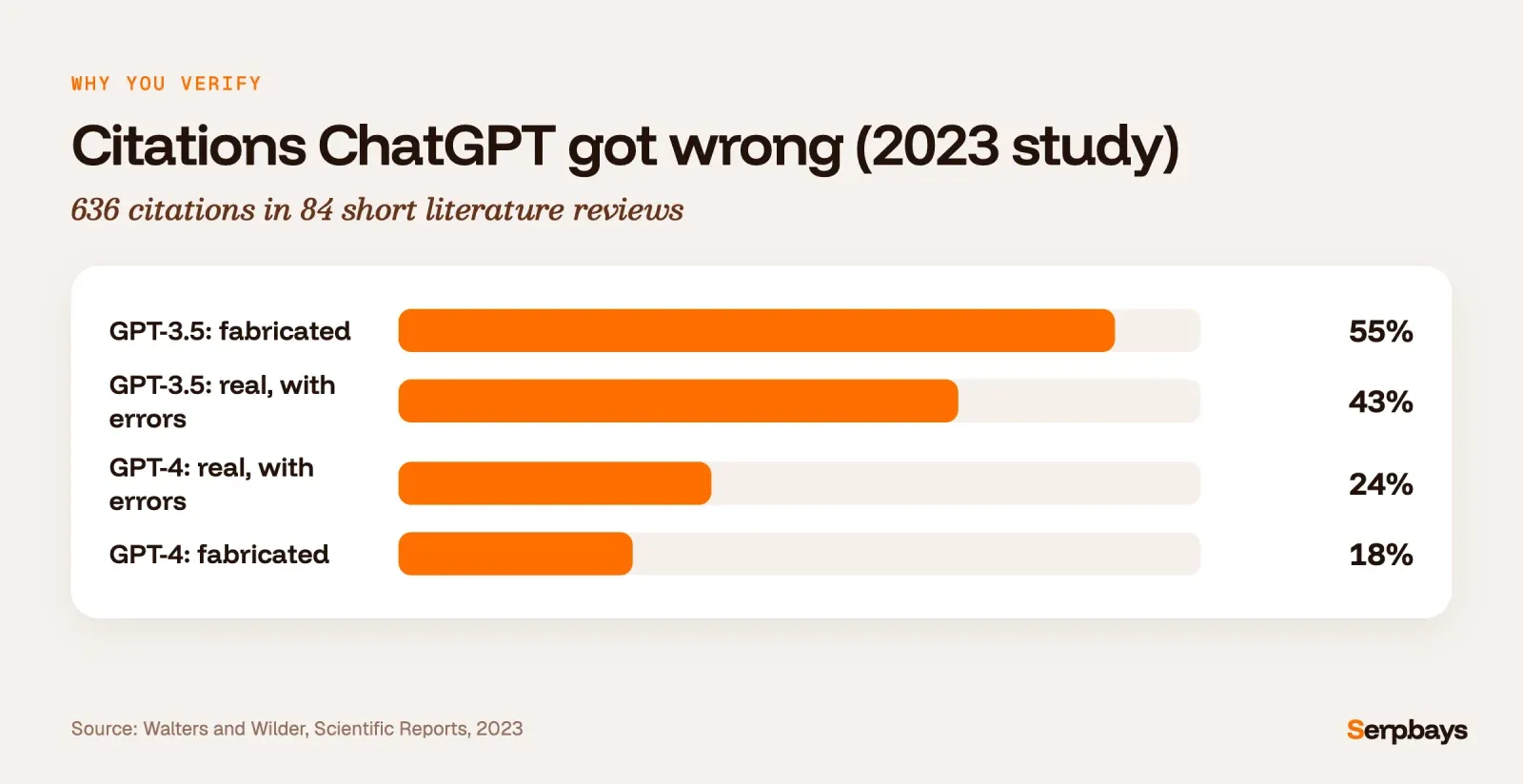
- It invents facts that look real. Google's guidance says generative models "don't retrieve facts, but predict a likely sequence of words." The clearest measurement I know is a 2023 Scientific Reports study by Walters and Wilder: across 636 citations in 84 short literature reviews written by ChatGPT, 55% of GPT-3.5's citations and 18% of GPT-4's were fabricated, and 43% and 24% of the real ones had substantive errors. Newer models do better, but the rule holds: never publish a statistic, quote or source from ChatGPT without opening it.
- It has no live SEO data. No search volume, keyword difficulty, backlinks or rankings, unless a connected tool or your paste supplies them.
- It writes the average of what exists. Ask for "a blog post about X" and you get the consensus of pages already ranking. That is the opposite of what earns links, as our post on content marketing for link building shows.
My position: the most overrated use of ChatGPT for SEO optimization is bulk article writing. The most underrated is the boring one, cleaning and sorting data you already own.
Is ChatGPT an SEO tool, or do you still need SEO tools?
You still need them. People searching for a ChatGPT SEO tool, or SEO tools for ChatGPT, are usually hoping one chat window can replace a keyword database, a crawler and a backlink index. It can't, because it doesn't hold that data.
Treat it as the layer between your tools and your output: tools give you numbers, ChatGPT turns them into drafts, you check the result. And I'd skip "ChatGPT SEO tools" that are only a prompt behind a paywall. If you can see the prompt, you can run it yourself.
FAQ
Does ChatGPT know keyword search volume?
Not on its own. It has no live connection to Keyword Planner or Search Console, so any volume it gives without your data is a guess. Export volumes from a keyword tool, paste them in, and ask ChatGPT only to sort and group them.
What are the best ChatGPT prompts for SEO?
A good ChatGPT prompt for SEO includes your real data between clear markers, forbids adding numbers or facts that are not in that data, and asks for quotes or MISSING flags so you can check the output quickly. The six prompts above follow that pattern.
Will Google penalise content written with ChatGPT?
Not because AI wrote it. Google's guidance allows generative AI for research and structure, but mass-producing pages without value can count as scaled content abuse, and Google asks you to fact-check all AI-generated content, including titles, meta descriptions and structured data.
Your next step
Pick one page that sits on page two for a keyword you care about. Export its queries and impressions from Search Console, run Prompt 1 to see which clusters the page actually serves, then run Prompt 6 against the page that outranks it. If Prompt 6 finds no real content gap, the gap is probably authority, not words. That is the point where a guest post on a relevant site is worth pricing up.
Vinayak Gupta is the founder of Serpbays and Wordscloud, with hands-on experience in SEO, content marketing, publisher outreach, and link building. He has worked with SEO agencies, SaaS companies, and digital brands to plan content strategies, evaluate backlink opportunities, and build authority through high-quality placements. At Serpbays, he focuses on making link building more transparent, reliable, and easier for agencies and businesses.
View profile →