Link Building Marketplace: How It Works and How to Choose One (2026)
What a link building marketplace is, how orders, escrow and verification work, when an agency or DIY is better, a buyer checklist and a fact-checked platform comparison.
· · 11 min read
Two listings can show the same DR 50 and a similar price, while one has real organic readers and the other has almost none. Pick a link building marketplace by the size of its catalogue, then pick sites by one number, and sooner or later you pay for the second kind.
Disclosure first: Serpbays, which publishes this blog, is a backlink marketplace. It appears in the comparison below, labelled as ours, and for every other platform I only repeat what its own website said when I checked it on 25 November 2026. This guide covers what a marketplace does, how the money and the checks work, when an agency or your own outreach is the better call, and how to choose a platform on facts instead of claims.
Short answer: A link building marketplace is a platform where publishers list their sites with prices and metrics, and you buy guest posts or link insertions on the sites you choose. The good ones show the domain and its traffic before you pay, hold your money until the link is live, and let you check the placement afterwards. Choose one by those controls, not by how many sites it claims to list.
What is a link building marketplace?
It is a two-sided platform. On one side, site owners list their websites and set a price for a sponsored guest post, a link insertion into an existing article, or both. On the other side, buyers (SEOs, agencies, brands) filter that catalogue, pick sites and place orders.
The platform sits in the middle. It shows the metrics, takes the payment, passes the brief to the publisher and handles disputes. That middle role is the whole point. Without it, you are emailing strangers, agreeing prices in a chat and paying up front with no recourse.
"Backlink marketplace" and "link building marketplace" mean the same thing. A guest post marketplace is the same model limited to one format. An aggregator is different: it indexes prices from many marketplaces so you can compare them, and you usually still order on the original platform.
How does a backlink marketplace work, step by step?
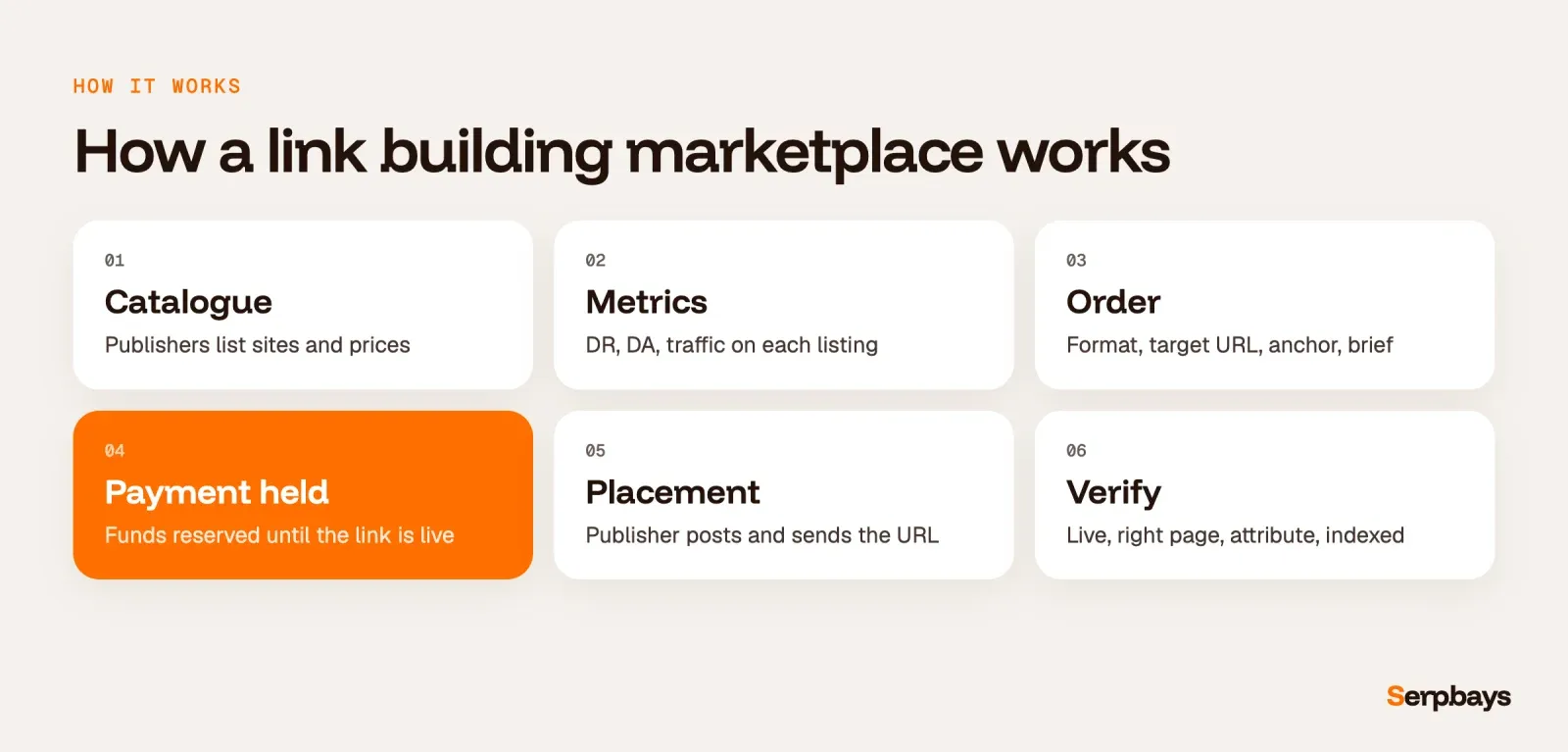
Most platforms follow the same six steps, even if they name them differently.
- Catalogue. Publishers submit sites. The platform reviews them (the depth of that review varies a lot) and lists them with niche, language, country and price.
- Metrics and filters. Each listing shows third-party numbers such as Ahrefs Domain Rating, Moz Domain Authority and an organic traffic estimate. Some platforms add data from the site's own Google Analytics or Search Console.
- Order and brief. You choose the format (guest post or link insertion), the target URL and the anchor, and either supply the article or order writing.
- Payment held. Your money is reserved on the platform, not sent straight to the publisher. On Serpbays, the buy backlinks page says "funds are held until your placement is live and meets the brief". This is the escrow step, and it is the main reason to use a marketplace at all.
- Placement. The publisher posts the content and submits the live URL.
- Verification and guarantee. You (and ideally the platform) check that the link is live, points to the right page, has the agreed attribute and is indexed. Many platforms then promise a fix or refund if the link disappears within a set period.
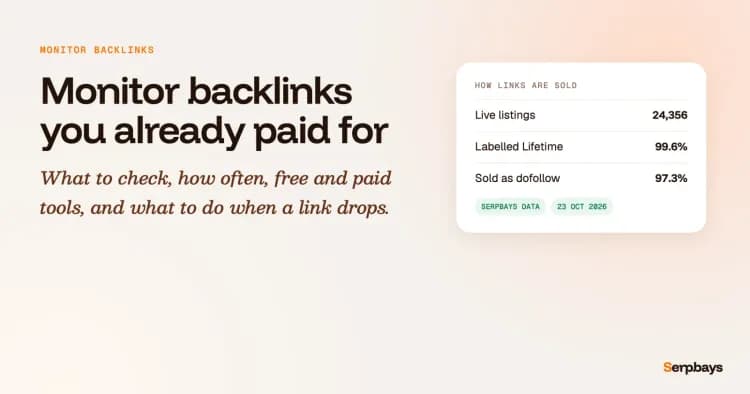
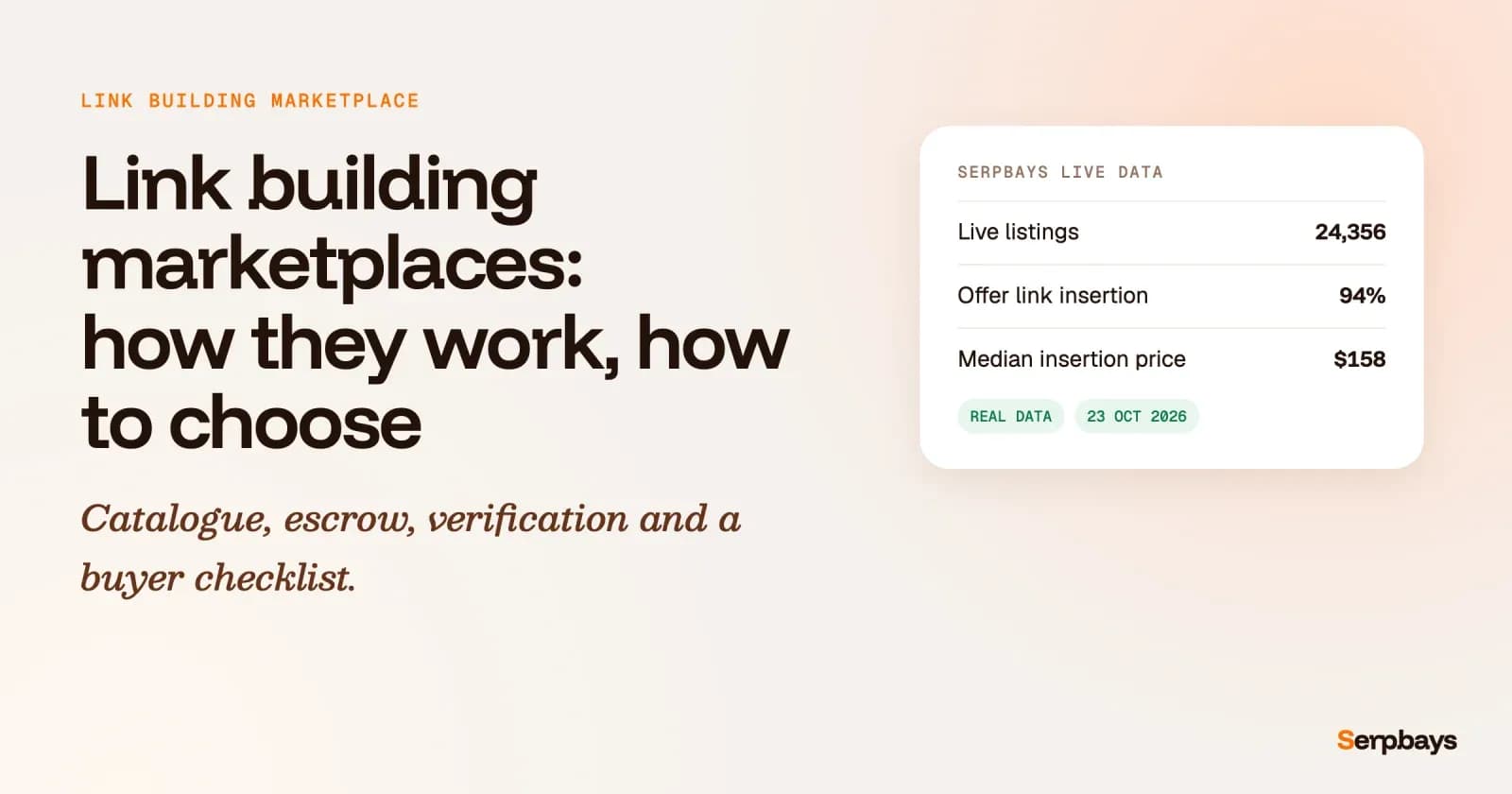
Formats differ by platform. On Serpbays, 22,934 of the 24,356 live listings (94%) offer link insertion as well as guest posts, and 99% of the link insertion listings are sold as "Lifetime" (Serpbays data, 25 November 2026). If you are unsure which format suits a page, our guest post vs niche edit guide covers the trade-offs.
Marketplace vs agency vs DIY outreach: which fits you?
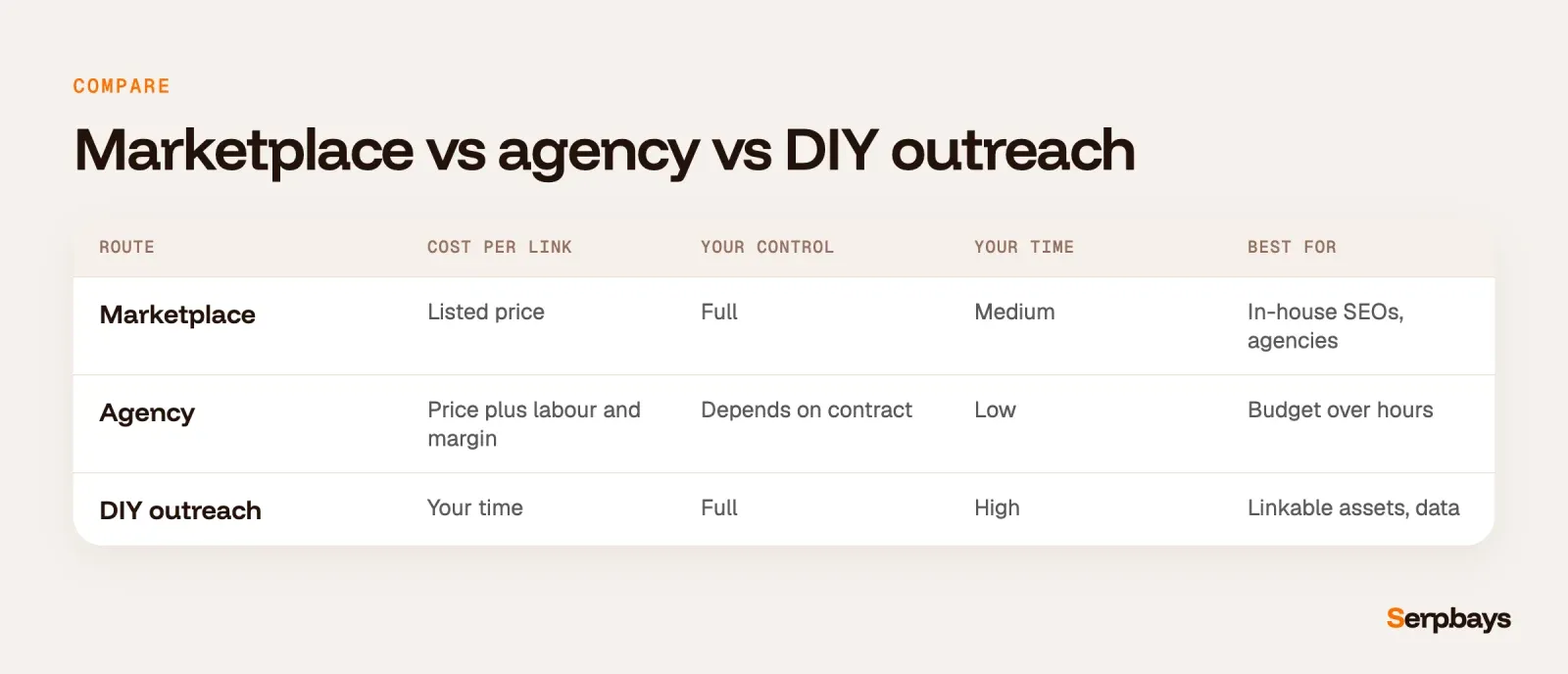
There are three ways to get paid or earned placements, and each one moves the work to a different person.
A marketplace gives you control and the lowest price per link, because you pay the listed price and do the selection yourself. The cost is your time: you vet sites, write or approve content and check placements. It suits in-house SEOs and agencies who know their niche.
An agency or managed service picks the sites, writes the content and reports back. You pay more per link for that labour and margin, and you see less of the selection unless the contract lets you approve each site. It suits teams with more budget than hours. Our guide to outsourcing link building goes through that decision in detail, and link building packages shows how to check an agency quote against marketplace prices.
DIY outreach means pitching editors yourself. It can earn links nobody can buy, but it is slow and the hit rate is low. In my experience it works best for linkable assets such as original data, not for routine placements.
My view: most teams end up mixing the three. Buy the predictable placements on a marketplace, outsource when volume outgrows your hours, and keep outreach for the links that money can't buy.
How do you choose a link building marketplace? A checklist
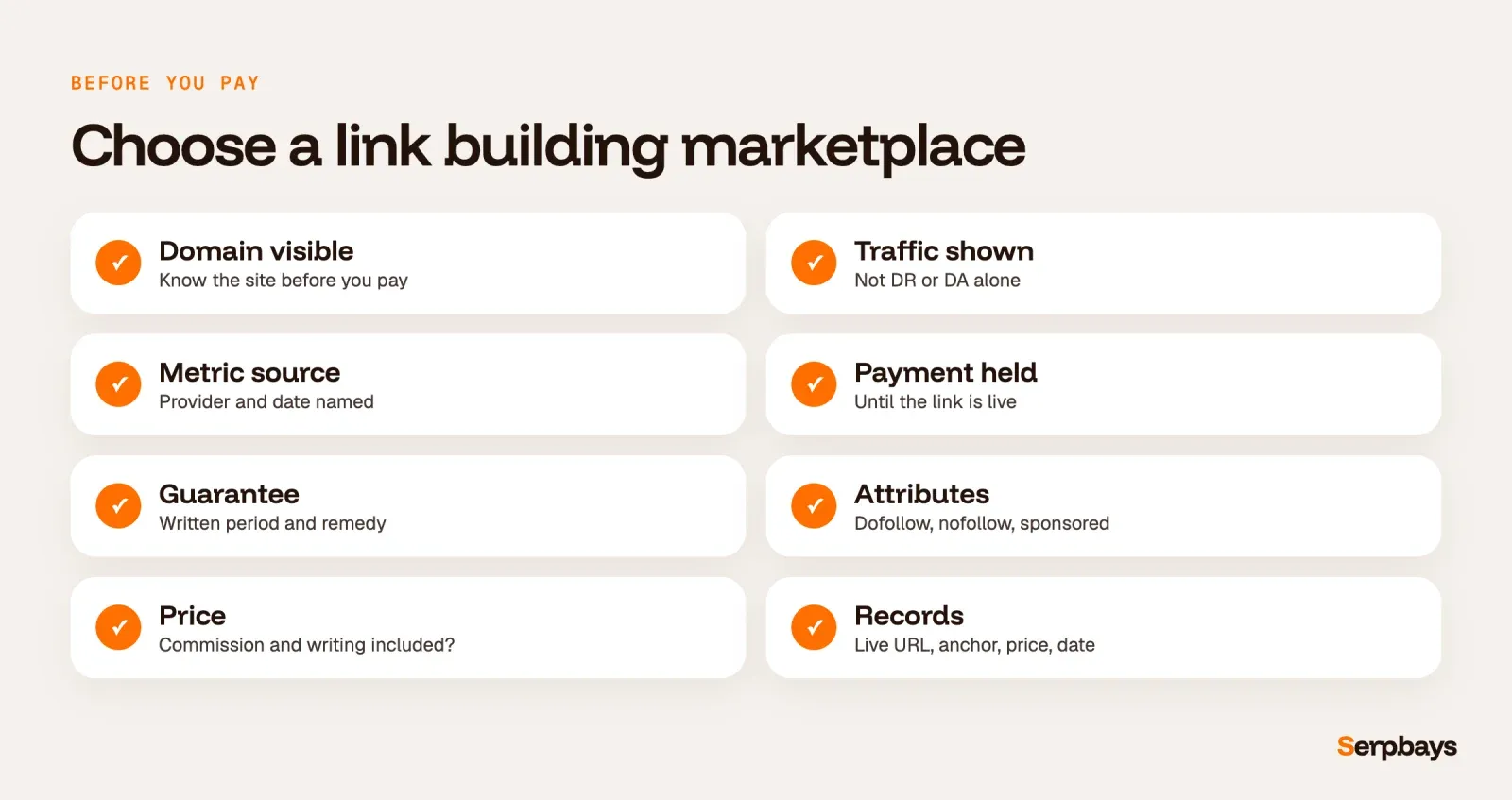
This is the part most "best of" lists skip. Before you add money to any platform, ours included, check these points.
- Domain visible before payment. You should know exactly which site you are buying on before money leaves your account. Some platforms mask domains until you sign up, which is fine. Paying blind is not.
- Traffic next to authority. DR or DA alone tells you little. Ahrefs' own help page on Domain Rating says you should never judge a website's quality on site-wide authority alone. Look for an organic traffic figure on every listing, and verify it with your own tools.
- Where the metrics come from. A listing that says "DA 60" should name the provider and ideally the date. First-party data (Google Analytics or Search Console access) is stronger than estimates.
- Payment held until the link is live. Read how refunds work if a publisher never delivers, and how long you have to dispute.
- A written guarantee period. How long must the link stay live, and what happens if it is removed or deindexed: a replacement, a refund or a credit?
- Clear link attributes. Each listing should state dofollow, nofollow or sponsored. You need this to manage risk (more on that below).
- Price transparency. Does the listed price include the platform commission and the article writing, or are they added at checkout?
- Exportable records. You want the live URL, anchor, price and date for every order, so you can monitor links later.
The trap I see most is treating catalogue size as quality. A catalogue of 100,000 sites is only useful if the filters let you throw away the 90% you don't want.
Even on our own marketplace, 3,671 of 24,025 live listings (15%) show under 100 monthly organic visits by Ahrefs' estimate, and 1,395 of those have a DR of 30 or more (Serpbays data, 25 November 2026, excluding 331 subdomains of one Polish regional news portal that all show DR 81). Filters exist for exactly this reason. Use them.
To check a shortlist quickly, paste the domains into our bulk DR checker, then look at traffic for the ones that pass. For a single site, the domain rating checker is faster.
How do link building marketplaces compare on their own claims?
The table below uses only what each platform states on its own homepage, checked on 25 November 2026. Catalogue sizes are each site's own claim, not something I audited, and they count different things (sites, offers, or channels). I haven't scored or ranked anyone. If you want a ranked roundup of places to buy, see our best places to buy backlinks list instead.
| Platform | Catalogue (as the site says) | Metrics the site names | Protection the site states |
|---|---|---|---|
| Serpbays (ours) | 24,356 live listings in our database on 25 Nov 2026 | "DA, DR, monthly traffic, and turnaround are stated up front" | Escrow protection: "funds are held until your placement is live and meets the brief" |
| Collaborator | 45,080 websites and 3,291 Telegram channels | Filter with 70+ parameters; 8,500+ sites with Google Analytics data, 7,500+ verified via Search Console | Free 3-month guarantee against deletion and non-indexing, optional paid 1-year guarantee |
| Adsy | 150K+ platforms | Moz DA, Ahrefs DR, GA traffic | Says it monitors the presence of links and provides task execution control |
| WhitePress | 148,000+ websites and 390,000+ offers, 36 languages | DR, DA and organic traffic mentioned | 36-month guarantee for publications with daily monitoring; pay-as-you-go |
| LinkBuilder.com (aggregator) | 445,000+ sites from 70+ sellers | DR, Trust Flow (Majestic) and traffic (Ahrefs) shown in the catalogue | Free tier and paid plans; says it offers a 14-day money-back guarantee |
Read the table as a list of claims to test, not a scoreboard. Collaborator says how many of its sites share Google Analytics data or are verified through Search Console. WhitePress says it offers a 36-month guarantee with daily monitoring. LinkBuilder.com is a different kind of product: the site says it aggregates over 5 million prices from 70+ marketplaces and platforms, so it is a price-comparison layer rather than a single catalogue.
For Serpbays, the live listing count comes from our own database. Prices sit in a wide band. The median link insertion price across live listings is $158, ranging from $80 for DR 0-19 sites to $287 for DR 60-79 sites (Serpbays data, 25 November 2026). For a breakdown of what smaller budgets buy, see what cheap backlinks actually buy.
Is link buying for SEO allowed on a marketplace?
Using a marketplace does not change Google's rules. Google's spam policies list "Buying or selling links for ranking purposes" as link spam, including "Exchanging money for links, or posts that contain links". The same page also says Google understands that buying and selling links is a normal part of the web for advertising, and that such links are not a policy violation as long as they are qualified with rel="nofollow" or rel="sponsored".
Google's guide to qualifying outbound links says the sponsored value is for links that are "advertisements or paid placements". So link buying for SEO, where the link passes ranking credit, carries risk however tidy the checkout is. A marketplace can show you the attribute and the site quality. It cannot make a paid followed link compliant.
Buyers clearly accept that trade-off. In Editorial.Link's 2026 survey of 518 SEO professionals, 63.1% said they would place links on sites listed on link building marketplaces if the quality were right. The same survey put the average acceptable price for one high-quality backlink at $508.95, based on 412 answers. My advice: keep anchors natural, avoid sites that obviously exist to sell links, and read our guide on toxic backlinks before you panic about any single link.
FAQ
Which link building marketplace is the best?
There isn't one best platform for everyone. The best fit is the one that shows the domain and traffic before you pay, holds funds until the link is live, states a guarantee period and has enough sites in your niche and language. Check those four points on two or three platforms, then compare prices for similar sites.
How much does link building cost on a marketplace?
Prices are set per site by each publisher. On Serpbays, the median link insertion price was $158 on 25 November 2026, from $80 for DR 0-19 sites up to $287 for DR 60-79 sites. Editorial.Link's 2026 survey found SEOs would accept $508.95 on average for one high-quality link.
Is buying backlinks illegal?
I'm not a lawyer, and advertising disclosure rules vary by country, so check yours. For SEO, the risk that matters is Google's spam policies: paid links that pass ranking credit count as link spam, while paid links marked rel="sponsored" or rel="nofollow" do not violate them.
Your next step
Pick one page you want to rank and write down five sites you would be proud to be linked from. Then open two marketplaces, filter for your niche with a traffic floor, and see which platform lets you check those sites, see the price and hold payment until the link is live. If you want to test that process on ours, start on the Serpbays buy backlinks page and run every shortlisted domain through the checklist above before you order.
Vinayak Gupta is the founder of Serpbays and Wordscloud, with hands-on experience in SEO, content marketing, publisher outreach, and link building. He has worked with SEO agencies, SaaS companies, and digital brands to plan content strategies, evaluate backlink opportunities, and build authority through high-quality placements. At Serpbays, he focuses on making link building more transparent, reliable, and easier for agencies and businesses.
View profile →