Law Firm Link Building in 2026: Directories, Local Links and Bar Rules
Which law firm backlinks to build first, what ABA Model Rule 7.2 means for paid placements, and what legal publishers cost, with Serpbays marketplace data.
· · 11 min read
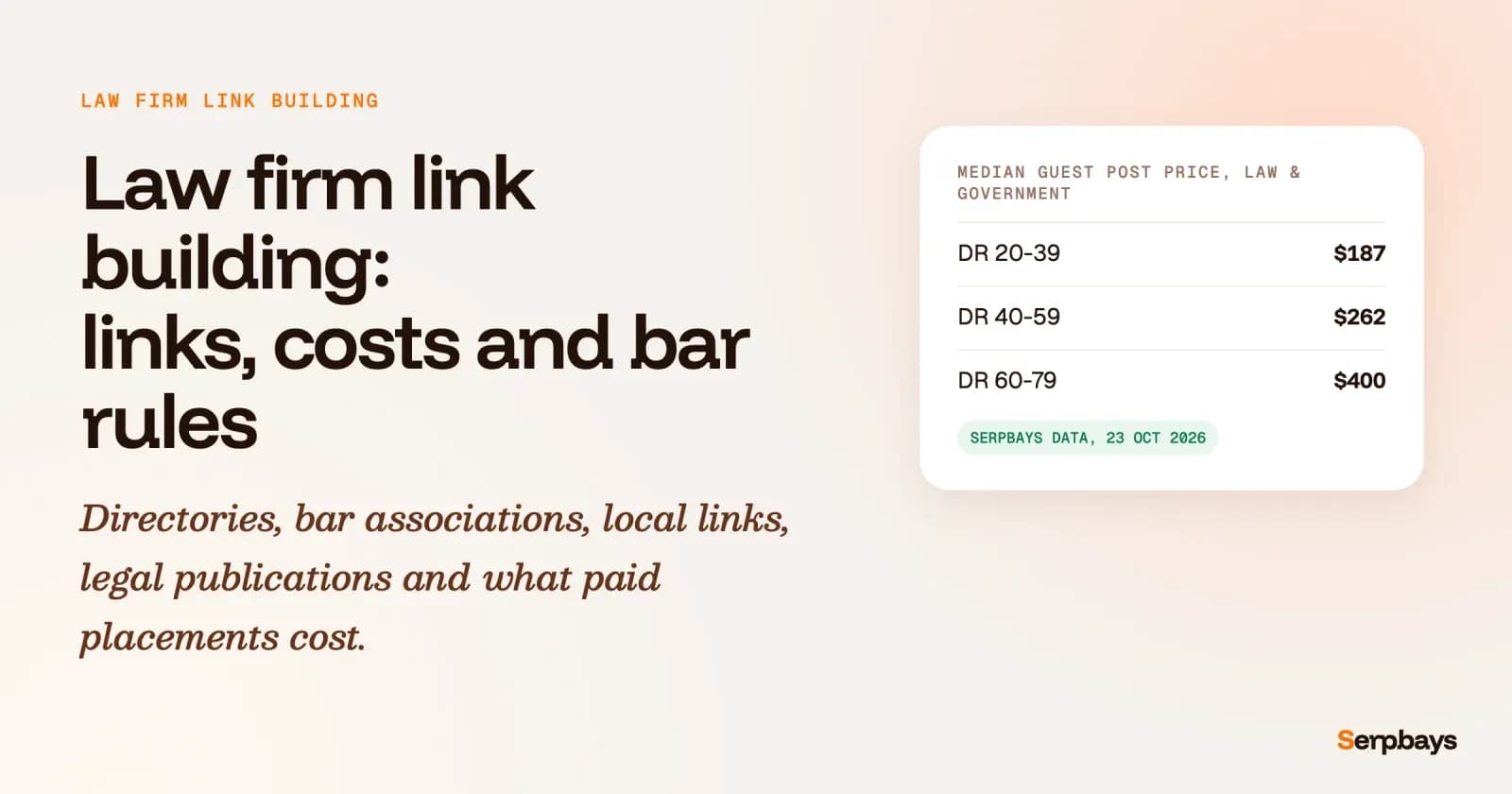
A personal injury firm can buy a guest post on a DR 50 site for a few hundred dollars and lose more than the fee. Google may treat the link as spam. If the article praises the firm as the best in town, a state bar may also see it as paying someone to recommend a lawyer. Few buyers face two rulebooks for one link the way lawyers do.
This guide covers law firm link building (most agencies call it link building for lawyers) as it works in 2026: which links to build first, what the ABA Model Rules actually say about paying for them, and what legal publishers cost on our marketplace. It is marketing guidance from someone who buys and sells links for a living, not legal advice.
Short answer: The best law firm backlinks come from legal directories, bar associations, local organisations, legal publications that quote or publish you, and content other lawyers and journalists want to cite. Paid placements can work, but in the US they sit under your state's version of ABA Model Rule 7.2 as well as Google's link rules. Keep them labelled as advertising, keep links qualified, and never let a paid article vouch for your competence.
Why is law firm link building harder than other niches?
Because legal content is, in my reading, a "Your Money or Your Life" topic, and Google holds those pages to a higher bar. Its guide to creating helpful, reliable content uses the YMYL label for topics that could significantly impact people's health, financial stability or safety, and says its systems give "even more weight" to strong E-E-A-T there. Of those aspects, it says "trust is most important." A page about a DUI defence or a custody dispute fits that description easily.
Links are one of the ways trust shows up. For the map pack, Google's Google Business Profile help page on local ranking lists relevance, distance and prominence, and says prominence is "based on info like how many websites link to your business and how many reviews you have." Most firms win clients from a city or a county, so lawyer SEO is mostly local SEO with stricter content standards.
The second difficulty is supply. Real legal publications are picky, and many sites that sell "law" placements are general news sites with a politics section. I'll show the numbers further down.
Can lawyers pay for backlinks under the ABA Model Rules?
This is the part most guides skip. The ABA Model Rules of Professional Conduct are a model. Each US jurisdiction adopts its own version, and the wording differs from state to state. The ABA's own list of jurisdictions adopting the Model Rules does not include California, and it lists Puerto Rico as not having adopted them. Outside the US, none of this applies; your own regulator sets the rules.
ABA Model Rule 7.2 says a lawyer "shall not compensate, give or promise anything of value to a person for recommending the lawyer's services," with five exceptions. The first lets a lawyer "pay the reasonable costs of advertisements or communications permitted by this Rule." Paragraph (d) adds that any such communication must include the name and contact information of at least one lawyer or firm responsible for its content.
The official comment on Rule 7.2 is more useful for link building than the rule itself:
- Comment 2: a communication "contains a recommendation if it endorses or vouches for a lawyer's credentials, abilities, competence, character, or other professional qualities." Directory listings that list lawyers by practice area, "without more," are not recommendations.
- Comment 3: paying for "on-line directory listings," "sponsorship fees" and "Internet-based advertisements" falls under the advertising exception, and lawyers may pay marketing vendors and website designers.
- Comment 5: paying lead generators is allowed only if the lead generator does not recommend the lawyer, among other conditions.
My reading, as a marketer: a paid directory listing or a sponsorship is advertising, which the rule allows. A paid guest post that reads like an independent writer calling you "the most trusted injury attorney in Dallas" is where the risk sits, because it looks like a bought endorsement. Write paid content as your firm's own voice, name the firm on it, and check your state bar's rules or an ethics counsel before you buy anything.
Google adds its own layer. Its spam policies list "buying or selling links for ranking purposes" as link spam, but also say links bought for advertising and sponsorship are fine when they carry rel="nofollow" or rel="sponsored". Google's guide to qualifying outbound links says to mark "advertisements or paid placements" with the sponsored value. Our explainer on what a sponsored post is covers disclosure in detail.
Which law firm backlinks should you build first?
Start with links that would exist even if Google didn't. They are the cheapest, they carry the least risk under both rulebooks, and they keep your firm's name and address consistent across the web.
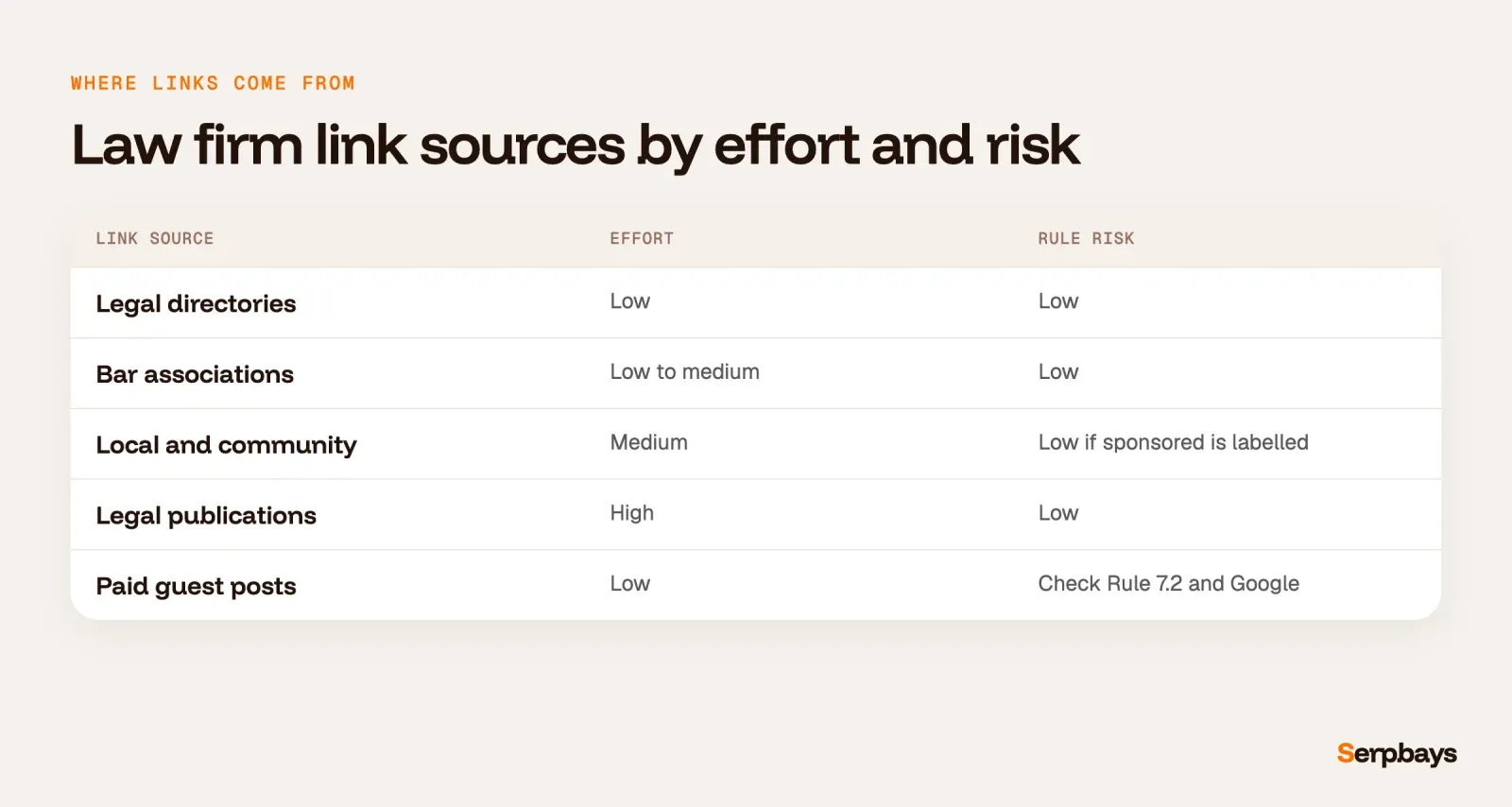
| Link source | Examples | Effort | Notes |
|---|---|---|---|
| Legal directories | Justia, Avvo, FindLaw, Martindale-Hubbell profiles | Low | Claim and complete them. Much of the value is visibility with clients, not link equity. |
| Bar associations | State and county bar member directories, section pages, CLE speaker pages | Low to medium | Membership and speaking, not payment, earn these. |
| Local and community | Chamber of Commerce, local charities you support, school or sports sponsorships | Medium | Sponsorship links should be rel="sponsored". |
| Legal publications | Bylined articles, expert quotes, law school or legal blog interviews | High | The strongest topical links. Pitch expertise, not your firm. |
| Content assets | Statute explainers, court process guides, local resource pages | High | Earn links from journalists, other lawyers and nonprofits over time. |
Two things I'd skip. Generic web directories with no legal or local audience: Google lists "low-quality directory or bookmark site links" as link spam. And link swaps with other firms: "excessive link exchanges" is on the same list, and a page of reciprocal attorney links helps nobody.
Journalist requests are the fastest route to legal publication links, because reporters always need a lawyer to explain a ruling. Our roundup of HARO alternatives lists the platforms that replaced it.
How do attorney backlinks come from content?
Lawyers have an advantage most niches lack: people genuinely need explanations of the law, and few sites write them well. A plain-English guide to your state's statute of limitations for injury claims, or a step-by-step walk through small claims court in your county, is the kind of page a local news site, a library or a nonprofit links to without being asked.
What works, in my experience:
- Process guides. A page on what happens at an arraignment in your county, written by a named attorney with a bar number on the bio.
- Change explainers. When a law changes, publish the explainer the same week and send it to the reporters who covered the bill.
- Resource pages. Lists of local legal aid clinics, victim support groups and court self-help centres. Organisations on the list often link back.
Keep these pages informational. A guide that ends in a hard sales pitch stops being something a journalist can cite. Our guide to content marketing for link building covers how to promote assets like these, and digital PR is the next step once you have data worth pitching.
What do law firm backlinks cost?
We ran read-only queries on the Serpbays marketplace on 27 November 2026. There is no separate "legal" tag. The closest category is "Law & Government", with 2,787 live listings. I excluded the 20 listings at DR 80 and above, which left 2,767.
Read the next numbers with one caveat. Only 41 of the 2,767 have law, legal, lawyer or attorney in the domain name, and 2,132 carry four or more category tags. So expect many paid "legal backlinks", here or on any marketplace, to be general news and magazine sites that also cover politics, courts and government. Check what each site actually publishes before you buy. A general news site is fine for a news-style story about a ruling. It is not the same as a link from a legal publication.
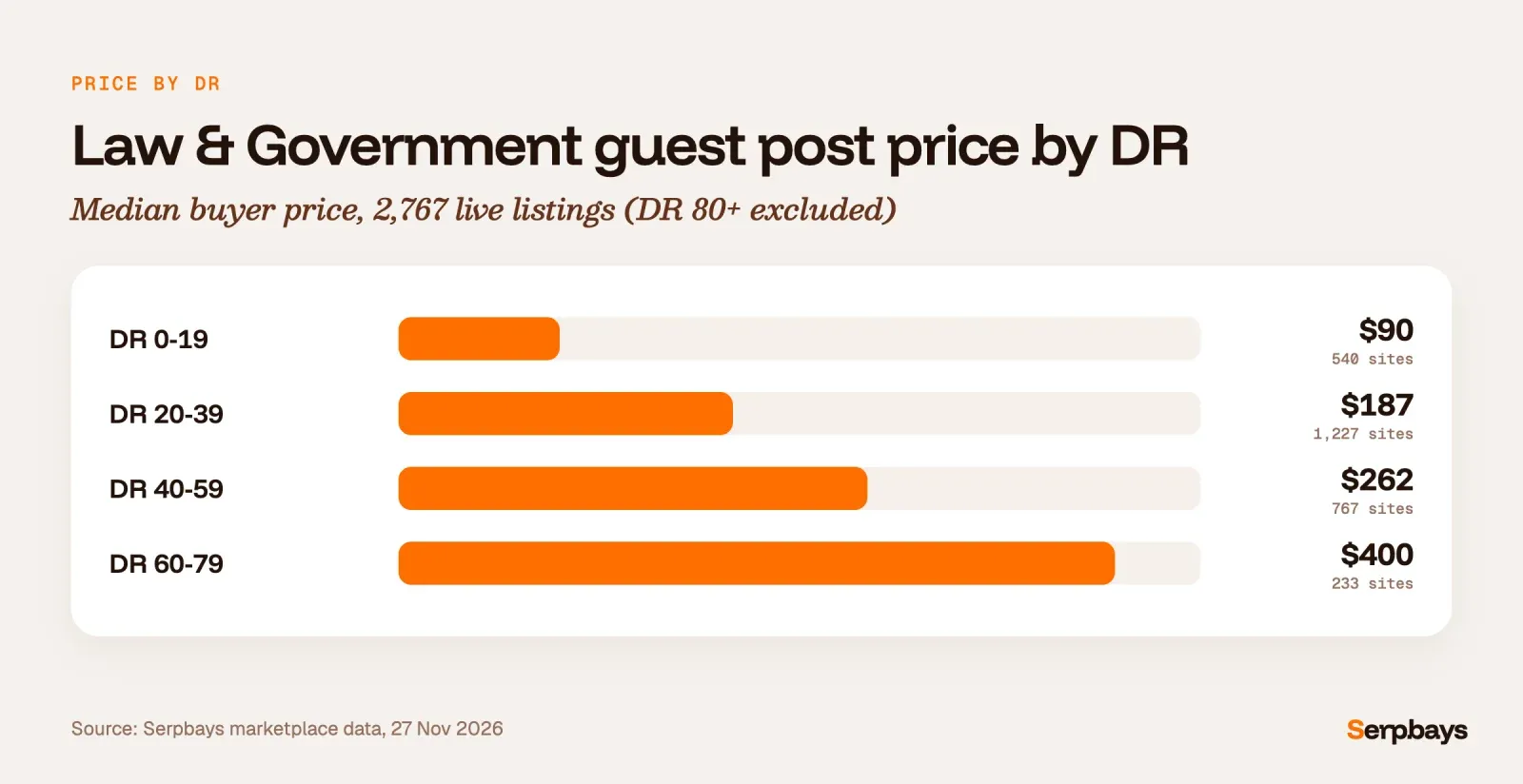
The median guest post price in the category is $195.50, and the median DR is 33. By Ahrefs DR band, the median buyer prices for a guest post are:
- DR 0-19: $90 (540 listings, middle half $29-163)
- DR 20-39: $187 (1,227 listings, $100-315)
- DR 40-59: $262 (767 listings, $120-404)
- DR 60-79: $400 (233 listings, $220-598)
Law costs more than the marketplace average. Comparing link insertion prices like for like, the Law & Government median is $196 against $161 across all 22,451 link insertion listings under DR 80, and it is higher in every DR band (DR 60-79: $400 against $287).
Geography matters more than DR. The 45 listings on English-speaking country domains (.uk, .au, .ca, .us, .nz, .ie) have a median of $581 at a median DR of 34. The most common domains after .com are .ua (284), .br (191) and .it (181). A US firm gets little from a Brazilian news site, whatever its DR. Our Law & Government guest post sites page lists publishers with their DR, DA and traffic, with prices shown after sign-in, and the wider backlink marketplace covers other niches.
How do you vet a legal publisher before paying?
DR alone tells you very little here. In the same category, 1,000 listings are DR 40 or higher, and 170 of those get under 1,000 monthly organic visits by Ahrefs' estimate. High authority with no readers is the classic sign of a site that exists to sell links.
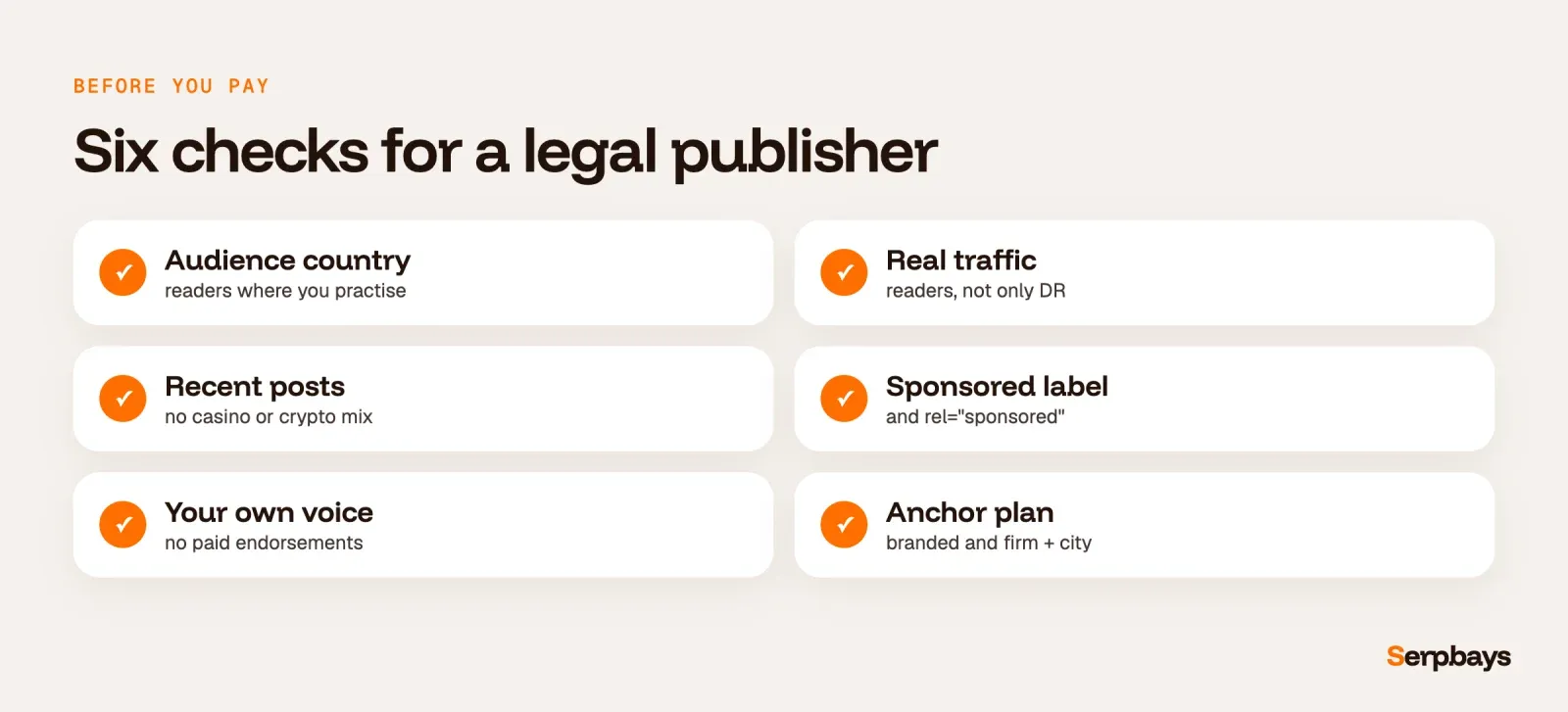
- Check the audience country. Your clients live in one state. A placement should reach readers in your country at least.
- Check real traffic. Use the seller's numbers as a starting point, then confirm DR yourself with our free domain rating checker, or the bulk DR checker for a whole shortlist.
- Read five recent posts. If legal advice sits next to casino reviews and crypto tips, walk away.
- Ask about the label. Will the post be marked as sponsored, and will the link carry rel="sponsored"? A publisher that refuses both is asking you to carry the risk.
- Write it as your own voice. Name the firm and a responsible lawyer, avoid "best" and "top" claims, and keep it informational.
- Plan the anchor. Branded and "firm name + city" anchors are safest for a YMYL site. Our guide to anchor text distribution has the ratios.
If a link already went wrong, read our take on toxic backlinks before you reach for the disavow tool. Most firms don't need it.
FAQ
How much does law firm link building cost?
On the Serpbays marketplace on 27 November 2026, the median guest post price in the Law & Government category was $195.50, rising from $90 at DR 0-19 to $400 at DR 60-79. English-speaking country domains cost much more, with a median of $581. Earned links cost staff time instead: writing guides, answering journalists and showing up at bar events.
Are legal directory links worth it for a law firm?
The established ones are. Justia, Avvo, FindLaw, Martindale-Hubbell and your state and county bar directories put your firm where clients and other lawyers look, and the ABA comment says a plain practice-area listing is not a recommendation. Skip generic directories that exist only to hold links.
Is it ethical for lawyers to buy backlinks?
Paying for advertising is allowed under ABA Model Rule 7.2(b)(1), but paying someone to recommend you is not, and each state applies its own version of the rule. Keep paid placements labelled, written in your firm's voice and qualified with rel="sponsored", and confirm with your state bar. This is general information, not legal advice.
What should you do next?
Open a spreadsheet and list every directory, bar section, court, charity and local organisation your firm already has a real relationship with. Check which ones link to you today. Fixing that list is the cheapest law firm link building you will ever do, and it gives you a clean base before you spend anything on paid placements.
Vinayak Gupta is the founder of Serpbays and Wordscloud, with hands-on experience in SEO, content marketing, publisher outreach, and link building. He has worked with SEO agencies, SaaS companies, and digital brands to plan content strategies, evaluate backlink opportunities, and build authority through high-quality placements. At Serpbays, he focuses on making link building more transparent, reliable, and easier for agencies and businesses.
View profile →