Link Equity in SEO: What Passes It, What Leaks It (Google's Own Rules)
Link equity explained from primary sources: how PageRank passes value, which links carry it, and what nofollow, redirects, noindex and link count do to it.
· · 11 min read
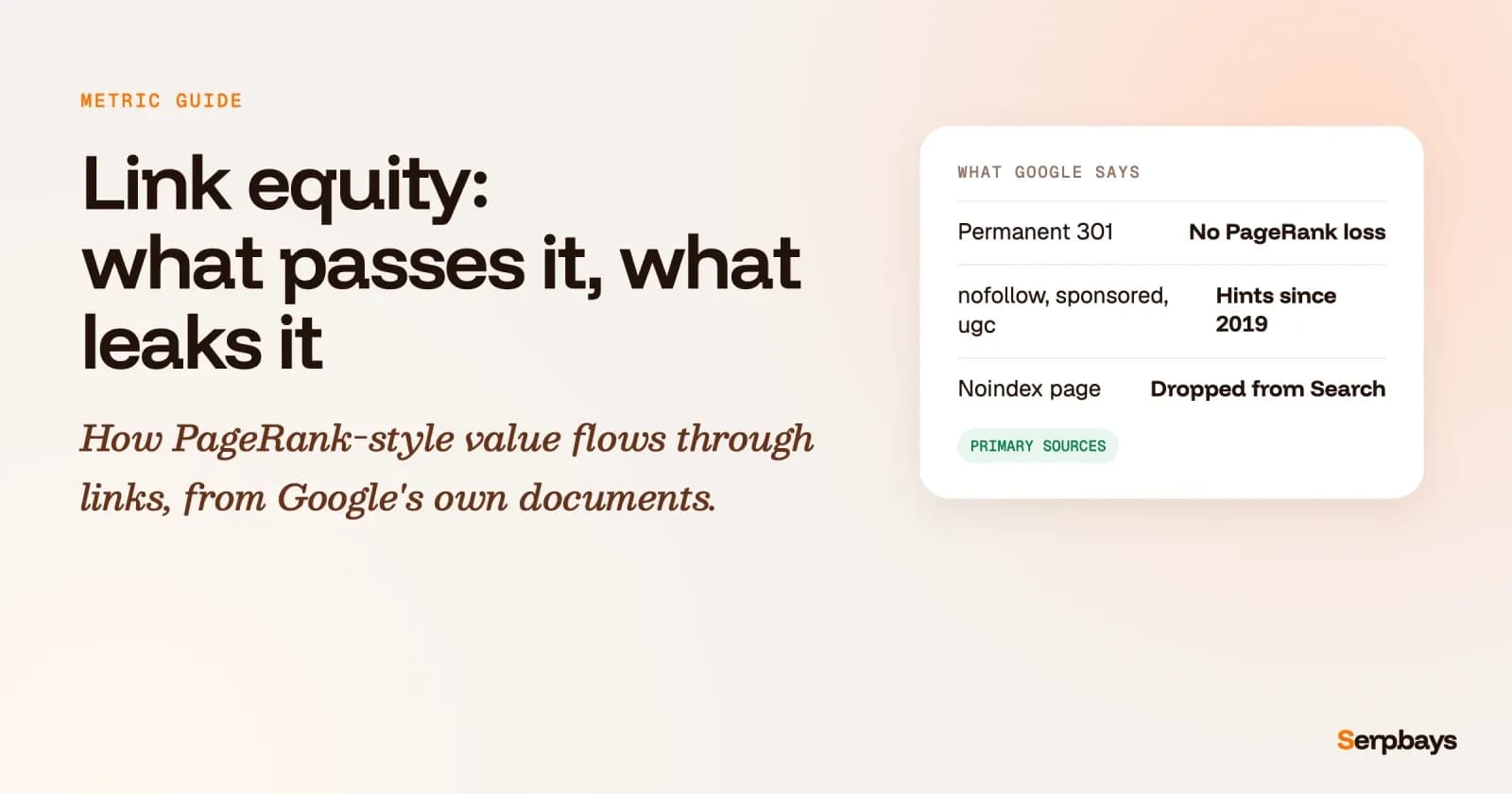
Plenty of SEO guides put a percentage on how much value a nofollow link, a 301 or a footer link passes. None of those figures come from Google. Google has never published a link equity percentage for anything.
What Google has published is enough to make good decisions: the PageRank patent, its link best practices, the 2019 nofollow change and its spam policies. This guide sticks to those primary sources and our own marketplace data.
Short answer: Link equity (often called link juice) is the ranking value a page passes to the pages it links to. It comes from PageRank-style link analysis, where a page's score is built from the scores of the pages linking to it and is split across that page's outgoing links. Followed, contextual links on relevant pages pass it best; nofollow, sponsored and ugc links, noindexed pages, broken targets and pages stuffed with links pass less or none.
What is link equity?
Link equity is the SEO term for the value one page hands to another through a hyperlink. "Link juice" is the slangier name for the same idea. Google's own documents talk about PageRank, "ranking credit" and links as a signal instead.
The idea is real. Google's guide to ranking systems says Google has "various systems that understand how pages link to each other as a way to determine what pages are about and which might be most helpful in response to a query." It names PageRank as one of them and says "How PageRank works has evolved a lot since then, and it continues to be part of our core ranking systems."
So link equity SEO is not folklore. But nobody outside Google knows the exact amounts, and anyone quoting a precise figure is guessing.
How does PageRank pass value through links?
The clearest public description is the PageRank patent, US6285999, "Method for node ranking in a linked database", filed by Stanford in 1998 with Lawrence Page as inventor. Its abstract says "The rank assigned to a document is calculated from the ranks of documents citing it."
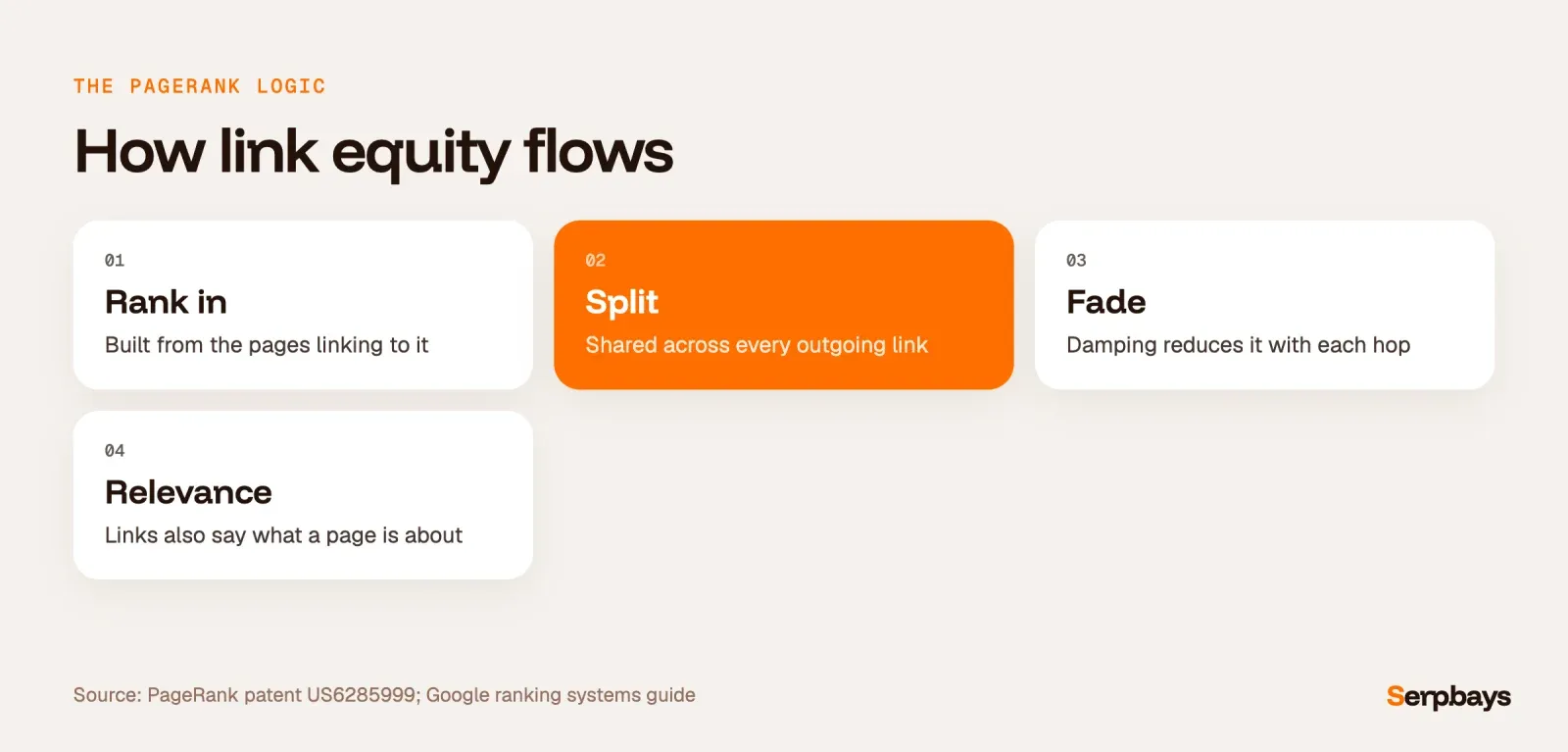
Three ideas from that 1998 patent explain most of what people mean by seo link equity:
- Value comes from the linking page's own rank. A link from a page that many important pages point to is worth more than a link from an orphan page. The patent says "a high rank indicates that a document is considered valuable by many people or by important people."
- The value is split across outgoing links. In the patent's formula, each page's contribution is divided by "the total number of forward links from node i." More links on the page means a smaller share for each one.
- Value fades with distance. A damping factor "limits the extent to which a document's rank can be inherited by children documents," modelling the fact that "users typically jump to a different place in the web after following a few links."
Google says PageRank has evolved a lot since, so treat the patent as the logic, not the current maths. It still works as a buying filter: who links to the page, how many links share it, and how far it sits from strong pages.
Which links pass link equity?
Google's link best practices open with this line: "Google uses links as a signal when determining the relevancy of pages and to find new pages to crawl." Note the word relevancy: a link also tells Google what the target is about.
From the same page, the links that work best share four traits:
- Crawlable. "Generally, Google can only crawl your link if it's an <a> HTML element" with an href.
- Followed. No nofollow, sponsored or ugc value in the rel attribute. These are the links people call dofollow links, though "dofollow" is not an actual attribute.
- Contextual. Google tells site owners to "link to those pages in context".
- Descriptive anchor. Google says good anchor text is "descriptive, reasonably concise, and relevant to the page that it's on". If you buy links, keep anchors varied. Our anchor text distribution guide covers safe ratios.
In my experience, relevance is where most buyers lose value. A followed link from a mid-strength page on your exact topic usually moves rankings more than one from a strong page in an unrelated niche.
Do nofollow, sponsored and ugc links pass link equity?
Officially: maybe, and Google decides. On 10 September 2019, Google announced that rel nofollow, rel sponsored and rel ugc "now work today as hints for us to incorporate for ranking purposes." Its current page on how to qualify outbound links still says "Links marked with these rel attributes will generally not be followed."
My position: a hint is not a promise. Never pay for nofollow links for their ranking value. Buy them only for the referral traffic or the brand placement. Our types of backlinks guide compares the four rel types side by side.
What reduces or blocks link equity?
Here is what Google's own documents say about the common leaks. Where Google is silent, I say so.
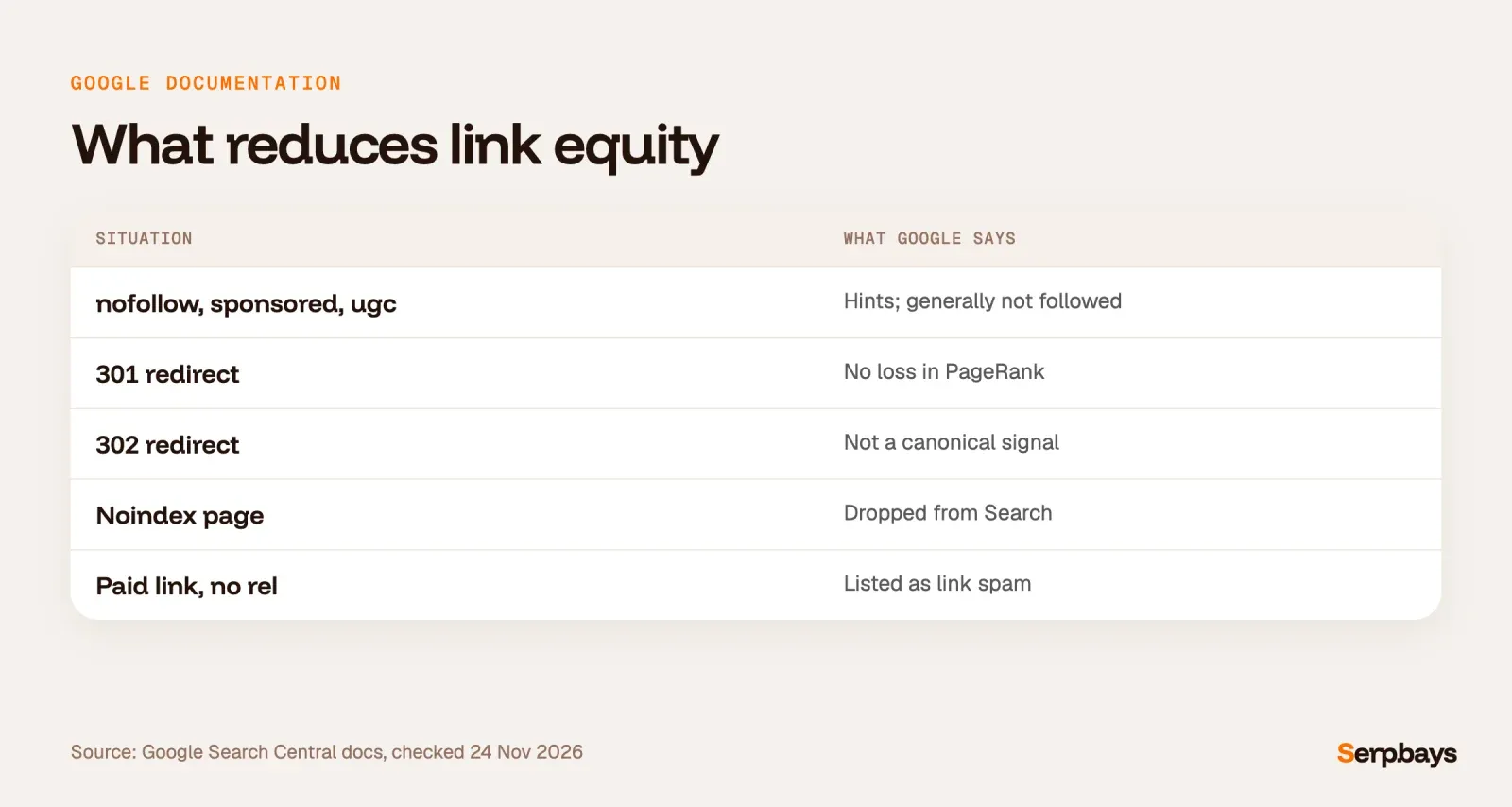
| Situation | What Google says | Practical effect |
|---|---|---|
| rel nofollow, sponsored or ugc | Treated as hints since 2019; "generally not be followed" | Don't count on equity |
| 301 or other permanent redirect | "301 and other permanent redirects don't cause a loss in PageRank" | Safe for moved URLs |
| 302 or other temporary redirect | Not used as a signal that the target should be canonical | Use 301 for permanent moves |
| Noindex on the page | Google will "drop that page entirely from Google Search results, regardless of whether other sites link to it" | Weak place to buy a link |
| Very many links on one page | "There's no magical ideal number of links"; "if you think it's too much, then it probably is" | Each link gets a smaller share |
| Paid link without rel qualifier | Listed as link spam in the spam policies | Risk of being discounted |
The redirect rows come from Google's site move guide, which opens that point with "Don't worry about link credit," and its redirects page.
So 301 redirect link equity is not the problem it is often sold as. The real problems are broken targets, long chains and 302s left in place for years. Run any target URL through our free redirect checker, which follows up to 10 hops and shows every status code.
Noindex is the leak buyers miss most. The quote comes from Google's noindex documentation, which doesn't say how links on a noindexed page are treated. My rule: if the page carrying your paid link can't be found in Google, don't pay for it. Paste placement URLs into the bulk noindex checker (up to 100 at once) before and after you buy.
The paid-link row in that table applies to any followed paid link, from any seller. Google's spam policies list "Buying or selling links for ranking purposes" as link spam, and say paid links are not a violation "as long as they are qualified with a rel="nofollow" or rel="sponsored" attribute". Anyone buying followed links accepts that risk.
In my experience, you reduce it by buying placements a real editor would publish anyway: relevant sites, in-content links, natural anchors. Our toxic backlinks guide covers what actually gets links discounted.
Does link placement on the page matter?
Google doesn't publish a weighting for body versus footer links. What it does publish points one way. Its spam policies list "Widely distributed links in the footers or templates of various sites" and "Keyword-rich, hidden, or low-quality links embedded in widgets" as examples of link spam.
That is reason enough to pay for in-content placements only. A sitewide footer link matches the exact pattern Google describes.
How does internal linking spread link equity?
The value doesn't stop at the page that earned the backlink. Your own links move it around your site. Google's link guide says "Every page you care about should have a link from at least one other page on your site."
This is where most sites waste the equity they already have: a post earns good backlinks, and the money page it should support gets no contextual link from it. Three fixes I use on every audit:
- Find your pages with the most referring domains and add one contextual link from each to a priority page on the same topic.
- Remove orphan pages, or link to them from a relevant hub.
- Don't add nofollow to your own internal links to "save" equity. Google's guide says to use nofollow "only when you don't trust the source," and that rules out your own pages.
In my view, PageRank sculpting with internal nofollow is a waste of time. If a page doesn't deserve a link, remove the link.
Can you measure link equity?
Not directly. Google doesn't show the PageRank of any page, so no pagerank and domain authority checker can give you Google's real number. Third-party scores model the link graph in their own way. Ahrefs says it calculates Domain Rating "in a somewhat similar way to how PageRank is calculated," except between websites instead of pages. Our guide to what Domain Rating means explains how it works and where it misleads, and you can check any site with the free DR checker.
Use those scores as a rough proxy for the linking page's rank, then judge relevance, link count, placement, follow status and indexing yourself. A DR 60 page with 150 outbound links and a noindex tag is a worse buy than a DR 35 page on your topic with five links in the body.
What does marketplace data say about followed links?
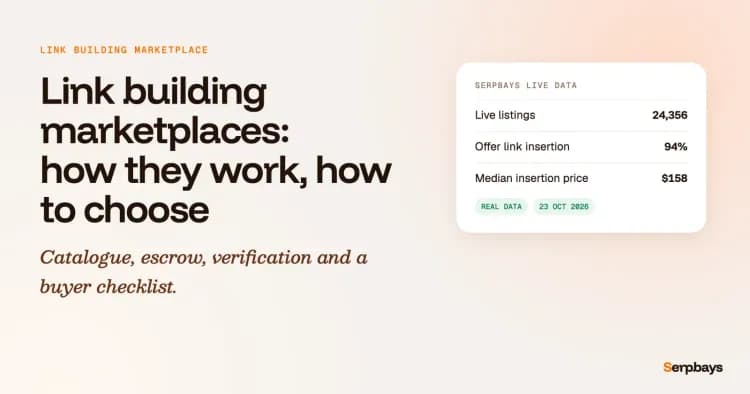
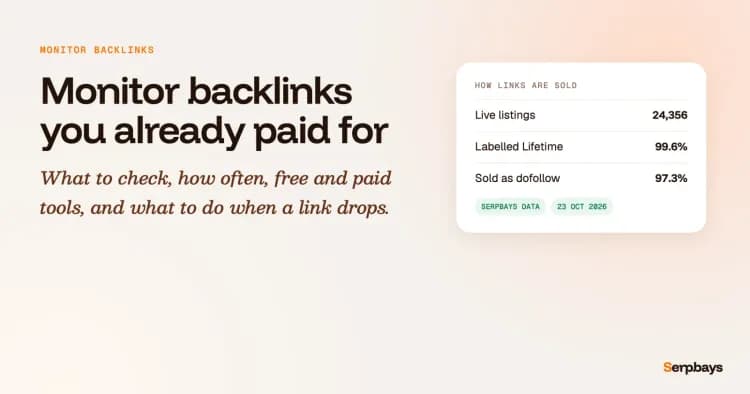
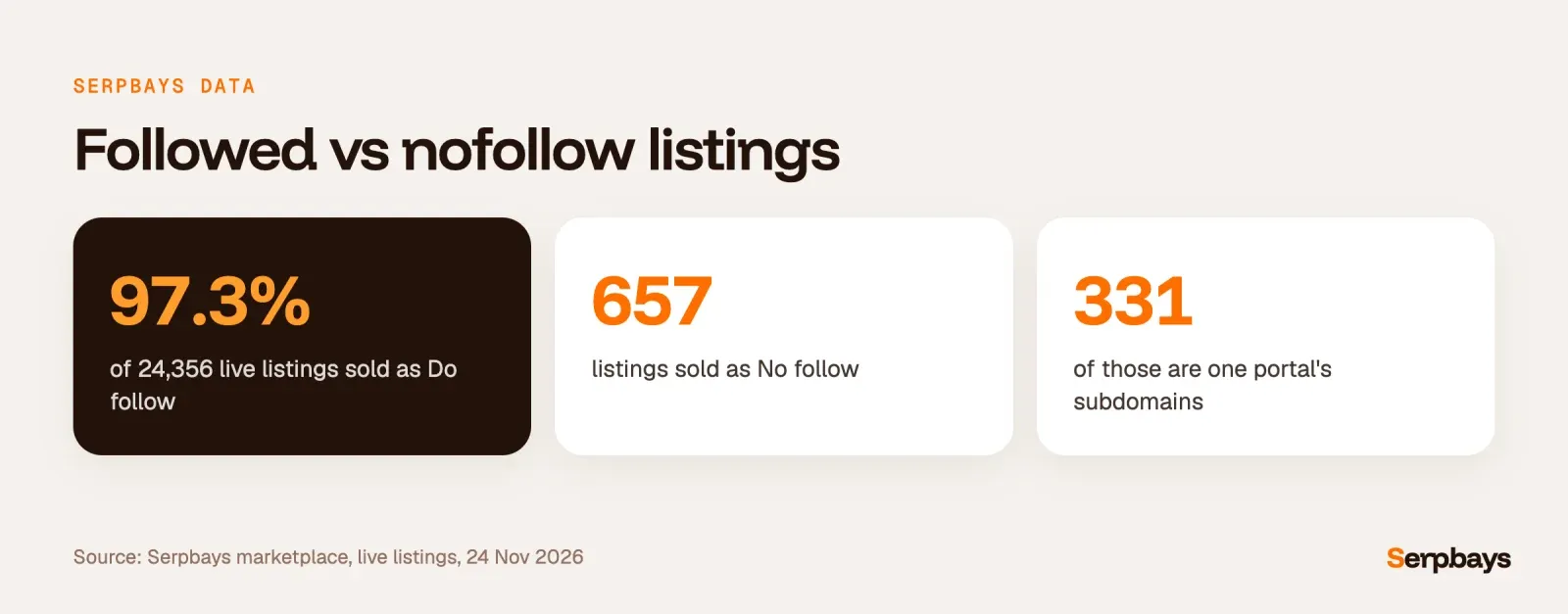
We checked how link type is listed across the Serpbays marketplace (Serpbays data, read-only query, 24 Nov 2026). Of 24,356 live listings, 23,699 (97.3%) are sold as Do follow and 657 as No follow.
The No follow group is skewed: 331 of those 657 listings are subdomains of one Polish regional news portal, naszemiasto.pl, all at DR 81. Half the nofollow supply is one network, so the group's average DR says little about a typical nofollow page.
For a buyer, the follow flag on a listing is only the first check. It tells you the link can pass equity, not that the page holding it has any to pass. That depends on the page checks above: who links to it, how many links share it, and whether it is indexed.
How do you get more link equity from the links you build?
- Check the linking page as well as the domain. Indexed? How many outbound links? Is your link in the body text?
- Prefer relevance over raw rank. Google uses links to work out "what pages are about".
- Point links at live, final URLs. No 404s, no chains, no temporary redirects on permanent moves.
- Re-check after you buy. Publishers change rel values, redesign and noindex old posts. Our guide to monitoring backlinks has the schedule.
Inserting a link into an existing, already-ranked article lands it on a page that already holds some equity. Our link insertion guide explains when that beats a fresh guest post.
FAQ
What is a link in SEO?
An HTML <a> element with an href pointing to another URL. Google uses links to find pages to crawl and as a relevancy signal. Links from other sites are backlinks; links between your own pages are internal links.
Do 301 redirects lose link equity?
Google's site move guide says "301 and other permanent redirects don't cause a loss in PageRank." The bigger risks are long chains, 302s used for permanent moves, and links ending on a 404.
Are backlinks good or bad?
Relevant, editorial backlinks are good: they pass ranking value and help Google understand your pages. Links made mainly to manipulate rankings, such as sitewide footer links, widget links or unqualified paid links, are listed as link spam in Google's policies. Google says sites that break those policies "may rank lower in results or not appear in results at all."
Your next step
Take the five pages on your site with the most referring domains. For each one, add a single contextual link to the money page on the same topic, then run your existing paid placement URLs through the noindex checker to make sure they can still pass anything. When you are ready to add new links, browse placements by niche on our buy backlinks page and pick relevant sites where your link sits in the body text.
Vinayak Gupta is the founder of Serpbays and Wordscloud, with hands-on experience in SEO, content marketing, publisher outreach, and link building. He has worked with SEO agencies, SaaS companies, and digital brands to plan content strategies, evaluate backlink opportunities, and build authority through high-quality placements. At Serpbays, he focuses on making link building more transparent, reliable, and easier for agencies and businesses.
View profile →